

How to Outline a Novel: The Complete Guide 2026
TL;DR Stephen King thinks outlining will kill your book. J.K. Rowling outlined all seven Harry Potter novels before finishing book one. Both sold hundreds of millions of copies. The answer is not pick a side. It is figure out which parts of your specific book break without a plan, and which parts go stiff the moment you over-plan them. |
Stephen King has sold over 350 million books without outlining a single one.
J.K. Rowling mapped all seven Harry Potter novels on a single handwritten spreadsheet before she finished writing chapter one.
Same era. Same bestseller lists. Completely opposite approaches.
So when someone tells you to outline, or tells you not to, the honest answer is: it depends entirely on what your book is made of. This guide is about figuring that out. The debate about whether to plan at all is covered in the plotter vs pantser guide. This is about what happens once you decide to outline.
The Architect and the Gardener (And the Thing Nobody Mentions)
George R.R. Martin is the one who named it.
Architects plan everything before they build. Gardeners plant a seed and follow it wherever it grows. Martin calls himself a gardener. His characters surprise him. His world expands as he writes. The result is some of the richest, most complex fiction in modern fantasy.
It has also been unfinished for over a decade.
That is not a criticism. It is data. Discovery writing produces alive, textured, surprising fiction. It also carries a specific risk: when you do not plan the parts that need planning, the book can grow itself into a corner it cannot get out of.
The question is never plotter or pantser. It is: which parts of your book need a blueprint, and which parts need room to breathe?
What Breaks Without a Plan (Your Genre Already Answered This)
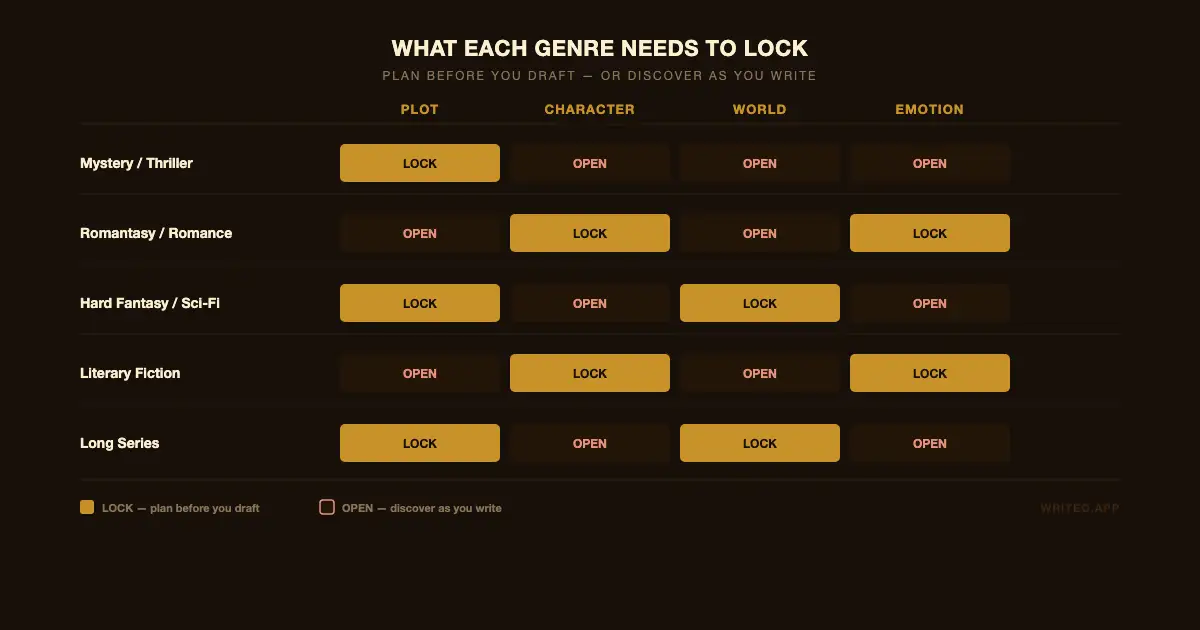
Different novels collapse in different places. The outlining decision is not one decision. It is four, and your genre has already made most of them for you.
Mystery and thriller. The plot must be airtight before you start. Gillian Flynn knew the twist in Gone Girl from page one. Every planted clue, every false lead was placed before she wrote a word of dialogue. You cannot discovery-write a mystery. The whole genre is a promise that the answer was sitting there the whole time, and you cannot keep that promise by winging it.
Romantasy and romance. The emotional arc needs to be mapped, not the plot. Readers are tracking the feeling between two people, not the sequence of events. Know the wound, the moment of admission, the dark night where it all breaks. Leave the plot loose. Over-plan the feeling and it reads like someone hitting marks.
Hard fantasy and science fiction. The world rules must be locked before you draft. Brandon Sanderson outlines his magic systems and plot structures in detail, then discovers his characters as he writes. He has said he will not start a book without knowing how it ends, but he lets the people surprise him on the way there. One layer planned, one layer free.
Literary fiction. The plot is often the last thing that matters. Over-outline a literary novel and the voice dies. What you need is not a scene list. It is the question the book is asking, and the rest you find on the page.
The Authors Who Outline and What They Actually Track
J.K. Rowling did not outline what happens in each chapter. She outlined which threads were active, which were dormant, and where each one needed to move. Her Order of the Phoenix spreadsheet tracks seven separate subplots simultaneously across the full book. It is a thread map, not a plot summary.
James Patterson writes 80-page outlines before a single page of manuscript. He has said he spends more time on the outline than on the book itself. For his kind of plot-driven thriller, the outline is the product. The draft is just filling it in.
John Grisham has been direct about it: "The more time I spend on the outline, the easier the book is to write." He treats the outline as the place where the hard thinking happens, so the draft does not have to carry that weight.
Leigh Bardugo has talked about how Six of Crows required surgical outlining. A heist only works if every moving part was placed before the story started. Every scene had to set up a payoff or deliver one. She was not outlining because she loves planning. She was outlining because the genre demanded it.
The Authors Who Don't Outline and What It Costs Them
Stephen King writes toward a situation, not a destination. His exact words from On Writing: "I distrust plot for two reasons: first, because our lives are largely plotless, and second, because I believe plotting and the spontaneity of real creation aren't compatible."
The Shining. It. Carrie. All of it found in the draft. His books are alive in a way planned books rarely are. They are also occasionally uneven in ways planned books rarely are.
Neil Gaiman starts with an image or a feeling, not a structure. American Gods came from a single idea about forgotten gods living in modern America. He found the shape as he wrote it. The result is one of the most atmospheric novels of its era. The plotting is the weakest part of it.
George R.R. Martin has the richest world, the most complex characters, and the most politically intricate story in modern fantasy. He also cannot finish it.
|
The Minimum Viable Outline: Three Things Every Novel Needs Before Page One
You do not need a forty-page document. You need three things locked before you draft, regardless of genre.
What does your protagonist believe that is wrong? This is the engine of the whole book. Every scene in the middle tests this belief. The climax breaks it. Without this, the middle collapses because you have no direction for the escalation.
What must be true at the end that is not true at the beginning? Not the plot ending. The emotional or philosophical shift. Katniss stops believing the Capitol is unbeatable. Eleanor Oliphant stops believing she is unlovable. Know this and you know where the whole book is pointed.
What does your world, plot, or magic system need to stay consistent about? Establish it before you draft. The rule you plan to break at the climax needs to exist before you can meaningfully break it.
Three things. That is the floor. Everything else depends on your genre and your instincts.
TIP Go through your outline scene by scene and finish this sentence for each one: "By the end of this scene, [character] now knows / believes / feels something they did not before." If you cannot finish the sentence, the scene does not have a reason to exist yet. |
The Middle Problem: Why Novels Fall Apart at Chapter Twenty
Most outlines are built from the opening and the ending inward. Writers know their inciting incident. They know their climax. They fill in the middle with events they hope will connect the two.
The middle is not a connector. It is where the protagonist's situation has to get genuinely, meaningfully worse in ways that are specific to this character in this story.
Vague bad things happening is not escalation. It is filler.
Plan the escalation of a belief, not just the escalation of events. Every scene in the middle should be testing the protagonist's wrong belief and finding new evidence it cannot hold. The events are how you test the belief. The belief is what the reader is actually tracking.
The middle does not connect the beginning to the ending. The middle destroys the thing the protagonist believed at the beginning. Plan for destruction, not connection. |
When the Outline Stops Working
Every writer reaches a point in the draft where the outline is wrong.
Not incomplete. Wrong. When this happens, there are two reasons and they need opposite responses.
The draft found something better. A character refused to do what the outline required. A scene went somewhere unexpected and it was more alive than the plan. This is good news. Update the outline. Do not force the draft back to a plan that was built before you knew what you were actually writing.
The draft took the easier path. It went somewhere softer, somewhere that avoids the real conflict. This feels like relief mid-draft, and relief mid-draft is almost always a warning sign. Go back. Take the harder path the outline was pointing toward.
|
What to Read Before You Outline (And What to Actually Study)
Gone Girl by Gillian Flynn. Study the information architecture across two narrators. Map what Nick knows that Amy does not, and when. Ask how far ahead Flynn had to decide each reveal for the Part Two twist to land the way it does. The outline for this book was seeing fifty pages ahead at every point.
Harry Potter and the Order of the Phoenix by J.K. Rowling. Study the thread management. Five major subplots running at the same time. None disappear for too long. None crowd the others out. Ask yourself honestly: could this have been written without Rowling's spreadsheet?
Six of Crows by Leigh Bardugo. Study the ensemble architecture. Six POVs, one heist, every character structurally essential. Ask what breaks if any one of them is removed. Ask how the outline held six emotional arcs without any of them drowning the others.
On Writing by Stephen King. Read it not as advice to follow but as a portrait of one specific writer's relationship with story. Notice what King's approach produces brilliantly and where it produces problems. Study the texture of discovery writing at its best, so you know when to use it and when not to.
If you are still working out whether to outline at all, the full breakdown is in the plotter vs pantser guide. Writing romantasy specifically? That guide covers how to map the emotional arc before you draft. |
The Outline Is Not There to Protect Your Plan
It is there to protect your story from you.
From the version of you at chapter five who does not yet know what chapter twenty-two requires. From the version of you at midnight who wants to take the easy path through a scene because the hard one is not yet visible. From the version of you three months in who refuses to see the structural problem because seeing it means more work.
King does not outline because his books are built on character and situation, and both need room. Rowling outlined everything because seven books of interconnected plot threads cannot be held in a human head without a map. Both understood what their specific book needed before they started writing it.