


How to Write a Character Arc Readers Actually Feel
TL;DR Most character arcs get planned and then lost. The writer knows the character changes. The reader watches events happen and gets told the person is different now. This guide is about building an arc the reader experiences alongside the character, starting with who the character is in chapter one and tracking every shift until the ending lands. |
At the start of A Court of Thorns and Roses, Feyre hunts in the snow to keep her family from starving. She is practical, self-erasing, and convinced that her own needs come second to everyone else's survival.
By the end of A Court of Mist and Fury, she makes a choice that would have been impossible for chapter-one Feyre. Not because the plot demanded it. Because two books of small moments changed how she sees herself.
That gap is the arc. And the reason it works is not the climax scene. It is everything that built toward it.
Writers lose this gap more often than they realize. By chapter twenty, it is easy to forget exactly who the character was at the start. By chapter forty, the transformation shows up in the outline but not on the page. The ending arrives and the character has technically changed, but the reader never felt it happen.
That is what this guide is for.
What a Character Arc Actually Is
The arc is not what happens to a character. It is what the character does when what happens gets hard.
Plot provides the pressure. The arc is the response to it. Two characters can go through identical events and come out completely differently, and those differences are the arc.
This matters because a lot of writers build strong plots and then wonder why the arc feels thin. The plot is the pressure system. The arc is what the character does inside it.
An arc also requires the character to be an active participant in their own change. A character who is swept along by events, reacting to everything without making meaningful choices, does not have an arc. They have a journey. Those two things are not the same.
The Three Types of Arc
Every character arc in fiction falls into one of three categories. Which one you are writing shapes every decision you make about structure, pacing, and what the character needs to face.
Positive Arc | Flat Arc | |
What it is Character moves from a false belief toward the truth. | What it is Character already holds the truth and uses it to shift the world around them. | What it is Character digs deeper into a false belief and is eventually destroyed by it. |
Examples Feyre (ACOTAR), Violet Sorrengail (Fourth Wing) | Examples Katniss Everdeen, Atticus Finch | Examples Walter White, Anakin Skywalker |
Most common in Most romantasy and fantasy fiction. | Most common in Action, thriller, some fantasy. | Most common in Literary fiction, tragedy, villain origin stories. |
Most romantasy and fantasy runs on positive change arcs. Readers come for the emotional payoff of watching someone grow into themselves. But flat arcs can be just as powerful when written deliberately.
The mistake is writing a positive arc by default without making that choice consciously. Defaulting to a type without deciding it is how you end up with a transformation that was never fully earned.
Before Chapter One, Pin Down the Before
Readers cannot feel the transformation unless they know who the character was before it started.
Writers tend to know their character at their best. They know the version the story is building toward. What is harder to hold clearly is the starting point: the specific, flawed, limited person your character is before anything changes.
Feyre at the start of ACOTAR believes she exists to keep her family alive and that her own wants are irrelevant. That belief is specific. It shapes every choice she makes. Because it is so clearly established, every crack in it registers.
Violet Sorrengail arrives at Basgiath believing her body will fail her and that she does not belong in a warrior's world. When that belief breaks down, the reader feels it because the starting point was concrete.
The before does not need to be explained in a prologue. It needs to show up in how the character acts, what they notice, and what they avoid in the first few chapters. Readers build the picture from behavior.
The Test Before writing chapter one, complete this sentence: "At the start of this story, my character believes [X] about themselves or the world, and this belief is costing them [Y]." If you cannot finish it, the arc does not have a starting point yet. |
The Arc Lives in Small Decisions, Not Big Moments
The climax is where the arc gets confirmed. It is not where the arc gets built.
The arc builds in every scene before the climax where the character faces a choice and responds in a way that is true to who they are at that point in the story. That accumulation of choices, drifting slowly from one kind of response to another, is what readers experience as change.
A character who avoids asking for help in chapters two, five, and nine, and then asks for help in chapter thirty: that moment lands because the reader watched the pattern. The shift in chapter thirty means something because of what happened in chapters two, five, and nine.
The small moments to watch for:
A sentence they say in chapter five that they would not say in chapter twenty, or the reverse
What they notice first when they walk into a room
Who they reach toward in a crisis versus who they pull away from
What they are willing to admit now that they were not willing to admit before
What they have stopped defending
Readers track these without knowing they are doing it. By the time the climax arrives, they have absorbed hundreds of small signals. When the character makes the big choice, it feels like it was always coming.
Common Mistake Saving all the change for the last act. If a character responds the same way to everything from chapter one through chapter thirty-five and then transforms completely in the final chapters, the reader will not buy it. The cracks need to appear before the reader expects them. |
Three Things to Know Before You Write
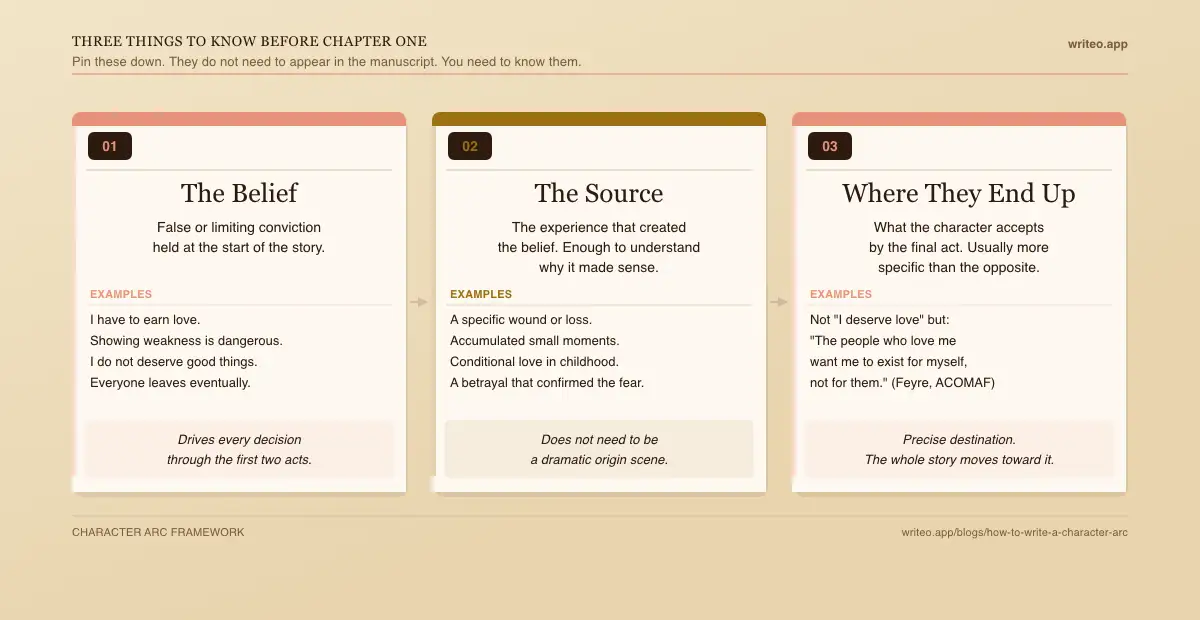
For a positive change arc, there are three components worth pinning down before you start. You do not have to name them in the manuscript. You have to know them.
The Belief
The false or limiting belief your character holds about themselves or the world at the start. It drives their decisions through the first act and most of the second. It usually comes from somewhere painful, and it feels completely true to them.
Some examples: I have to earn love. Showing vulnerability is weakness. I do not deserve good things. Everyone leaves eventually. I am only useful when I am useful to someone else.
The Source
The experience that created the belief. Readers do not need every detail. They need enough to understand why the belief makes emotional sense. A character who believes they must earn love arrived at that conviction somehow.
The source does not have to be a dramatic backstory event. It can be something quiet and accumulated, like growing up in a household where love was conditional.
Where They End Up
What the character comes to accept by the end. Not always the opposite of the starting belief. Usually something more specific.
In A Court of Mist and Fury, Feyre does not just learn that she deserves good things. She learns that the people who genuinely love her want her to exist for herself, not for them. That is a precise destination. The whole book moves toward it.
How to Pace the Arc Across Your Draft
The arc should be moving in every act, even when the plot is doing most of the heavy lifting.
First Act (0 to 25%)
Show the starting belief in action. Let the reader understand the character's logic from the inside, not as a flaw to be corrected but as a way of surviving that made sense at some point.
The reader should understand why the character is the way they are before the story starts pressing on it.
Second Act, First Half (25 to 50%)
Introduce pressure on the belief. Not breaking it yet. Testing it. The character gets close to something that would challenge the belief and pulls away.
That retreat is not a failure of the arc. It is the arc. Watching a character almost change and then retreat is one of the most effective beats in character writing.
Midpoint (50%)
The character gets a glimpse of what accepting a new belief would look like. Often a small, partial moment: they ask for help once, they admit something to one person, they let themselves want something.
The midpoint is a preview of the transformation, not the transformation itself.
Second Act, Second Half (50 to 75%)
The pressure deepens. The character may slide back toward the starting belief under stress. The cost of holding onto it becomes harder to ignore. This is the richest section for character work because the stakes are highest.
Third Act (75 to 100%)
The character chooses between the old belief and something truer, in a moment where retreat is no longer possible.
After the choice, show who they are now through behavior. Not through a speech. Let them do something in the final pages that chapter-one them could not have done.
Worth Knowing This structure applies to positive change arcs. Flat arcs work differently: the character holds steady while the world around them shifts. Negative arcs invert the structure entirely. Know which type you are writing before you map the pacing. |
Show the Change. Do Not Announce It.
The most common arc problem in manuscripts is not a weak arc. It is an arc that existed in the outline but did not make it fully onto the page.
Writers know the character changed. They wrote the climax. They wrote the ending. But across the middle two hundred pages, the character kept responding the same way to things. The ending arrives and announces the change. The reader has not watched it happen.
A practical test: find a scene from chapter eight where your character handles something specific. Then find a scene from chapter thirty with a similar situation. Is the response different?
If it is identical, the arc was probably not moving in that stretch. The difference does not need to be dramatic. A character who is closed off in chapter eight and slightly less closed in chapter thirty is building something. Multiplied across dozens of scenes, that small drift becomes the transformation the reader feels at the climax.
Common Mistake Using internal monologue to report that a character has changed. "She realized she was different now" is not an arc. "She walked into the room and did not check for the exits" is. Show the new behavior and let the reader make the connection. |
How Writeo Helps You Track the Arc
The practical problem with writing a character arc across a full draft is that drafts take months and arcs move slowly.
You write the starting belief in month one. You build the cracks through months two and three. By month five, when you are writing the climax, you may not clearly remember what specific belief you established, or which scenes moved the arc and which held it in place.
This is the most common reason arc work thins out in the second half of a draft. Not a lack of intention. A lack of record.
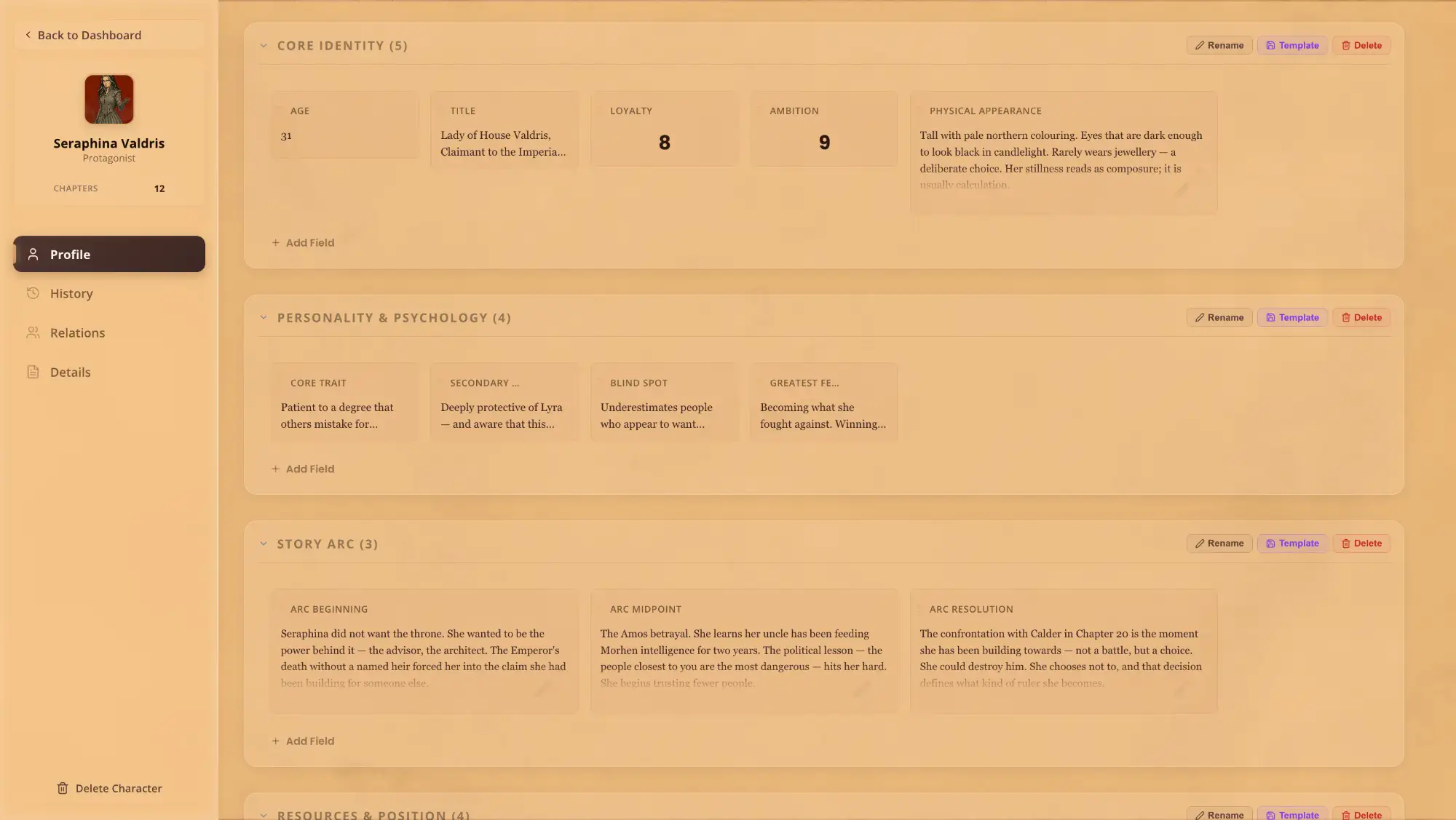
A character profile built for arc tracking in Writeo, with custom fields for the belief, source, and current position in the arc.
Writeo's character profiles use custom sections you build yourself. You can create a field called "Starting Belief," another called "Source," another called "Where They Are in the Arc Right Now." These are not fixed fields. You design them for your story and update them as the draft moves.
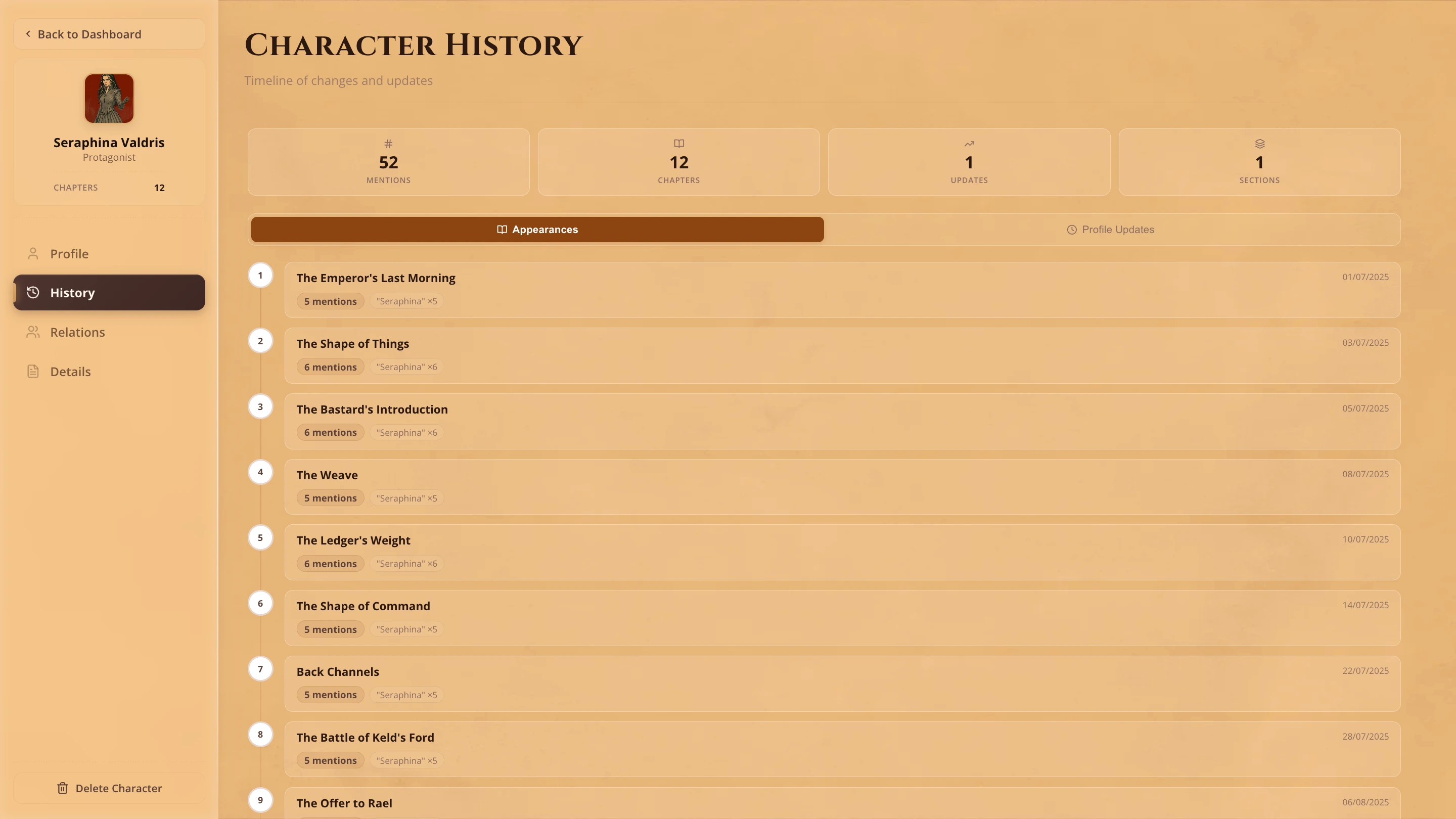
The Character History tab in Writeo logs every change with the chapter context. Over a full draft, it becomes an arc timeline.
Every time you update a character section, Writeo logs the change automatically in the Character History tab: the old value, the new value, and the chapter that triggered the update.
Over the course of a draft, that log becomes a timeline of the arc. Before writing the climax, scroll through it. You will see exactly how the character moved, where the significant shifts were, and whether there are stretches where nothing changed when something should have.
The Chapter Appearances feature shows which chapters the character appears in across the full draft. If the character is absent from chapters twelve through twenty, the arc was probably not moving in that stretch. That is worth knowing before the revision.
Building character profiles is one piece of the system. Before tracking the arc, you need your characters organized. Read our guide on how to organize characters in a novel to set up the foundation. For tracking how characters move across the draft from chapter to chapter, read how to keep track of characters in a novel. |
Frequently Asked Questions
QWhat is the difference between a character arc and character development?
QDoes every character need an arc?
QHow long should a character arc be?
QWhat is a flat character arc?
QHow do you write a negative arc without losing reader sympathy?
QCan you write a character arc as a pantser?
QHow do you track a character arc across a series?
Treat each book as one stage in the larger arc, with its own movement and partial resolution. Keep precise records of where the character's beliefs stand at the end of each book. Readers may not remember exactly what was established in book one by the time they reach book three. You need that continuity to hold up precisely. Writeo's Character History log is useful here because it stores every profile update across your full project.
The Arc Is Already Inside Your Character
You do not impose an arc on a character from outside. You find the one that was already there.
The starting belief was always there. The experience that created it was always there. The direction the story needs to push them was always there. Your job as the writer is to know those three things before chapter one and keep them visible across the entire draft.
Build the pressure. Show the choices honestly. Let the small moments do the work they were designed to do.
Pin down the before. Track the shifts. Earn the ending.
The reader will feel what you built. They always do.
Track your character's arc from chapter one to the finale inside Writeo. Free to start, no credit card needed. Start free at writeo.app |