

The Tension Is the Story
TL;DR Slow burn does not work by hiding the attraction. It works by making the attraction completely visible to the reader and then creating conditions where acting on it is impossible. This guide covers the full arc, from first friction to the payoff scene readers will reread, including a stage map for pacing across a full draft and the single biggest mistake that makes slow burns collapse before the halfway mark. |
There is a scene in A Court of Mist and Fury where Feyre is standing at a window in Velaris and notices Rhysand watching her. Not demanding anything. Just watching.
She notices it. She looks away. She notices she noticed.
Sarah J. Maas does not make a big deal of it. She does not stop for a three-paragraph spiral. She moves the scene forward. But every reader felt it. We had been feeling it for two hundred pages without being able to name it.
That moment, unremarkable on the surface and electric underneath, is what slow burn actually is. Not delayed. Not withheld. Felt, and then denied.
That distinction is where most writers lose the thread.
The One Thing Most Writers Get Wrong
The instinct when writing slow burn is to hide the attraction. Keep it vague. Do not let the characters show it too early.
That instinct is wrong, and it will kill your romance before it starts.
Slow burn does not work by hiding the attraction from readers. It works by making the attraction completely visible to readers, sometimes before the characters themselves can name it, and then creating conditions where acting on it is impossible.
The reader has to be ahead of the characters. That gap between what the reader sees and what the characters will admit is where every ounce of tension lives.
When writers hide the attraction instead of showing it suppressed, readers do not feel suspense. They feel confusion. They start wondering if the connection is even real. Once that happens, no payoff can save it.
Common Mistake If your reader is not sure whether the characters are attracted to each other by chapter five, you have not built slow burn. You have built ambiguity. The goal is for the reader to feel the pull long before the characters act on it. |
The Tension Is the Pleasure, Not the Road to It
Here is what separates slow burn from a romance that simply starts late.
In a slow burn, the waiting is not the obstacle to get through. The waiting is the point.
Readers do not stay for three hundred pages because they are tolerating the tension to reach the kiss. They stay because the tension itself feels good. The charged glances, the accidental touches, the conversations loaded with everything unsaid. Those are the pleasurable parts. The payoff satisfies, but the pining is the experience.
This changes how you write every single scene. A scene of unresolved tension is not a scene to push through quickly. It is a scene to make count.
Each one needs to deliver something new: a layer of awareness, a moment of unexpected vulnerability, a crack in one character's armor that they immediately try to plaster back over.
Readers will stay through hundreds of pages of unresolved romantic tension if each scene moves the emotional state forward. They will not stay through three scenes in a row that feel like the same longing look, reworded.
In Fourth Wing, Rebecca Yarros understands this at a structural level. Xaden Riorson is not a straightforward slow burn love interest. He is a mystery. His motivations stay unclear, his protectiveness feels inexplicable, and every time Violet tries to read him, she gets something new. The reader is not just asking "will they get together." We are asking "who is this person, and why does it matter so much?"
That is a far more durable hook across four hundred pages.
Your Characters Need a Real Reason to Stay Apart
The obstacle has to justify the length of the burn. This sounds obvious. Based on what I see in drafts, it is not.
A slow burn across thirty pages can work with a small obstacle: misread signals, bad timing, professional context. A slow burn across three hundred pages needs something that can hold weight for three hundred pages.
If your characters are kept apart by a misunderstanding that could be resolved in one honest conversation, you do not have a slow burn. You have a setup waiting to collapse.
External obstacles work because they are concrete. In The Cruel Prince, Jude and Cardan are structurally opposed. Their positions are incompatible. That is not something either of them can solve through honesty. The obstacle lives in the world, not just in their heads.
Internal obstacles work because they are invisible until they crack. The reader sees the attraction before the character admits it. The character's self-protective logic makes sense: survival mode, prior betrayal, the conviction that they cannot afford to want anything. The reader spends the book wanting the character to see what we already see.
The strongest slow burns combine both. A Court of Mist and Fury keeps Feyre and Rhysand apart through external circumstances: courts, politics, prior relationships. But even without all of that, Feyre is not ready. She does not yet know who she is outside of her former life. That second layer is what makes the payoff feel like a release rather than just a reward.
Worth Knowing External obstacles are easier to write but easier to dismantle. If your slow burn only has external obstacles, ask what each character is carrying that makes love feel dangerous or impossible regardless of circumstance. Internal wounds hit harder when they finally break. |
From Blood and Ash by Jennifer L. Armentrout handles this particularly well. Poppy and Hawke are kept apart by her role as the Maiden, but Poppy's deeper obstacle is that she has been told her entire life she belongs to the gods and has no future. She does not let herself want. That internal wound is what makes the slow burn land so hard when it finally breaks.
The Six Stages of a Slow Burn Arc
Most slow burn advice treats the arc as one thing: build tension, then pay it off. In a novel of 80,000 to 100,000 words, that is not enough to work from. The arc needs stages, or by chapter fifteen you will be writing the same almost-moment for the fourth time and wondering why it has lost its charge.
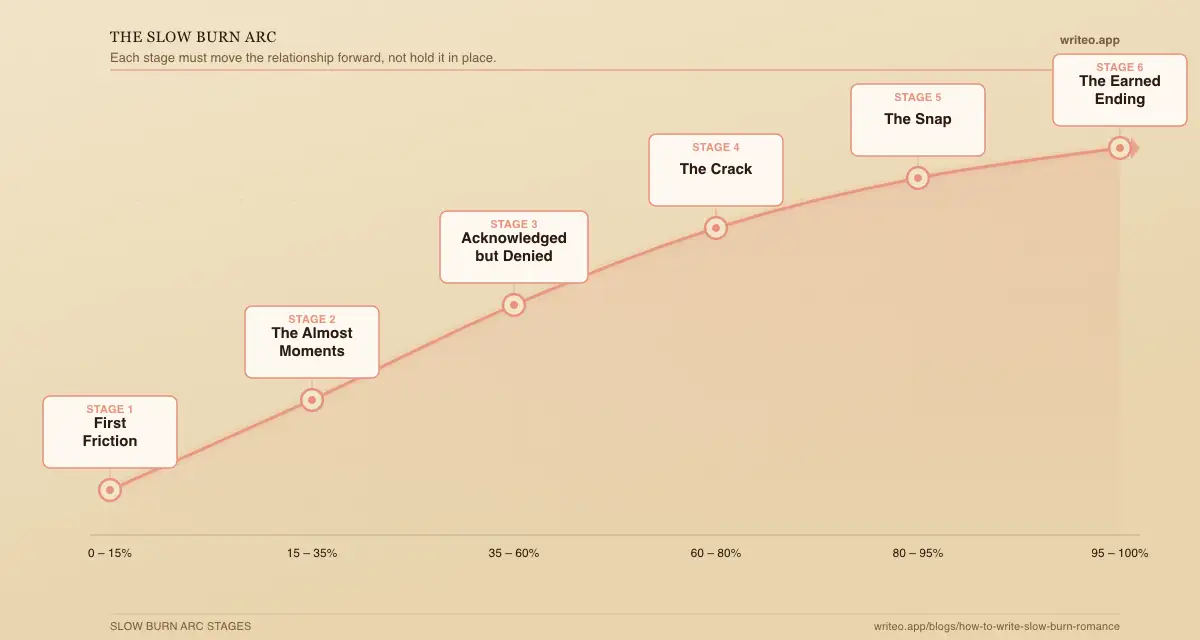
Each stage has a job. If your characters are still at Stage 2 by the 60% mark, the slow burn isn't building, it's stalling
Stage 1 0 to 15% | First Friction. They notice each other, but the noticing is neutral, hostile, or circumstantial. No attraction acknowledged. Establish who these two people are to each other before anything shifts. This baseline is what the reader will measure all future movement against. |
Stage 2 15 to 35% | The Almost Moments. Charged interactions that could mean something or nothing. Physical proximity that gets noticed. A moment of unexpected care that is immediately dismissed. The reader starts to feel it; the characters do not name it. Specific detail is everything here. Not "there was tension." Specific: the way he paused before answering, the moment she realized she had been watching the door. |
Stage 3 35 to 60% | Acknowledged but Denied. One or both characters begin to understand what they are feeling and actively work against it. This is the richest section of a slow burn. The character is lying to themselves, and the reader knows it. The gap between what they are telling themselves and what we can see is where the best scenes live. |
Stage 4 60 to 80% | The Crack. Something breaks the denial. Not the full confession, but a moment that cannot be walked back. A first touch that lingers. A crisis that forces one character to reveal they care. Partial payoffs live here. After the crack, both characters know. The reader knows they know. The only remaining question is what they will do about it. |
Stage 5 80 to 95% | The Snap. The dam breaks. This scene needs to be proportional to the wait. It does not have to be explicit, but it has to feel inevitable, specific to these two people, and like nothing in the world could have stopped it in that moment. Generic payoff scenes after long slow burns feel like a betrayal. Write the payoff that only these two characters could have. |
Stage 6 95 to 100% | The Earned Ending. What comes after the snap matters as much as the snap itself. A resolution that ties everything up too cleanly after a slow burn feels thin. These characters are real now. Real things are complicated. Give them scenes where they exist in the aftermath with all their damage still intact. |
Tip If you are writing a series, you do not have to complete all six stages in book one. But each book still needs to move the arc forward and deliver at least one meaningful partial payoff. A book that ends with the relationship in exactly the same state as it began will lose readers before they reach book two. |
Every Scene Needs to Move Something
This is the part of slow burn writing that almost no guide covers, and it is the part that determines whether the payoff lands.
At every stage, something about the relationship needs to shift. Not much. But something.
If you finish a scene between your two love interests and the relationship is in exactly the same state as when the scene started, you have missed the scene's potential.
Regression counts. Retreat counts. One character deciding to pull back harder than before is still movement. What does not work is maintenance. Two characters holding in place, scene after scene, is the structure of a story going nowhere.
After every scene involving both characters, ask yourself: What is different between them now that was not true before this scene?
It can be tiny. He used her first name instead of her surname. She stopped tensing when he walked into the room. He told her one true thing. Small things, accumulating. By the time you reach the payoff, the reader should be able to trace the path backwards and feel how inevitable it all was.
The Test After every scene that involves your two leads, write one sentence in your notes: "After this scene, [Character A] now [does/knows/feels/believes X] that they did not before." If you cannot complete that sentence, the scene needs another pass. |
What Slow Burn Dialogue Actually Sounds Like
Dialogue is where most slow burn romance either soars or collapses. The mistake is writing it too direct.
Characters who clearly want each other but are not saying it yet do not speak in loaded half-confessions. They talk about other things. They talk around the thing. They use humor as deflection, practicality as armor, sharpness as a way to keep distance.
The subtext is in what they do not say.
The real tell is in the listening. A character who is falling for someone does not announce it. They notice things. They remember what the other person said three chapters ago. They respond to small things with disproportionate attention. That kind of attentiveness on the page reads as attraction without a word of it being named.
The other tell is what happens after a charged exchange. The moment passed. Now what? They change the subject. They get practical. They leave the room. Write the deflection as carefully as you write the charged moment. The pivot is where the tension is stored.
Look at the early exchanges between Violet and Xaden in Fourth Wing. The banter is not warm. It is weaponized. Each of them is using sharpness to maintain distance. It only softens in increments, and every increment tells you something about where they are in the arc.
In Kingdom of the Wicked by Kerri Maniscalco, Emilia and Wrath circle each other through layers of half-truths. The reader knows more than Emilia does, and the gap between what we understand and what she is willing to see is agonizing in the best way. That is not accidental. Every line of dialogue is placed to widen or narrow that gap on purpose.
Physical Beats: Less Is Everything, Until It Is Not
In the early stages, physical detail is your most precise instrument. Not explicit. Precise.
The difference between "they stood close together" and "she was aware of exactly how much space she had left between them" is the difference between describing a scene and putting the reader inside a body. The second version shows someone monitoring distance. That monitoring is suppressed attraction, made visible without being named.
Here is roughly how physical awareness tends to escalate across a slow burn:
Stages 1 to 2: Noticing proximity without wanting to. Eye contact held a second too long. Being aware of where the other person is in a room without looking for them.
Stages 2 to 3: Accidental contact. Noticing the temperature of it, the weight of it, the decision not to pull away. Noticing physical details you would not notice about someone you were indifferent to.
Stages 3 to 4: Deliberate proximity. Touch that has a practical excuse: a wound being treated, a fight that ends too close, being steadied after a fall. The effort of not touching when there is no excuse.
Stages 4 to 5: Chosen contact. Touch initiated without an excuse available. The moment where neither character manufactures a reason, and neither steps back.
Move through this in order. A touch that belongs to Stage 4 does not land if you have not done the work of Stages 2 and 3. The escalation is what gives each moment its weight.
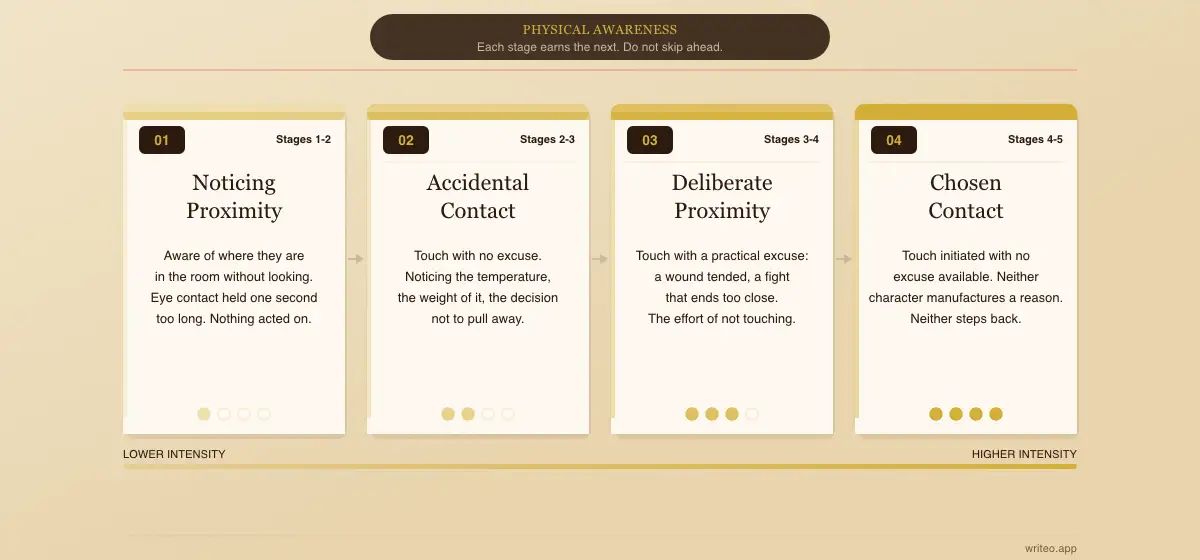
Physical awareness builds in stages. Each moment earns the next.
The Frustration Line: When Slow Burn Becomes Slow Death
There is a version of this where readers put the book down.
It happens when the arc stops moving and the scenes start repeating. Same longing. Same internal monologue. Same almost-moment that goes nowhere. After two or three scenes like this in a row, readers stop believing the characters will ever change.
The warning signs:
You have written three consecutive scenes where neither character learns anything new about the other
The internal monologue is covering the same emotional ground it covered twenty pages ago
The obstacle has not changed or deepened. It is just still there
Your beta readers are skimming the romantic scenes instead of engaging with them
The fix is not to fast-forward the romance. The fix is to make something happen. A crisis. A revelation. A conversation that goes somewhere unexpected. The romance can stay unresolved. The situation cannot stay static.
Slow burn needs momentum to survive its own length. Readers will stay patient if they believe the story is going somewhere. The moment they stop believing that, you have lost them.
Common Mistake Three scenes in a row where both characters feel the pull but nothing shifts reads as stalling, not slow burn. Each scene needs to add at least one new piece of information about either the characters or their dynamic, even if the romantic arc itself has not moved. |
How Writeo Helps You Track the Arc
The hardest part of writing a slow burn across a full draft is not the craft. It is the tracking.
You write Stage 2 in month two. You write Stage 4 in month five. By the time you are writing the payoff, you have forgotten exactly what shifted in chapter fourteen. You cannot remember if the first touch was in chapter nine or chapter twelve.
This is where most slow burn romances develop problems in revision, not in the writing itself.
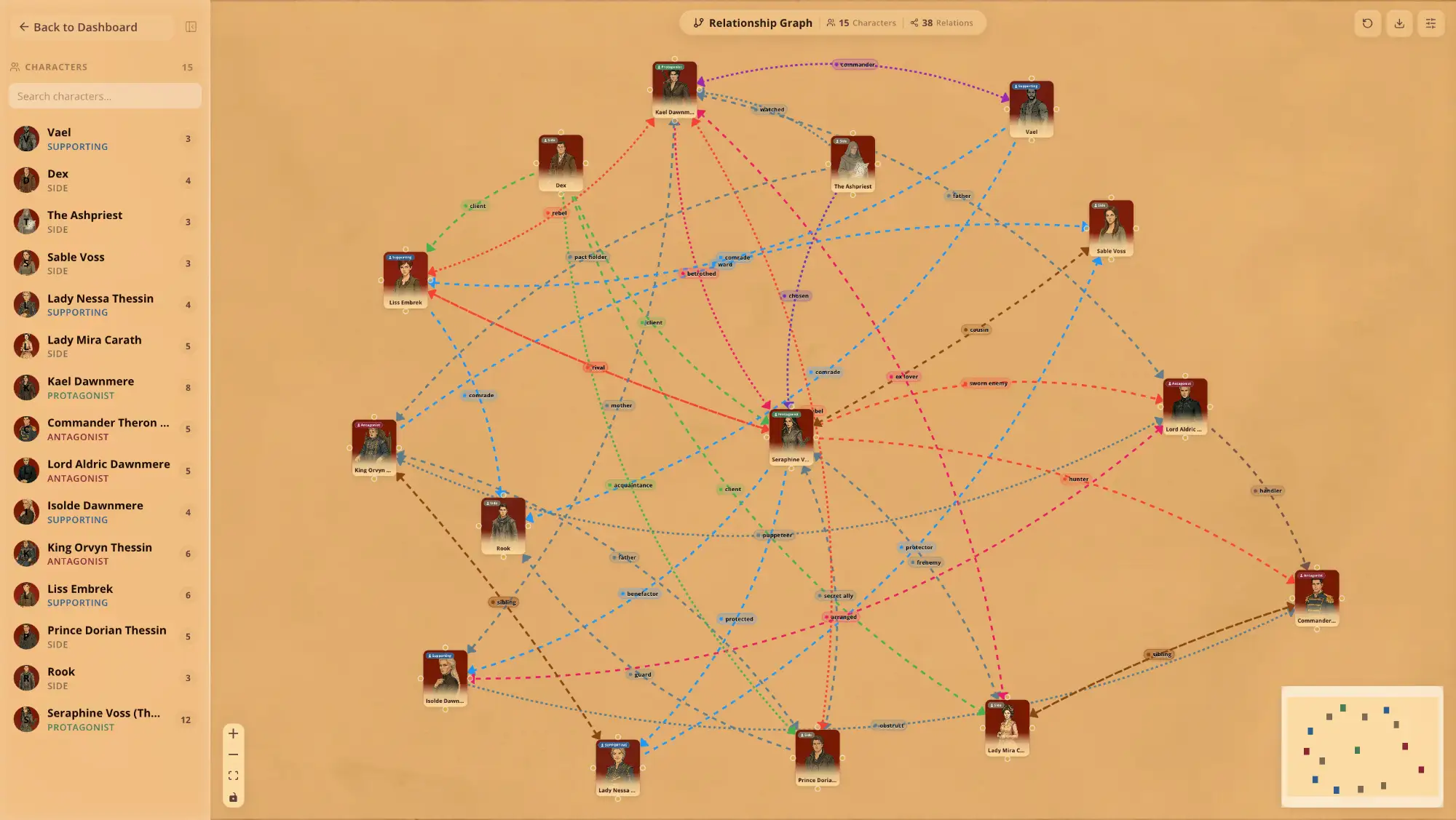
Writeo relationship graph: every connection in your novel, visible at once.
Writeo's relationship system is built around this exact problem. When you log a relationship between two characters, you record the type, the intensity on a scale of one to ten, and whether the relationship is visible to the world or kept secret. That is your starting state.

Log every shift as you write it. By the time you reach the payoff, you will have the whole arc mapped.
As the draft progresses, the Evolve Relation feature lets you log each shift with a short description and a chapter tag. Not a full summary, just a note. "Chapter 12: she stopped flinching when he walked past her. Small thing. He noticed." That note stays attached to the chapter and the relationship.
By the time you reach the payoff, you have the whole arc mapped. If a step is missing, you will see exactly where the gap is.
The relationship graph gives you the whole picture: every connection in your novel, how intense each one is, which relationships are secret versus visible. For a slow burn, watching the intensity number move from a two to an eight across a draft is a way of seeing your arc work in real time.
Need a system for keeping track of all your characters alongside the arc? Read our guide on how to keep track of characters in a novel for a complete walkthrough. |
Frequently Asked Questions
QHow long should a slow burn romance take?
QWhat is the difference between slow burn and enemies to lovers?
QHow do you write slow burn in a standalone vs a series?
QHow do you know if your slow burn is dragging?
QShould both characters know they have feelings in a slow burn?
QWhat is the biggest mistake writers make with slow burn?
QHow explicit does the payoff need to be?
Write the Characters Who Fall Badly
Readers do not fall in love with characters who fall in love cleanly. They fall in love with characters who fall in love badly. Reluctantly, inconveniently, while actively trying not to.
The slow burn is a story about two people resisting something they already know is going to happen. The reader knows it is going to happen. The characters might know it too. But something is standing in the way: circumstance, fear, damage, loyalty, terrible timing. The reader's job is to want it badly enough to wait.
Your job is to give them enough in each chapter to keep wanting.
Write the friction. Write the denial. Write the almost-moments with the specificity they deserve: the name used instead of a title, the door left open that usually stays closed, the one question answered honestly when everything else has been deflection.
Then write the payoff that could only belong to these two characters. Not a generic confession scene. Not the first kiss that works on any slow burn couple. The specific, inevitable, earned moment that this story and no other story was building toward.