

You have the twist. You can picture the exact moment the reader gasps, the line of dialogue that rewrites everything, the chapter ending that makes someone text a friend at midnight. What you don't have is the road that leads there. Every time you sit down to draft, the story either telegraphs the surprise so early that it dies on the page, or hides it so well that the reveal feels like it came from nowhere.
This is the most common problem writers have with plot twists, and it is not a talent problem. A twist is a promise you make quietly, over many chapters, and then keep in a way they didn't see coming. The craft is in the setup: what the reader believes, what you let them notice, and what you let them miss.
This post walks through ten techniques that work, in the order you can actually use them. To keep things concrete, we'll follow one running example: Tessa is a young healer, and her warm, protective mentor Aldric is secretly the one who betrayed the kingdom. Swap in your own twist as you read. Each section ends with a small task you can do in your manuscript today.
1. Start from the end
Most writers plan a twist forward: first this happens, then that, and eventually the surprise. That is how you end up with a reveal that feels bolted on. A twist is easier to build backward, because it is really a statement about what the reader believed before it arrived.
Start with one sentence: "Before the twist, my reader must believe ___."
In our example, the sentence reads: Before the twist, my reader must believe that Aldric would die to protect Tessa. That single belief is the load-bearing wall of your entire setup. Everything you write before the reveal either strengthens that belief or quietly cracks it.
This reframes the job. Your real job is to build a belief, and then remove it at the right moment. When you know exactly what the belief is, you can check every scene against it: does this chapter make the reader trust Aldric more, or does it hint at the truth? Both are useful, but they have to be intentional.
It also forces a second question that many writers skip: what must the reader feel, not just believe? A twist hurts when the reader was emotionally invested in the false version. Write down the feeling too: safe, cared for, a little envious of their bond.
Try this: Write your "reader must believe" sentence and the feeling that goes with it. Tape it above your desk. Every scene before the reveal should serve one or the other.
2. Make the lie comfortable
Readers do not miss twists because they are careless. They miss them because the false version of the story is more pleasant to believe than the true one. If the reader wants Aldric to be good, they will explain away every strange detail on his behalf. Gone Girl does this with Amy's diary: the entries are so warm and likeable that readers take her side, which is exactly what the diary was written to make them do.
So the lie has to be attractive. Give the false belief a reason to be loved:
Warmth: Aldric remembers how Tessa takes her tea and notices when she hasn't slept.
Humor: He teases her gently, which makes him feel safe and human.
Proof: In chapter two, he saves her life. That scene is not just plot, it is evidence the reader will lean on later.
Need: Tessa has no father, and Aldric fills that gap. The reader wants this relationship to be real, because Tessa does.
A common mistake is making the false version of a character bland or suspicious-looking from the start, then hoping a clever reveal will make up for it. If the reader is already uneasy, the twist confirms a hunch instead of overturning a belief. Comfort is the cover story. The more the reader relaxes, the further the story can go before they look closely.
This also protects the emotional weight of the twist. When the reader has genuinely loved the lie, the reveal doesn't just surprise them, it costs them something.
Try this: List three specific scenes that make the false belief feel safe, and make one of them a moment where that character does something genuinely generous.
3. Plant three clues, not one
The test of a good twist is the reaction on the reread: "I should have seen it." The test of a bad twist is "that came from nowhere." The difference is almost always clues, and one clue is rarely enough. The first twist I ever wrote had exactly one clue, tucked into chapter two. Not one of my beta readers remembered it, and every one of them said the reveal came out of nowhere. They were right. A single hint can be missed entirely, which makes the reveal feel unfair, or it can be so isolated that readers forget it by the time it matters.
Use three, spread across the story:
Clue | Where it goes | What it does |
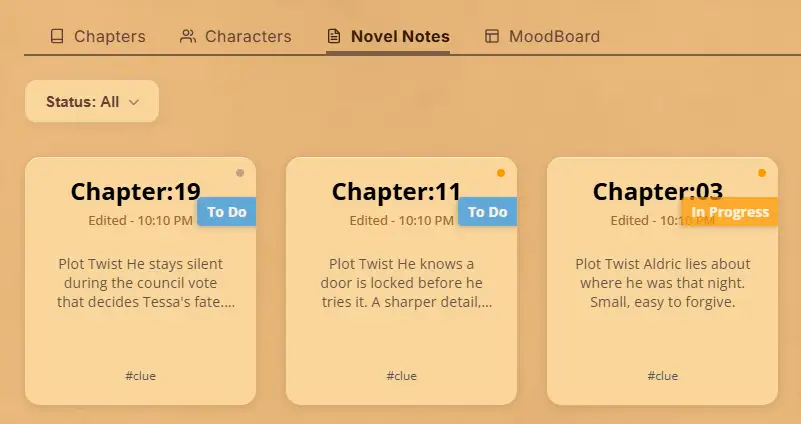
Early | Chapter 3 | Aldric lies about where he was that night. Small, easy to forgive. |
Middle | Chapter 11 | He knows a door is locked before he tries it. A sharper detail, wrapped in action. |
Just before | Chapter 19 | He stays silent during the council vote that decides Tessa's fate. The reader senses something, but the scene is moving too fast to stop. |
The early clue establishes the pattern. The middle clue tests whether the reader is paying attention. The final clue is the one that, on reread, makes them put the book down and look at the ceiling.
Spacing matters. If all three sit within a few chapters, readers connect them and guess the twist. If they are too far apart, there is no sense of a thread. Aim for gaps wide enough that other plot moves between them, but close enough that a reader could connect the dots if they tried.
Try this: Open your outline and mark three chapter numbers where a clue could live. If you cannot find three, your story has room for another scene. If you write in WriteO, save each clue as a note linked to its chapter, so you can see the spacing at a glance.
4. Hide clues in plain sight
The best clues are not hidden. They are placed where the reader's attention is somewhere else. A clue works when the reader sees it, but does not yet know it matters.
There are a few reliable places to put one.
Inside a list. Readers skim lists and remember the first and last items. Put the clue in the middle. "She packed bread, rope, a lantern, his seal ring, and a map." The ring is the clue, but it sits among ordinary objects, so nothing flags it as important. On the reread, that ring is the first thing you notice.
Inside a joke or a light moment. Laughter lowers a reader's guard. If Aldric makes a wry comment about how "no one in this kingdom keeps secrets as well as I do," and Tessa laughs, the reader laughs too. The line is true, and nobody is checking.
Inside an emotional scene. When a reader is moved, they stop analyzing. Place a clue in the middle of a tender moment, such as Aldric comforting Tessa after a loss, and have him say one small thing that is a little too informed. The reader is busy feeling, not investigating.
A useful rule: never put a clue in a scene where the reader's only job is to notice it. Give the scene its own purpose, its own tension, and let the clue ride along as background.
Try this: Take one clue and move it. If it currently sits alone in a quiet line of dialogue, bury it in a list, a joke, or the middle of a high-emotion beat.
5. Write every key scene twice
The strongest twists are built from scenes that mean one thing the first time and something else on the second read. It comes from planning each scene so that it is true in both versions of the story.
For every scene that involves your twist character, write two short notes:
First read: what the reader understands.
Second read: what is actually happening.
Here is an example. Aldric says to Tessa, "I would never let anything happen to you."
First read: a loving promise from a protector.
Second read: a statement of control. He decides what happens to her, and he is telling her so.
Nothing about the line changes between readings. Only the reader's knowledge does. That is the sign of a well-built twist: you did not lie, you let the reader assume. The Sixth Sense is built this way. The first time you watch the anniversary dinner, Malcolm's wife ignoring him looks like a marriage falling apart. The second time, you know why she never answers.
This technique also stops you from the most common fairness trap, which is writing a line that would be false if the twist were true. If Aldric says something no honest traitor could say, readers will feel cheated. Check every line he speaks: could it be said sincerely by the person he really is? If so, it is fair.
Try this: Pick three scenes featuring your twist character. Write the first-read and second-read notes beside each. If you cannot write a second-read note, the scene is a missed opportunity. In WriteO, the chapter's notes are a good place for these, so they sit right beside the scene.
6. Add a red herring with its own clues
If your story has only one suspicious person, readers will suspect them. A red herring is a second, believable explanation that gives the reader somewhere else to put their suspicion. It works best when it is built with the same care as the real clue.
A weak red herring is a character who acts suspicious for no reason. A strong one has a motive, an opportunity, and secrets of their own that turn out to be about something else.
In our example, Tessa has a rival, Dorian, who is jealous of her talent. Across chapters eight to fourteen:
He is seen near the archives the night a letter disappears.
He argues with Tessa in public and storms off.
He lies about where he was, for a reason that is revealed later to be personal and harmless.
Every clue against Dorian is real, and every one has an innocent explanation. When the truth comes out, the reader can look back and see that the story played fair with both suspects.
Two rules keep red herrings from backfiring. First, resolve them. A dropped suspect feels like a plot hole. Give Dorian a small, satisfying moment of being cleared, ideally one that deepens his character. Second, don't make the red herring so convincing that the real answer feels like a cheat. The reader should be able to hold both theories in mind and feel the pull of each.
Try this: Write a one-line motive, opportunity, and secret for your red herring. If any of the three is missing, the suspicion will not hold.
7. Omit, don't lie
The quickest way to lose a reader's trust is to have your point-of-view character think something false, or describe something the narrator knows is untrue. If a character narrates, "Aldric had been with me all night," and the twist reveals he wasn't, readers feel tricked rather than surprised.
The fair alternative is omission. You control what the character sees, hears, and notices. You do not control what is true.
There are a few ways to omit cleanly.
Limit the POV. Tessa can only report what she perceives. If Aldric speaks to someone out of earshot, she sees his lips move but not the words. The reader knows something happened, not what.
Cut away before the key moment. End the scene at the edge of the discovery. She heard the door close behind her. She did not turn around. The reader fills the gap with the most comfortable explanation.
Skip time. Jump from the evening to the next morning and let a short line of dialogue cover the gap. What happened in between is something the reader can imagine, but never verify.
Omission also keeps your narrator honest on the reread. Every sentence is true. It is the gaps that did the work. When readers go back, they find nothing false, only places where they chose not to look.
Try this: Find one scene where you reveal too much. Rewrite it to end one beat earlier, at the moment before the thing is seen or said.
8. Make the twist cost your character
A twist that happens to a character is a plot event. A twist that happens because of a character is a story. The difference is whether the protagonist's own choices, flaws, or wounds helped build the trap.
In our example, Tessa could have noticed the signs. She didn't, because she needed a father figure more than she needed the truth. When the reveal arrives, it is not only Aldric's betrayal. It is also the moment she realizes what she ignored, and why. Harry Potter does the reverse with Snape. Harry dislikes him so much that every sign of Snape's loyalty reads as cruelty, and readers, seeing through Harry's eyes, make the same mistake for seven books.
That is what turns surprise into heartbreak. The reader is not just shocked at Aldric. They understand Tessa, and they understand that her need was real, and that it was used against her.
To build this in, connect the twist to one of the following:
A choice: she trusted him over her own instincts, or over a warning from a friend.
A wound: her fear of being alone made her an easy target.
A blind spot: the very quality that makes her good, like her loyalty, is what the betrayal exploits.
Avoid twists that arrive by coincidence, such as a letter dropped at the right moment or a character conveniently confessing. The reveal should feel like something the story has been moving toward, not something that fell from the sky.
The cost also gives you your next act. Once the character knows what the twist cost them, what they do about it becomes the engine of the rest of the book.
Try this: Write one sentence that finishes "My protagonist didn't see it because ___." If the answer is "they weren't paying attention," dig deeper.
9. Time the reveal
A twist lands hardest when the character is looking the other way. If your protagonist is waiting for the reveal, the reader will be waiting too. Instead, put the twist at the moment the character wants something else badly.
A few timing choices make a big difference.
Put it at a high point. Tessa is about to be crowned. The whole story has been building toward this moment, and the reader is emotionally ready to celebrate. The discovery of the letter lands in the middle of the victory, and the gap between the two feelings is where the shock lives.
Give it a ticking clock. If something must happen in the next ten minutes, the character cannot stop to process what they found. The reader feels both the reveal and the pressure to act at the same time.
End the chapter on it. A twist is stronger when the reader has to turn the page to see the reaction. Close on the line that changes everything, then start the next chapter with consequences, not explanation.
Resist the urge to explain right away. A paragraph of backstory after the reveal drains the energy. Let the character, and the reader, sit in the moment of not knowing what comes next.
Pressure also protects your clues. When stakes are high, readers move quickly through scenes, which is exactly when subtle details slip past them.
Try this: Look at where your twist currently sits in the chapter. Move it to the last two lines, and start the next chapter after the dust has begun to settle.
10. Write the aftermath
Many writers treat the reveal as the finish line and then rush to the ending. The reveal is actually the midpoint of the reader's experience. What happens in the scenes right after decides whether the twist feels meaningful or merely clever.
The aftermath has three jobs.
Show the reaction. Give your character a scene to feel it, in a way that fits who they are. Tessa might go very still, then ask a practical question, because that is how she handles pain. Specific reactions make the reveal real.
Re-read the past. Let the character, and the reader, revisit an earlier moment with new eyes. Tessa rereads a comforting letter from Aldric, and the same words now read as a threat. This is the payoff for all the double-meaning scenes you wrote. It is where the reader feels the twist land a second time.
Change what the character wants. A good twist redirects the story. Before, Tessa wanted to earn Aldric's approval. Now she wants the truth, or justice, or distance. If nothing changes in what she wants, the twist is only decoration.
There is a simple test for whether your twist is working: does it make an earlier scene hurt more? If a quiet moment from chapter five now feels cruel or tragic, the twist has changed the meaning of the book. If it only adds a new fact, it hasn't gone deep enough yet.
Try this: Choose one early scene and write the paragraph where your character remembers it after the reveal.
Test it, then trust it
You are the worst person to judge your own twist, because you already know the answer. A short test with a real reader tells you more than another round of rewriting.
Give a friend or beta reader the manuscript and ask them to pause at three points. At each one, ask a single question: "What do you think happens next?"
If they guess the twist early, add a decoy, or move a clue into a more distracting scene.
If they never suspect it, even on the reread, add one more clue.
If they are surprised but say "I should have seen it," you are done.
Before you send it out, run through this checklist:
I can finish the sentence "Before the twist, my reader must believe ___."
The false version of the story is comforting, not suspicious.
Three clues are planted, spaced across the story.
At least one clue is buried in a list, a joke, or an emotional scene.
Key scenes work both on first read and on reread.
A red herring has its own motive, opportunity, and secret.
Nothing in the narration is false. I only omitted.
The twist costs the protagonist something tied to a choice or a wound.
The reveal arrives under pressure and ends the chapter.
The aftermath changes what the character wants.
A great twist is not a trick. It is a story that was always telling the truth, in a way the reader wasn't ready to hear. Start from the end, plant the clues, and trust the reread.