

Readers don't fall for morality. They fall for specificity. If people keep rooting for your villain over your hero, it's rarely the villain's fault; it's that your hero got a job description instead of a personality.
Here's a system for fixing that, step by step.
We give them good morals and forget to give them a personality. Villains have no pressure. Writers just let them be bad. Heroes get calculated instead, and calculated reads as boring.
Meanwhile the villain gets to be petty, funny, obsessive, wrong for reasons that actually make sense. They get flaws with texture, and texture is what readers fall in love with.
Here's the thing worth separating out first: the villain wants to burn the world down; the hero wants to do the right thing, and that's not the flaw. That's the whole point of a hero. The flaw is stopping there, like "wanting to do the right thing" is a full personality instead of just the starting line. The fix isn't making him bad. It's making him stop being "good." "Good" energy is obedient, agreeable, safe. Spice is opinions, contradictions, a temper to manage. Keep the morals. Lose the leash.
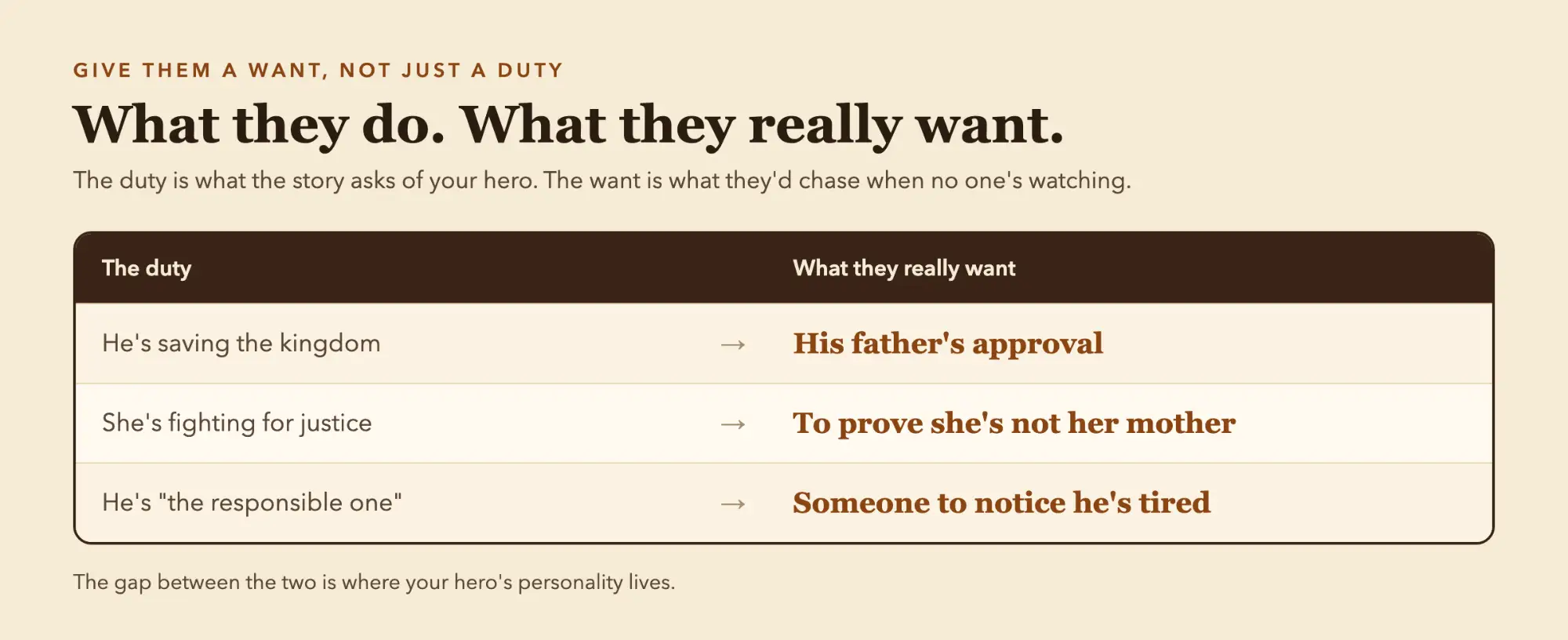
Give Them a Want, Not Just a Duty
"Save the kingdom" is a job description, not a personality. What does your hero want when no one's watching? What do they want that they're ashamed of wanting?
He's saving the kingdom, but really he wants his father's approval.
She's fighting for justice, but really she wants to prove she's not her mother.
He's "the responsible one," but really he just wants someone to notice he's tired.
Let Them Be Wrong
A hero who's never wrong is a hero no one believes in. Give them a belief that's actually flawed, not "trust issues," something with teeth. Let the story prove them wrong.
She believes mercy is always weakness, because the one time she showed it, someone died for it.
He believes loyalty means never questioning the people he loves, until that loyalty gets someone hurt.
Steal From Your Villain
Look at what makes your villain magnetic: the specificity, the conviction, the humor, the mess. Now ask: what's the hero's version of that? Same intensity, different direction.
Your villain burns cities for a better world. Your hero would burn his own reputation to protect one person.
Your villain is ruthless for control. Your hero is ruthless for the people she loves.
Give Them a Voice, Not Just a Vocabulary
Villains often get the best lines because writers let them be sharp. Let your hero be sharp too: funny, sarcastic, petty sometimes. A "good" character isn't a polite one.
Not "we have to stop him, no matter the cost." Try "I'm not dying for a man who couldn't even show up to his own coronation."
Not a solemn vow. Let them complain on the way to keeping it.
Give Them a Backstory Worth Relating To
Villains are compelling because we understand why they broke. Your hero needs that too: a real reason, a real wound, specific enough that readers see themselves in it. Not tragedy for shock value. One that explains who they became.
Not "her parents died and now she's brave." She froze once when it mattered, and someone else paid for it. Now she overcorrects into recklessness.
He wasn't betrayed once. He was slowly taught that needing people is a liability, one small disappointment at a time.
Turn the Weakness Into the Strength
Villains don't hide their damage; they weaponize it. The hero should have a wound that makes them flinch but also makes them dangerous when it counts.
Her fear of losing people made her cautious. Now it makes her impossible to threaten, because she's already lost everything.
His need for control made him controlling. Now it makes him the only one calm enough to lead in the chaos.
Let Villains Be Villains
Don't fix any of this by softening the villain instead. Redemption arcs can work, but villains don't need one to be great. Write him so well that everyone hates him: no arc, no excuse, no last-minute heart of gold. Let him just be right about being wrong.
Quick Hero Checklist
Run your hero through these six questions before your next draft.
Do they want something they'd never say out loud?
Do they believe something the story will prove wrong?
Do they have your villain's intensity, pointed in a different direction?
Could you tell their dialogue apart from everyone else's without a tag?
Is their wound specific enough to explain who they became?
Does that wound make them dangerous when it counts?
Keep Your Hero's Want, Flaw and Wound in WriteO
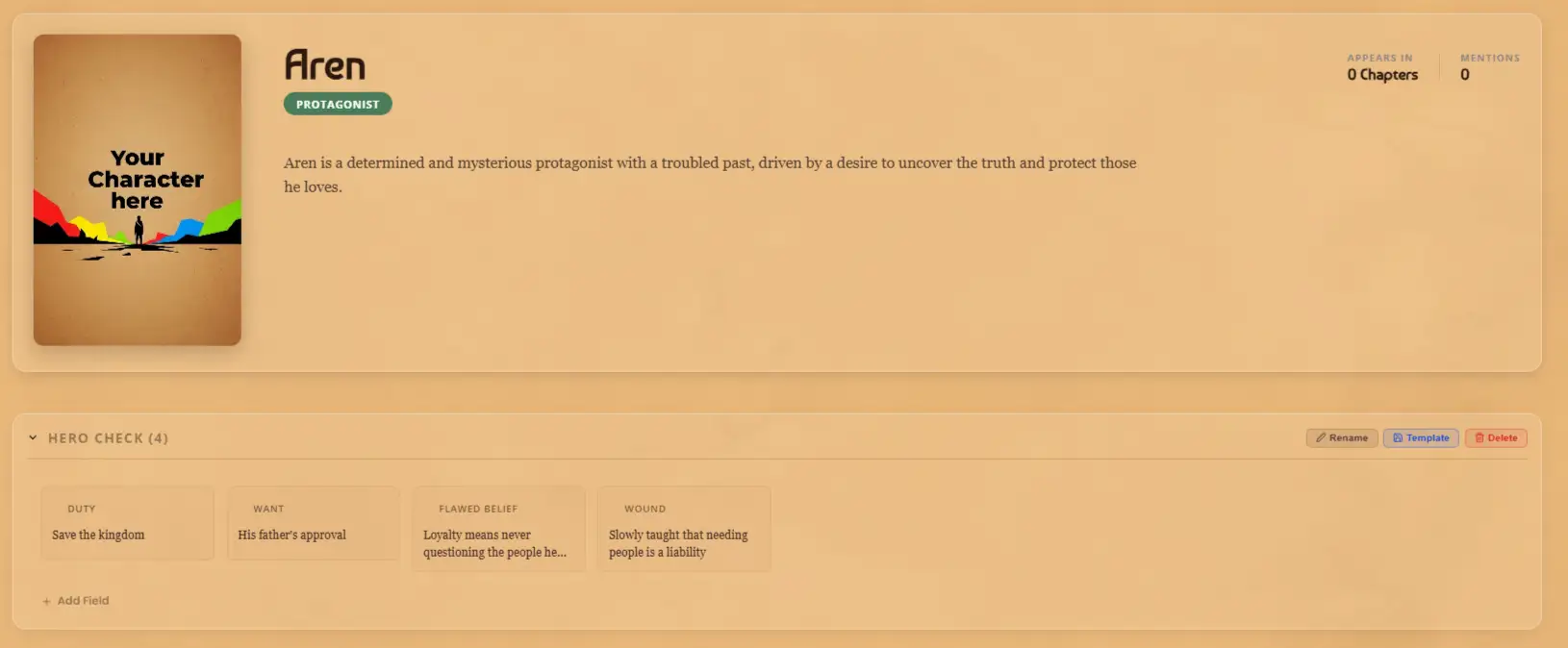
It's easy to know all of this in your head and still lose track of it by chapter fifteen. In WriteO, every character gets a profile with sections you build yourself, so your hero can carry a Duty, a Want, a Flawed Belief and a Wound right on their page. Save that layout as a template and your villain gets the same one. While you write, open the character panel without leaving the chapter. Every edit to a profile is logged, so you can see how your hero changed from the first chapter to the last, and the relationship map records how things shift between your hero and your villain.
The Bottom Line
Great heroes aren't accidents of good behavior; they follow a system. A want underneath the duty, a flaw with real teeth, a voice that sounds like a person instead of a principle. Run your hero through these fixes, and readers will stop rooting for the villain to win, because now they've got someone worth losing to.
Frequently Asked Questions
QWhy is my protagonist boring?
Usually because they have good morals and no personality. They have a duty instead of a want, no flaw with real teeth, and a voice that sounds like a principle. Readers fall for specificity, not goodness.
QHow do I make my hero as interesting as my villain?
Look at what makes your villain magnetic, like their conviction, their humor or their mess, and give your hero their own version of it. Same intensity, different direction.
QCan a good character have real flaws?
Yes. Keep the morals and give them a temper, a belief that's wrong, or a want they're ashamed of. For characters who go further, see our guide to morally grey characters.
QWhat's the difference between a hero's duty and their want?
Duty is what the story asks of them. Want is what they'd chase if no one were watching. The gap between the two is where their personality lives.
QDoes my villain need a redemption arc?
No. Redemption arcs can work, but a villain can be great with no arc, no excuse and no last-minute heart of gold.