

Introduction
I spent years terrified of telling. Every writing guide I read repeated the same rule: show, don't tell. So I buried my characters under gestures and hints until my readers had to play detective just to learn who was who. My villain was so subtle that one beta reader thought he was the love interest. That was the day I realized that telling, done well, is not a weakness. It is a tool.
What direct characterization is, and why it matters
Direct characterization is when the narrator plainly tells the reader who a character is. Instead of leaving clues to decode, you state the facts: what they look like, what kind of person they are, how they habitually behave and where they come from.
It is the counterpart to indirect characterization, where readers infer personality from actions, dialogue and choices. Both matter. The strongest characters use direct statements as the foundation and indirect moments as the proof.
Here is why it deserves a place in your toolkit:
It anchors the reader fast. One clear sentence lets readers picture a character immediately, so they can stop guessing and start caring.
It saves pages. Telling us a man is "notoriously short-tempered" takes five words. Proving it through three scenes takes thirty pages you may not have.
It separates your cast. When every character gets distinct, deliberate descriptors, readers stop mixing them up.
It sets expectations you can play with. Once you tell readers a character is cruel, every act of kindness becomes a surprise and every act of cruelty lands harder.
It signals importance. How much you describe a character tells readers how much attention to pay them.
The secret is not whether to tell, but what to tell. A hero and a background shopkeeper should not receive the same description. That is where the four pillars, mapped to role, come in.
How to do it: the four pillars, mapped to role
Every direct description draws from four pillars. Think of them as four lenses you point at a character.
Physical appearance: what they look like. Choose one or two telling details, not a full inventory. "A prominent scar divided his left eyebrow" beats a list of hair, eye and height.
Personality and temperament: what kind of person they are, stated outright. "She was naturally compassionate but fiercely independent."
Mannerisms and habits: their repeated, characteristic behaviors. "She had a habit of biting her lower lip whenever she was deep in thought."
Background and social identity: upbringing, status, occupation and defining circumstances. "She was a seasoned physician, having spent nearly two decades tending to the kingdom's sick."
You rarely need all four at full strength. The role a character plays decides which pillar leads and which stays quiet.
For main characters, touch all four pillars but let the lead pillar take the most space. For minor characters, pick one pillar and stop there.
The protagonist: personality leads
Physical appearance: one or two details that reflect their inner state, not a full portrait. Ink stained the edges of her fingers permanently.
Personality and temperament: state a core trait plus a contradiction the story will test. Elara was stubborn in the way that only frightened people are stubborn.
Mannerisms and habits: a habit that leaks emotion under pressure. She traced invisible maps on any flat surface whenever she was nervous.
Background and social identity: give the starting point, but hold the full history back. She was the youngest cartographer the guild had ever hired.
Put together:
Elara was stubborn in the way that only frightened people are stubborn. She was the youngest cartographer the guild had ever hired, and she made sure nobody forgot it. Ink stained the edges of her fingers permanently, and she traced invisible maps on any flat surface whenever she was nervous.
The antagonist: appearance and personality lead
Physical appearance: one unsettling detail that signals danger. He was a tall, gaunt man whose smile never quite reached his pale grey eyes.
Personality and temperament: name the trait that makes them a threat. He believed that mercy was a form of weakness.
Mannerisms and habits: a controlled, deliberate habit that hints at menace. He never raised his voice; he simply waited until others filled the silence.
Background and social identity: explain their power and entitlement, not their full motive. Born into one of the kingdom's oldest noble families, he had been raised to expect obedience.
Put together:
Lord Varric was a tall, gaunt man whose smile never quite reached his pale grey eyes. Born into one of the kingdom's oldest noble families, he had been raised to believe that mercy was a form of weakness. He never raised his voice. He simply waited, and sooner or later, everyone told him what he wanted to know.
The mentor: background leads
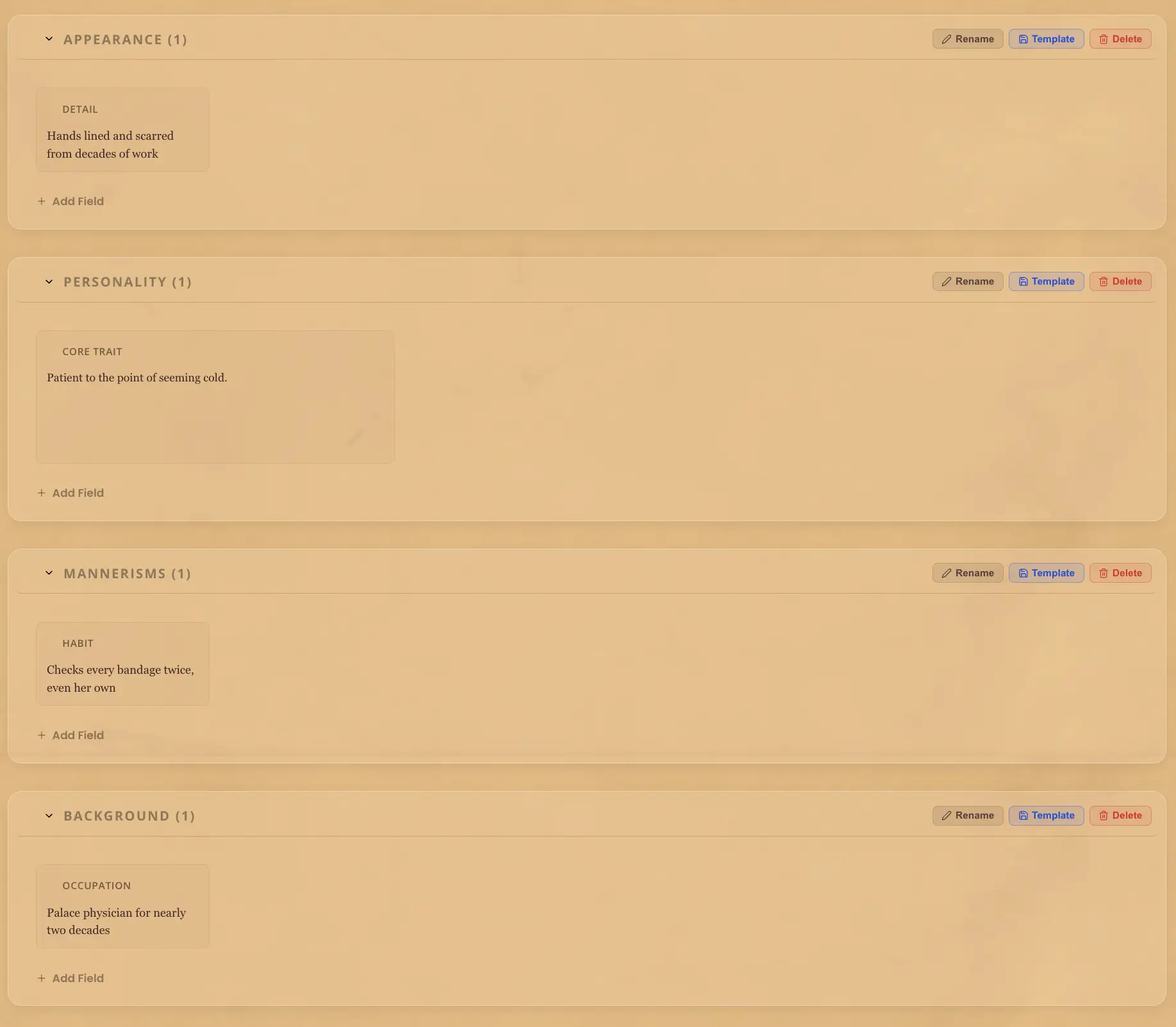
Physical appearance: signs of age, wear or experience. Her hands were lined and scarred from decades of work.
Personality and temperament: calm, measured traits that suggest wisdom. She was patient to the point of seeming cold.
Mannerisms and habits: steady, practiced habits that show mastery. She checked every bandage twice, even her own.
Background and social identity: lead with expertise and years served. She was a seasoned physician, having spent nearly two decades tending to the kingdom's sick.
Put together:
Maren was a seasoned physician, having spent nearly two decades tending to the kingdom's sick. Her hands were lined and scarred from the work, and she was patient to the point of seeming cold. She checked every bandage twice, even her own.
The love interest: mannerisms lead
Physical appearance: describe them through the protagonist's eyes, focusing on what draws attention. His dark curls fell carelessly across his forehead.
Personality and temperament: reveal only part of who they are and keep some mystery. He was quiet, though rarely shy.
Mannerisms and habits: a distinctive habit the protagonist notices and remembers. He hummed under his breath whenever he thought no one was listening.
Background and social identity: hint at a world that differs from the protagonist's, creating tension. He was a soldier's son in a city of scholars.
Put together:
Caius hummed under his breath whenever he thought no one was listening. He was quiet, though rarely shy, and his dark curls fell carelessly across his forehead. A soldier's son in a city of scholars, he never seemed to know where to put his hands.
The sidekick or friend: mannerisms and personality lead
Physical appearance: keep it light, with one memorable and often comic detail. He had a wide grin that was missing one tooth.
Personality and temperament: a temperament that contrasts with the hero. He was cheerful, reckless and loyal to a fault.
Mannerisms and habits: a loud, recognizable quirk. He was an incessant talker, rarely allowing anyone else to finish a sentence.
Background and social identity: a simple, relatable origin. He was a baker's son who had never left the valley.
Put together:
Tobin was an incessant talker, rarely allowing anyone else to finish a sentence. A baker's son who had never left the valley, he was cheerful, reckless and loyal to a fault, and his wide grin was missing one tooth.
The minor character: one vivid tag
Physical appearance: a single striking feature, if this is their tag. A broad, red-faced woman.
Personality and temperament: one word is enough. Suspicious.
Mannerisms and habits: one repeated action, if this is their tag. She wiped the same spotless cup the entire time.
Background and social identity: only their job or function. The innkeeper.
Put together:
The innkeeper wiped the same spotless cup the entire time Elara spoke to her.
Her job tells readers where she fits, and the cup is her one tag. That is all a minor character needs.
Matching description to personality
The role tells you which pillar to lead with. Personality tells you how to write it. Let the description carry the character's energy:
Cold or calculating characters: use precise, clipped, controlled language. "Sharp, angular features" and "meticulous" habits.
Warm characters: use softer, fuller sentences and details that invite closeness, such as laughter lines or a habit of touching people's arms.
Chaotic or impulsive characters: use energetic, run-on phrasing and habits that spill over. "An incessant talker, rarely allowing anyone else to finish a sentence."
Arrogant characters: let the narrator's word choice carry a judgment. "An insufferable degree of self-confidence."
Guarded or mysterious characters: describe the surface carefully and say little about the inside. The gaps become part of the description.
Three rules that keep it sharp
Pick specific over generic. "Brown hair" is invisible. "Dark curls that fell carelessly across his forehead" carries attitude.
Pair each pillar with contrast. "A petite woman with an imposing presence" is memorable because the two halves collide.
Tell once, then prove it. State the trait directly, then let a later scene confirm or challenge it.
How WriteO Handles This
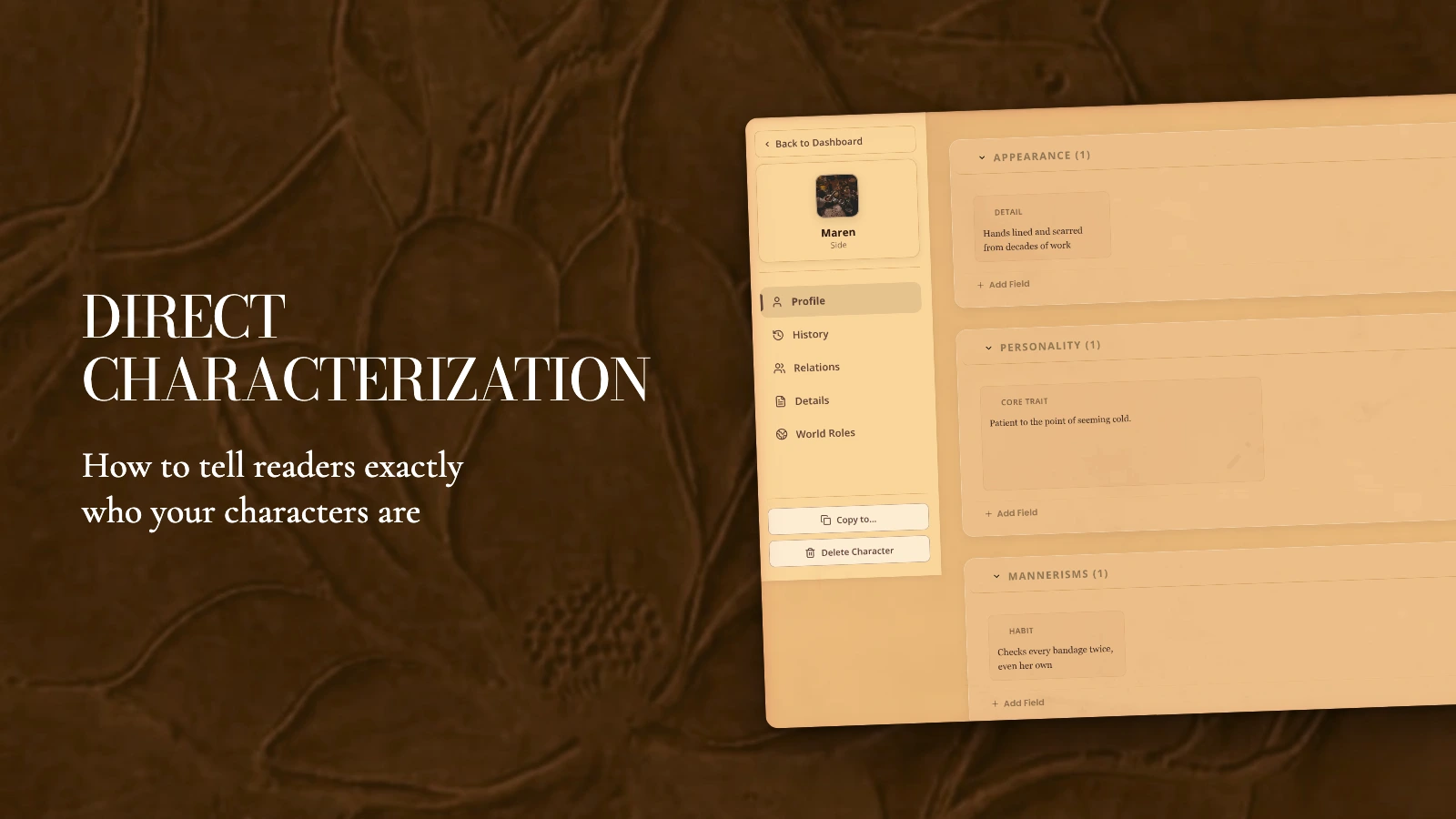
The hard part of telling once is remembering what you told. Fifty pages later, was the scar over his left eyebrow or his right? In WriteO's character profiles, each character has sections such as Appearance, Personality and Backstory, and you can add your own and drag them into any order. Set them up to match the four pillars, then fill in only what that character's role needs.
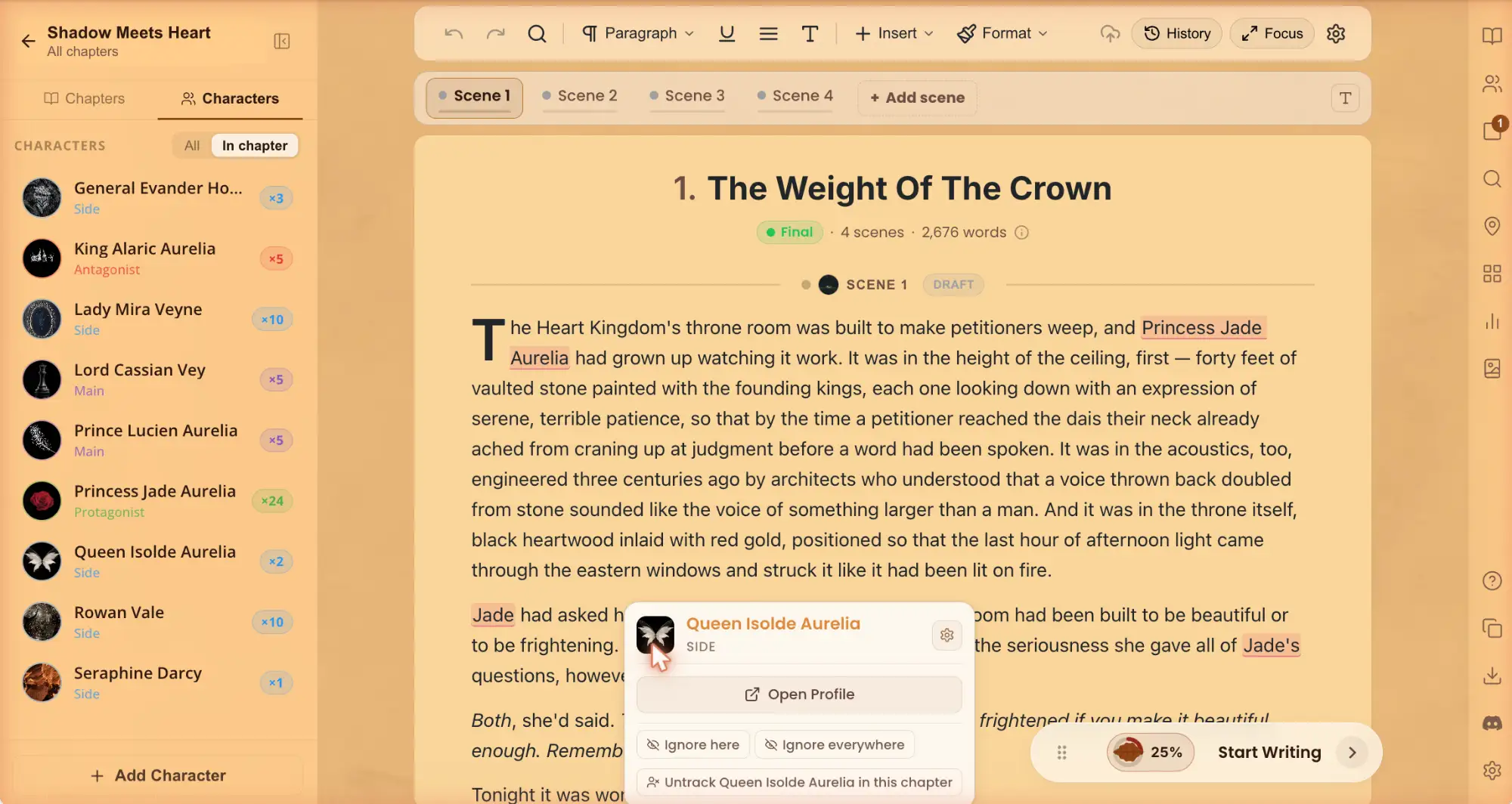
While you write, WriteO highlights each character's name in the chapter in their own color. Hover over a name and a card shows who it is and their role, with a link to the full profile, so you can check what you've already told readers without leaving the page. The sidebar lists everyone in the chapter and how often each one is mentioned. For more ways to keep a cast straight, see our complete guide to organizing characters.
Final thoughts
I used to think telling was the lazy option. Now I see it as a promise to the reader: this is who this person is, so watch closely. When you choose the right pillar for each role and write it in a voice that matches the character's personality, a single sentence can do the work of an entire chapter.
So open your manuscript, find the character readers keep forgetting, and run them through the four pillars. Tell us who they are, clearly and boldly. Then let the story prove you right, or beautifully wrong.
Ready to build your cast? Give WriteO a try and keep every character's profile next to your manuscript.
Frequently Asked Questions
QWhat is direct characterization?
Direct characterization is when the narrator tells readers outright what a character is like: their looks, personality, habits or background. For example: "He believed that mercy was a form of weakness."
QWhat is the difference between direct and indirect characterization?
Direct characterization states a trait. Indirect characterization lets readers work it out from what the character says and does. "She was patient" is direct; a scene where she calmly re-checks every bandage is indirect. Most strong characters use both: tell once, then prove it.
QIsn't direct characterization just telling instead of showing?
Yes, and that's fine. "Show, don't tell" warns against telling everything, not against telling at all. One clear sentence of description gives readers an anchor, and later scenes can confirm it or turn it on its head.
QHow much should you describe a minor character?
Usually one vivid tag, such as a single feature or habit, plus their job or function. Save the full four pillars for your main characters.