

A strong female protagonist doesn't have to choose between independence and romance. She can fall in love, be vulnerable, crave affection, and still be the person driving her own story.
Yet one mistake shows up again and again in romance writing. A love interest rides in as her knight in shining armor and slowly takes over. He makes her decisions, solves her problems, and becomes the center of her existence. By the final chapter, the woman readers fell in love with has quietly disappeared.
Your heroine doesn't need a knight in shining armor. The goal is a romance where two people complement each other without one becoming the other's entire identity. Here's how to write it. The examples below use a male love interest, but every point works for any pairing.
1. Redefine What Makes a Female Lead Strong
Too often, "strong" gets flattened into emotionless, sarcastic, intimidating, or endlessly stubborn. That isn't strength. It's a costume.
Real strength sits alongside emotional needs, insecurities, fears, and weaknesses. Your heroine can be ambitious and affectionate, confident and uncertain, independent and romantic, all at once. Before the love interest ever appears, readers should know what makes her interesting beyond her relationship status.
Niche tip: Give her a contradiction. Memorable characters are never defined by a single trait. Consider:
A fearless detective who is terrified of emotional intimacy.
A successful businesswoman who can't accept a compliment.
A fiercely independent woman who secretly wishes someone would take care of her, just occasionally.
That gap between who she appears to be and what she quietly longs for is where your romance lives.
Common mistake: Making her so strong that she becomes emotionally inaccessible. A character with no cracks has nowhere to grow.
2. She Doesn't Need a Knight in Shining Armor
Your male lead doesn't need to rescue her to be valuable to the story. When he becomes her permanent problem-solver, she stops being the protagonist and starts being the plot device.
Resist the urge to manufacture danger just so he can swoop in. Let her fight her own battles, make hard decisions, and live with the consequences. He can care deeply about her safety without controlling her choices. He can stand beside her instead of constantly standing in front of her.
Niche tip: Replace the rescue scene with the support scene.
Instead of this | Try this |
He fights all her battles | He stands beside her while she handles a tough confrontation |
He makes decisions on her behalf | He offers advice but respects her final call |
He solves problems she can handle herself | He supports her after a failure without making her feel incompetent |
She becomes helpless whenever he's around | He recognizes when she needs comfort, not a solution |
Common mistake: Making him look impressive by deliberately making her helpless. If his heroism depends on her incompetence, neither character wins.
Remember: he can be her safe place without being her savior.
3. Give Her a Life Outside the Love Interest
Before readers learn what she wants from a relationship, show them what she wants from life. Establish her ambitions, friendships, responsibilities, hobbies, and personal conflicts. Give her meaningful scenes where he isn't even in the room.
Her goals should matter, especially when they complicate the romance. That friction is a gift, not a problem.
Niche tip: Try the absence test. Temporarily remove the love interest from your outline. Does your protagonist still have:
A meaningful external goal?
A personal conflict?
Difficult decisions to make?
Relationships worth exploring?
Something important to lose?
If the answer is no, she may be functioning more as a love interest than a protagonist.
Common mistake: Building her entire storyline around whether he likes her, texts her, notices her, or chooses her.
4. Make Him Admire Her for More Than Her Appearance
Attraction gets a romance started. Admiration makes it last. Show the love interest appreciating her intelligence, abilities, principles, and ambitions, and give him reasons to respect her before he falls for her.
Keep that admiration specific. Generic praise could apply to anyone; specific observation proves he actually sees her.
Niche tip: Write an admiration scene, not just an attraction scene. Instead of describing how beautiful she looks for the fifth time, show him noticing:
How she handles a difficult negotiation.
How she remembers tiny details about people.
How she refuses to compromise her principles.
How she approaches a problem differently from everyone else.
Let readers understand why he admires her through what he observes and how he acts on it.
Common mistake: Introducing her as exceptionally capable, then letting him constantly correct, lecture, or undermine her. Readers will notice the contradiction, even if you don't.
5. Let Her Be Vulnerable Without Making Her Helpless
Vulnerability is not weakness. It's the moment a character risks something real. Explore what scares her about falling in love, and show the distance between her public confidence and her private insecurities.
Let her feel jealousy, longing, uncertainty, and affection. Let her ask for help without becoming dependent. Her emotional growth should deepen her personality, not erase it.
Niche tip: Use behavioral contradictions. For example:
She confronts an enemy without hesitation but struggles to confess her feelings.
She leads an entire team but gets nervous around someone she genuinely likes.
She rarely asks for favors but remembers every small thing he does for her.
She's comfortable with professional praise but turns awkward when someone remembers her favorite childhood snack.
These contradictions make her feel human, and they give readers something tender to root for.
Common mistake: Making her suddenly passive, childish, or incompetent the moment the romance intensifies.
6. Let Her Have Romantic Agency
An independent woman should be independent in love, too. Let her initiate flirting, dates, kisses, and difficult conversations. Let her express attraction without the story treating it as desperation.
She should be free to pursue someone she genuinely likes, set boundaries, and walk away when those boundaries are crossed. She is an active participant in defining the relationship, not a judge waiting to rule on his proposals.
Niche tip: Reverse the romantic initiative. Look at the scenes where the male lead would traditionally make the first move. What if she:
Initiates their first kiss?
Asks him on a date?
Admits she's attracted to him first?
Reaches for his hand?
Makes the first move toward reconciliation?
You don't have to flip every trope. Just make sure she has choices beyond accepting or rejecting his advances.
Common mistake: Writing a woman who runs her own life with total confidence but has no agency in her own love story.
7. Create Conflict Without Making Him Her Biggest Obstacle
Romance needs tension, but tension isn't the same as disrespect. The best conflict grows naturally from who these two people are: their values, priorities, and beliefs. She should challenge him just as much as he challenges her.
Avoid leaning on contrived misunderstandings or chapters of miscommunication that a single honest conversation would fix. Readers notice when conflict exists only because the author needs it.
Niche tip: Use values-based conflict. Instead of having him ignore her messages for three chapters, give them opposing beliefs:
She values transparency; he believes some truths cause unnecessary damage.
She believes in second chances; he believes consequences matter.
She wants to build something of her own; he prioritizes stability.
She believes vulnerability creates intimacy; he sees it as a risk.
Now every disagreement reveals character and opens a door to growth.
Common mistake: Confusing possessiveness, jealousy, and disrespect with romantic intensity. Controlling behavior isn't passion.
8. Give Her Flaws That Actually Affect the Relationship
A strong female lead shouldn't be perfect. Perfection is boring, and it leaves the romance nothing to work through. Consider flaws such as:
Being overly controlling because she struggles to trust others.
Avoiding difficult conversations.
Treating vulnerability as a loss of power.
Prioritizing achievement at the expense of emotional connection.
Assuming she always knows what's best.
Struggling to apologize.
Niche tip: Make her flaws inconvenient. If she's stubborn, let that stubbornness cost her something. If she's fiercely independent, show how refusing help leaves her isolated when it matters most.
Don't make every flaw secretly attractive, and don't turn the love interest into someone who simply tolerates everything she does. Flaws should create friction, and friction should create change.
Common mistake: Confusing a strong personality with a character who never needs to grow.
9. Don't Make Her Abandon Her Ambitions for a Happy Ending
Her career, dreams, and personal goals should keep moving throughout the romance. Explore how the relationship fits into her existing life rather than replacing it. Compromises should be mutual, and her professional success should never be framed as the obstacle to domestic happiness.
Niche tip: Write the post-romance reality. Ask yourself what their relationship looks like on an ordinary Tuesday. Does she still attend meetings, chase her ambitions, see her friends, and make her own decisions? Does he adjust his life, too?
A believable happily-ever-after feels like two people building a shared life, not one person disappearing into the other's.
Common mistake: Introducing an ambitious heroine, then having her abandon everything for the love interest in the final chapters. Readers who loved her drive will feel betrayed.
10. Common Romance-Writing Problems and How to Fix Them
Keep this quick-reference table handy while you revise.
Common problem | How to fix it |
She's strong but emotionally unavailable | Give her specific emotional needs and fears. |
He constantly rescues her | Let her resolve major conflicts herself. |
She loses her personality around him | Preserve her established voice and decision-making. |
Her ambitions disappear | Keep her personal goals active. |
She's always right | Let her make mistakes and face consequences. |
He has no personality beyond loving her | |
She forgives disrespect too easily | Make boundaries and consequences meaningful. |
Their banter is just constant arguing | Balance teasing with genuine tenderness. |
She never initiates romance | Give her chances to express desire and affection. |
The romance overshadows her character arc | Make the relationship complement her individual growth. |
11. Practical Exercise: The Strong Female Lead Romance Audit
Open your manuscript and find these five scenes. Run each one through the questions below.
The attraction scene
Does she actively notice and respond to the love interest?
Does she have preferences beyond his appearance?
The conflict scene
Does she express her own perspective?
Does she make meaningful decisions?
The vulnerability scene
Does she reveal something personal without losing her established personality?
The turning-point scene
Does she make a choice that changes the relationship?
Is she actively shaping their future?
The resolution
Does she keep her ambitions, identity, friendships, and independence?
Does the relationship feel like a mutual choice?
If you answer "no" more than once or twice, that's where your revision starts.
Bonus tips to sprinkle into your draft:
Give her something she refuses to compromise on. Readers understand her strength through what she protects, not how often she wins arguments.
Let her be wrong about him. She can misjudge his intentions or underestimate his emotional intelligence.
Don't equate competence with coldness. She can be nurturing, playful, and ambitious at once.
Give her romantic preferences. What humor, kindness, or intelligence catches her eye?
Let her show affection her own way. A practical heroine might repair his broken watch instead of writing a love letter.
Keep her friendships alive. Her friends shouldn't vanish when the romance begins.
Let him need her, too. Mutual support turns a rescue mission into a partnership.
How WriteO Helps You Keep Her Strong
The hardest part of this advice isn't understanding it. It's remembering it at chapter 30, when the romance is finally working and her goals have quietly slipped out of the story. WriteO keeps her whole life in view while you write.
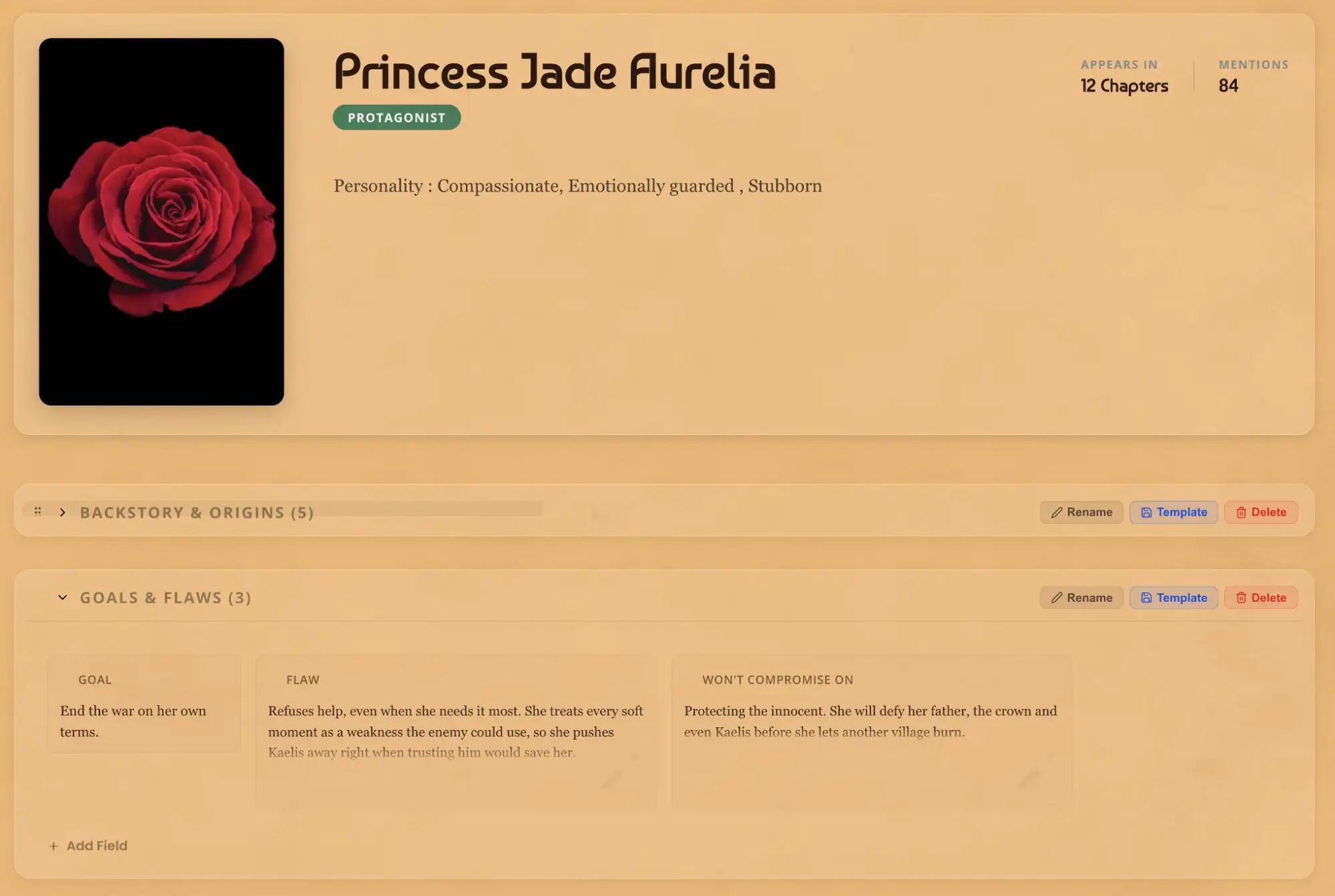
Give her goals and flaws their own place. Every character in WriteO has a profile with sections for appearance, personality and backstory, and you can add your own. Add sections for her goals, her flaws and the one thing she refuses to compromise on, then keep the profile open next to the chapter you're drafting. If a scene asks her to drop something on that list, you'll notice.
Run the absence test on real chapters. WriteO tracks which chapters each character appears in and how often they're mentioned, and the editor's "Mentioned" filter shows who is in the current chapter. Compare her chapter list with the love interest's. If every chapter she's in, he's in too, she has no scenes of her own yet.
Map her life, not just the romance. The Relationship Visualizer shows your cast as a colour-coded map. Put her in the middle and connect her best friend, her rival, her mentor and her family, not only him. If the only strong line on the map runs to the love interest, the absence test will fail too. Click Evolve on any relationship to record how it changed, in which chapter and why, so you can see the turning-point scene from the audit above on the page. It works just as well for a romantasy cast of rival courts as for a contemporary office romance.

Conclusion: She Can Have Both Love and Independence
A strong female protagonist doesn't need to reject romance to prove her independence. She doesn't need to be rescued to deserve affection. And she doesn't need to sacrifice her ambitions to build a meaningful relationship.
The best romances don't shrink their characters. They give them room to become more fully themselves. When you write a love story where both people grow, challenge each other, and choose each other freely, readers won't just believe in the romance. They'll believe in her.
"She doesn't need a knight in shining armor. She needs someone who can stand beside her without expecting her to put down her sword."
Ready to write her? Give WriteO a try and keep her goals, her friendships and her whole story in view from the first chapter to the last.
Frequently Asked Questions
QWhat makes a female lead strong in a romance?
Her own goals, choices and flaws. A strong female lead drives her story, makes decisions that change the relationship and keeps her ambitions after she falls in love. Strength isn't coldness or sarcasm; she can be emotional and still be the one steering.
QCan a strong female lead be vulnerable?
Yes. Vulnerability is the moment she risks something real, like admitting her feelings or asking for help. It only becomes a problem when the story makes her helpless or passive once the romance starts.
QHow do you write a love interest who doesn't overshadow her?
Give him his own goals, friends and flaws, and let him support her instead of rescuing her. He should admire specific things about her and need her as much as she needs him.
QDoes a strong female lead have to give up her career for a happy ending?
No. A believable happy ending fits the relationship into her life rather than replacing it. Any compromises should be made by both of them.
QHow do I know if my heroine is too dependent on the love interest?
Try the absence test: take him out of your outline and check whether she still has a goal, a conflict, hard decisions and relationships of her own. If not, she needs scenes and stakes that don't involve him.