

Have you ever stared at a blank document for two hours, then written 500 effortless words at 11 PM?
If so, you're not lazy and you're not undisciplined. You may simply be writing at the wrong time.
Some writers swear by the 5 AM alarm. Others don't produce a decent sentence until the house goes quiet at midnight. Both camps are convinced they've found the secret. The truth is less dramatic: your most productive writing hours aren't 5 AM or midnight. They're the hours when your mind, your energy, your environment, and the type of writing you're doing all line up.
Productivity isn't about how long you sit at your desk. It's about what you get out of the hours you actually have.
So instead of copying someone else's routine, treat this as an experiment, not a personality test. By the end of this guide, you'll have a simple seven-day method for finding out when you really write best.
Morning, afternoon, or night: what actually changes?
No time of day is universally better for writing. Each one simply gives you a different mix of advantages and trade-offs. Researchers call your natural timing your chronotype: some people are larks who peak early, some are owls who peak late, and most of us sit somewhere in between.
Early morning writers
Mornings offer fewer interruptions and less mental clutter. You haven't read your messages, argued with anyone, or made fifty small decisions yet. That makes mornings ideal for writers who like starting with a clean mental slate.
The catch: if you're naturally groggy at dawn, forcing a 5 AM start can make every sentence feel like pushing a car uphill. Waking up early isn't a productivity achievement on its own.
A tip: most people experience "sleep inertia" for roughly the first 20 to 30 minutes after waking. If you're a morning writer, don't judge your session by those first groggy minutes. Get up, have water or coffee, and start writing half an hour later.
Afternoon writers
The afternoon suits writers who need time to warm up. By midday, your mind has settled into the rhythm of the day and the early fog is long gone.
The catch: meetings, errands, and responsibilities pile up here. There's also the well-known post-lunch energy dip, usually somewhere between 1 and 4 PM.
Night writers
Night brings quiet. Your obligations are done, your phone is calmer, and many people feel mentally settled once the day's pressure is off.
The catch: fatigue quietly erodes concentration, editing judgement, and eventually your sleep. A late session that costs you tomorrow's energy isn't free.
Don't confuse the atmosphere of night writing with actually producing your best work at night. A dark room, a lamp, and a mug of tea feel creative. But track your output, not your aesthetic.
Understand your personal writing rhythm
Here's where most productivity advice stops too early. Finding your best hours isn't just about when you feel awake. It depends on three things working together.
1. Your energy patterns
Start by noticing your ordinary days, not your ideal ones.
When do you feel genuinely alert, not just caffeinated?
When does concentrating feel almost effortless?
When does your slump arrive, and how long does it last?
2. Your creative versus analytical energy
This is the most underrated idea in this whole guide: not all writing uses the same kind of brain.
Writing task | What it demands |
Drafting new scenes | Imagination, flow, a willingness to be messy |
Editing | Attention to detail, critical judgement |
Outlining | Organisation, seeing how ideas connect |
Research | Sustained concentration, processing information |
This means a writer can be brilliant at drafting at night and far better at editing in the morning. Neither is "the" best hour. They're the best hours for different jobs.
A tip: slightly tired can actually help drafting. When your inner critic is a little sleepy, you're less likely to delete every sentence the moment you write it. The same tiredness is terrible for editing, where you need that critic wide awake. So if your late-night drafts flow but your late-night edits are sloppy, that's not a contradiction. It's a pattern worth using.
3. Your natural interruptions
University timetables, jobs, family, noise, a shared room, a phone that never stops. All of these shape which hours are realistically yours.
The best writing hour isn't only the one where you feel sharpest. It's also an hour you can actually protect.
The 7-day writing hour experiment
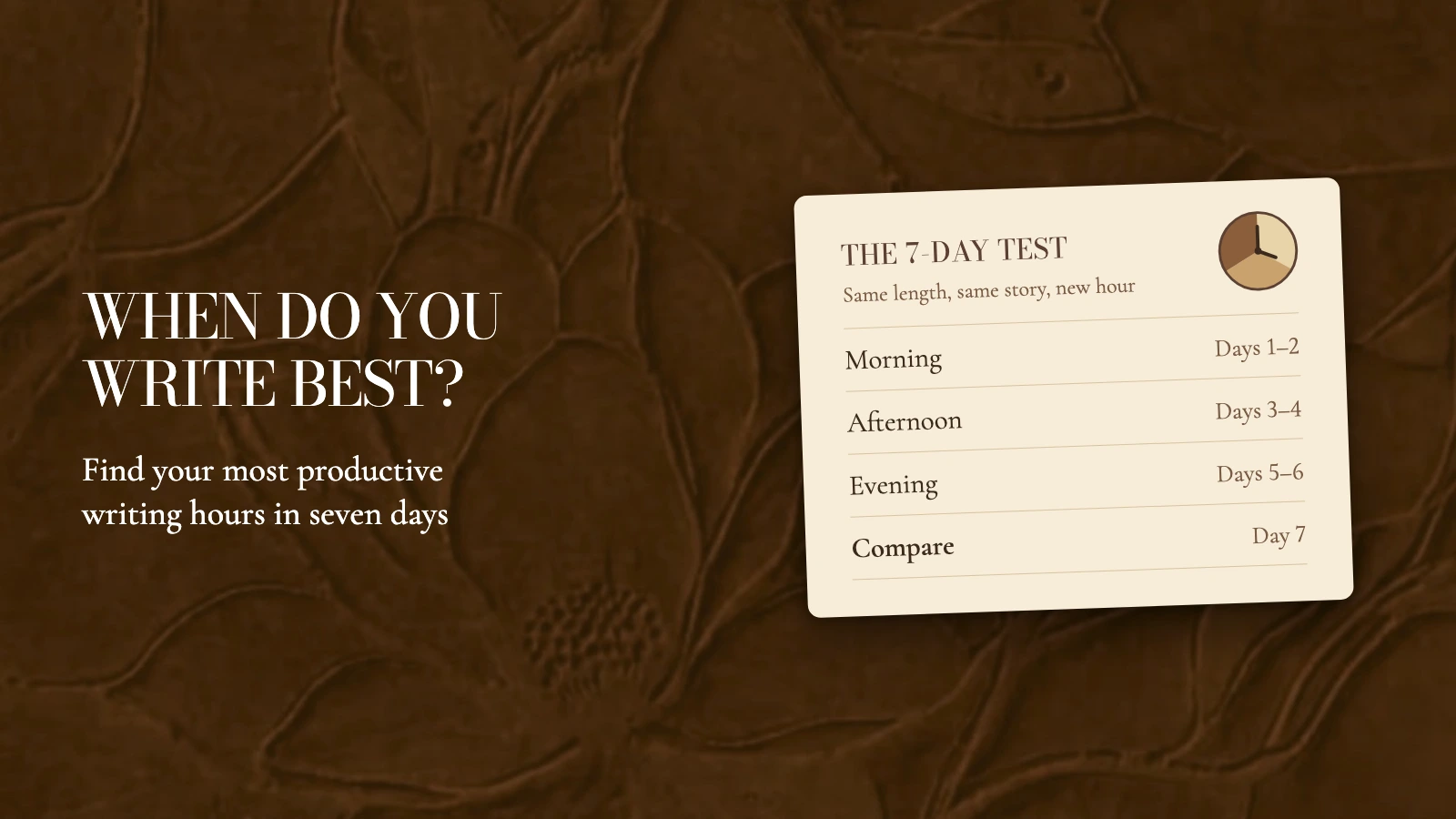
"Discover your rhythm" is useless advice without a method. Here's one you can start tomorrow: test three time windows over one week, then compare.
Days | What to do |
Day 1–2 | Write in the morning |
Day 3–4 | Write in the afternoon |
Day 5–6 | Write in the evening |
Day 7 | Review your results |
Keep these things the same
A fair test only changes one thing: the time. Keep everything else as steady as you can.
Session length: 30 to 45 minutes each time.
Project: the same story or type of writing, where possible.
Environment: the same desk, café, or corner.
No editing: you're measuring first-draft output, so keep moving forward.
What to track after each session
Words written.
Minutes spent actually writing, not just sitting at the desk.
Number of interruptions.
Concentration, on a 1–5 scale.
How hard it was to get started.
How satisfied you felt afterwards.
Two additions that make the results far more honest
Measure your "first-sentence time." Note how many minutes pass between sitting down and typing your first real sentence. This single number often reveals more than word count. A window where you start in two minutes is usually your natural window, even if the word count is similar elsewhere.
Do a blind 48-hour reread. Two days after each session, reread what you wrote without checking when you wrote it. Rate the quality from 1 to 5, then check the timestamps. Many writers discover their "inspired" midnight pages are weaker than their quiet morning ones, or the other way round. Your feelings in the moment are not a reliable judge.
Important: seven days gives you a starting hypothesis, not a scientific verdict. If two windows come out close, run the experiment again for another week.
Let WriteO track the experiment for you
Logging every session by hand is where most people give up on day three. WriteO's Progress dashboard does the tracking automatically while you write:
Set a goal. Open the Goals tab and add a Daily Time goal, such as 30 minutes a day, so every time window is judged against the same target.
Just write. Each session's active time and words typed are recorded automatically. Deleting text doesn't lower your totals by default; if you'd rather it did, turn on "Removed words lower my goals".
Compare your sessions. The Sessions tab lists every session with its date and time, words written, duration and words per minute, so your morning, afternoon, and evening results sit side by side.
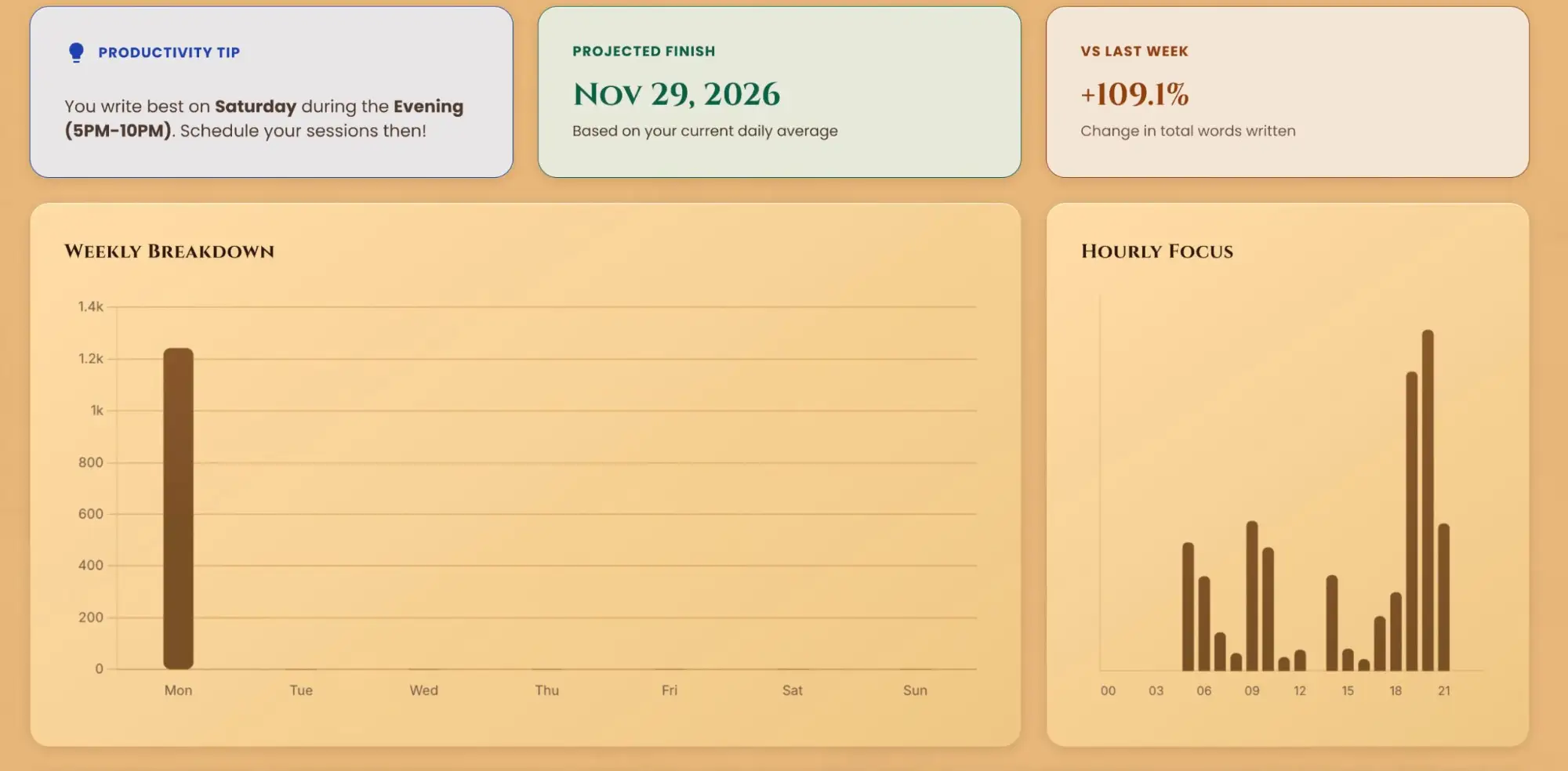
Look for the pattern. On Day 7, open Analytics. The Hourly Focus chart shows which hours you actually wrote in, the WPM Trend shows your speed, and the productivity tip at the top names your best day and time, for example “You write best on Thursday during the Evening (5PM–10PM).”
The free plan keeps seven days of history, which is exactly one experiment. PRO and Lifetime keep everything, including a 365-day activity heatmap that shows how your writing habits shift over time.
Run it during a writing challenge. WriteO also runs free writing challenges, like the November Writing Challenge, where the words you type count toward a goal you pick. The challenge page has its own Words per day chart that marks your best day, so a week of the experiment inside a challenge shows you which time window carried you furthest, with the whole community writing alongside you.

How to tell you've found your productive writing hours
Word count matters, but it isn't the whole story. Look for these signs instead:
You start writing without a 20-minute negotiation with yourself.
You stay focused without reaching for your phone every few minutes.
Ideas arrive more naturally, and you're not forcing every line.
You make meaningful progress, like finishing a scene, not just adding words.
You end the session satisfied rather than completely drained.
One distinction worth remembering: your fastest session isn't automatically your best session. Quality, consistency, and how sustainable the routine feels matter just as much.
A tip: pay attention to how you feel an hour after you stop. If a session leaves you buzzing and keen to return, that window is feeding your writing. If it leaves you wrung out for the rest of the day, it may be costing more than it gives, however many words it produced.
What if you don't have a consistent schedule?
Many aspiring novelists are juggling university, jobs, family, and days that never look the same twice. You can still use everything above. You just need a more flexible approach. Aiming for a big push instead? Our 50,000 words in November plan turns it into daily targets. Or join one of WriteO's free writing challenges and let the challenge page keep count for you.
Use writing windows, not fixed times. Aim for "a 30-minute window sometime this morning" rather than "exactly 7 AM."
Set a minimum session. Even 15 minutes keeps a project alive and your characters in your head.
Match the task to the energy you have. Tired and distracted? Edit, outline, or research. Fresh and focused? Draft.
Keep a running note. When you can't write, capture dialogue, plot ideas, and small observations on your phone.
Stop at a useful point. Leave yourself a quick note about what happens next so restarting feels easy.
A tip: build a task menu. Make a short list of writing jobs sorted by the energy they need. For example: high energy (draft a new scene), medium (revise a chapter), low (fix names, check a timeline, reread notes). When a gap opens up in your day, you don't waste it deciding. You just pick the task that matches how you feel.
Another tip: use transitions. The 15 minutes on a bus, after a lecture, or while dinner cooks are perfect for thinking through your next scene. You arrive at the desk already knowing what to write, which makes a short session far more productive.
Keep every task in one place. A task menu only works if switching tasks is instant. In WriteO, your planning and drafting live in the same workspace, so you can match the job to your energy without hunting through apps:
High energy: open your chapter and draft the next scene.
Medium energy: revise an earlier chapter or reorganise your chapter order.
Low energy: update a character profile, map how two characters are connected, or add images to your story's moodboard.
Even a tired 15 minutes spent on character profiles or a moodboard still moves your book forward, and it means your next high-energy session starts with richer material.
Small habits that make your writing hours count
Once you know your best window, these habits help you get more out of it. For the bigger picture, see our seven habits for staying productive while writing a novel.
Leave yourself a breadcrumb. Before you stop, write one sentence about what comes next. It removes the hardest part of restarting: deciding where to begin. In WriteO, link a note to the chapter you're drafting and it's there in the editor next time you open it.
Never open a blank page. Start each session with your last paragraph, outline, or scene notes already on screen.
Set a scene goal, not just a word goal. Instead of "write 1,000 words," aim to finish a conversation, introduce a character, or resolve a scene.
Warm up inside your story. Reread the last 100 to 200 words, or write a few messy sentences from your character's point of view. Generic writing prompts warm you up for someone else's story.
Protect your best hour. Don't spend your highest-energy window answering emails or tidying folders. Those can happen in your weakest hour.
A few more habits worth trying
Stop while you know what comes next. Hemingway's old trick still works. He advised stopping when you're going well and know what will happen next. Some writers go further and stop mid-sentence. Ending a session in the middle of a sentence you know how to finish makes the next start almost automatic.
Write before you consume. Scrolling, news, and messages fill your head with other people's words and worries. Even ten minutes of writing before you check your phone protects your own voice.
Match the scene to your mood. Restless and irritable? Write the argument or the chase scene. Calm and reflective? Write the quiet, emotional moment. Your current mood can be fuel rather than an obstacle.
Use a start-up cue. The same playlist, candle, or drink at every session trains your brain that it's writing time. After a few weeks, the cue alone helps you settle faster.
Re-test when life changes. A new semester, job, season, or even a new project can shift your best hours. Run the seven-day experiment again whenever your routine changes significantly.
Final thoughts: find a rhythm you can actually keep
There's no universally perfect writing hour. Midnight isn't secretly more creative, and 5 AM isn't a badge of honour.
Your ideal schedule may also change with your workload, your project, and your life. That's normal. Consistency doesn't mean writing at the exact same minute every day. It means building a routine that keeps bringing you back to your work.
So stop comparing your routine with other writers'. Run the experiment, trust your own data, and adjust as you go.
Your best writing hours aren't the ones that look impressive on someone else's schedule. They're the ones that bring you back to your story, again and again.
Bonus: try it yourself
What's your writing personality?
Which one sounds most like you? Tell us in the WriteO Discord or on Instagram at @writeoapp.
The early-bird novelist — writes before the world wakes up.
The afternoon plotter — needs the day to warm up first.
The late-night storyteller — comes alive once the house goes quiet.
The whenever-inspiration-strikes writer — no fixed hour, just fierce bursts.
Now run the experiment and see whether your results agree with your answer. You might be surprised. And if you want to know whether you plan or discover your stories, read plotter vs pantser.
The Writer's Hour Tracker
Copy this table into a note in WriteO and fill in one row after each session. The first two rows are examples only.
Date | Writing time | Words | Minutes to first sentence | Focus (1–5) | 48-hour quality (1–5) | Notes |
Day 1 | 8 AM | 350 | 4 | 4 | 4 | Quiet, slow start |
Day 2 | 11 PM | 600 | 2 | 5 | 3 | Good flow, needed heavy edits |
Day 3 | ||||||
Day 4 | ||||||
Day 5 | ||||||
Day 6 |
On Day 7, look across the rows. Your best window is usually the one that scores well on several columns, not just words.
Frequently Asked Questions
QWhat is the best time of day to write?
There isn't one best time for everyone. Your best time is when your energy, your environment and the kind of writing you're doing line up. Test morning, afternoon and evening for two days each, then compare your words, focus and how easily you started.
QIs it better to write in the morning or at night?
Mornings usually bring fewer interruptions and a sharper inner critic, which helps editing. Nights bring quiet and a looser mind, which can help drafting. Many writers do both: draft at night, edit in the morning.
QHow long should a writing session be?
For the experiment, keep every session 30 to 45 minutes so the results are fair. Day to day, even 15 minutes keeps a project moving. Go longer only while your focus holds.