

Effective editing isn't rereading until it feels right. It's working in passes, from big to small, with a specific question for each pass.
If you've rewritten chapter one twelve times and it still feels flat, the problem is usually order. You're polishing sentences inside scenes you'll later cut.
Run three passes, in this order:
Structure: Does the plot hold together from start to finish?
Scene: Does every scene earn its place?
Line: Does every sentence pull its weight?
The six techniques below cover the scene and line passes. One running example ties them together: Sera, a smuggler captain, takes on Tobias, a disgraced lord who books passage on her ship. She doesn't know he's the fugitive the crown is hunting.
If the structure pass needs work first, start with our guide on how to outline a novel.
1. Give every scene a want and a shift
A scene earns its place when someone wants something and the situation changes by the end. If nothing shifts, the scene is a summary wearing a costume.
Why it works: Readers track change, not activity. A shift in power, knowledge, or stakes is what pulls them into the next scene.
Example:
Want: Sera wants Tobias's gold and nothing else from him. Tobias wants to reach the border without being recognized.
Shift: A customs officer boards, and Sera lies to protect him before she knows why.
Now the scene ends with a debt between them, and a question: why did she do it?
Try this: For each scene, write one line: [Character] wants ___. By the end, ___ changes. If you can't fill in the second blank, cut the scene or merge it with another.
Rotate the shift type. Alternate between shifts in power, knowledge, and relationship, so scenes don't all turn the same way.
Give side characters wants too. The customs officer wants a bribe, not just a search. Even small wants create friction.
Watch for twin scenes. If two scenes have the same want and the same shift, merge them into one stronger scene.
2. Enter late, leave early
Start the scene as close to the conflict as possible, and end it before the tension drains away.
Why it works: Setup paragraphs feel necessary while drafting, but readers fill in travel and routine on their own. Starting mid-tension hooks them instantly.
Example:
Before: "Sera checked the rigging at dawn, counted the cargo twice, and went below to meet her new passenger."
After: "Her new passenger was already sitting in her chair, drinking her best wine."
The ending works the same way. Cut the paragraph where Sera reflects on what happened. End on the line where Tobias says, "You'll want to hide the crates. They're searching every ship."
Try this: Delete the first and last paragraph of a scene. Reread it. If nothing important is missing, leave them out.
Start on a line of dialogue or an action. Avoid opening with weather, waking up, or a character looking in a mirror.
End on a question or a turn. The final line should make readers want the next scene, not tidy up this one.
Move backstory to later. If Sera's history with the crown matters, slip it in mid-scene, when she's under pressure.
3. Cut filter words
Filter words, such as saw, felt, heard, noticed, realized, and wondered, report a character's experience instead of delivering it.
Why it works: Every filter word puts a pane of glass between the reader and the character. Remove it, and the reader experiences the moment directly.
Example:
Before: "Sera heard boots on the deck above and felt her stomach drop."
After: "Boots hit the deck above. Sera's stomach dropped."
Try this: Search your chapter for "felt," "saw," and "heard." Rewrite each one so the sensation happens on the page, not through the character's report.
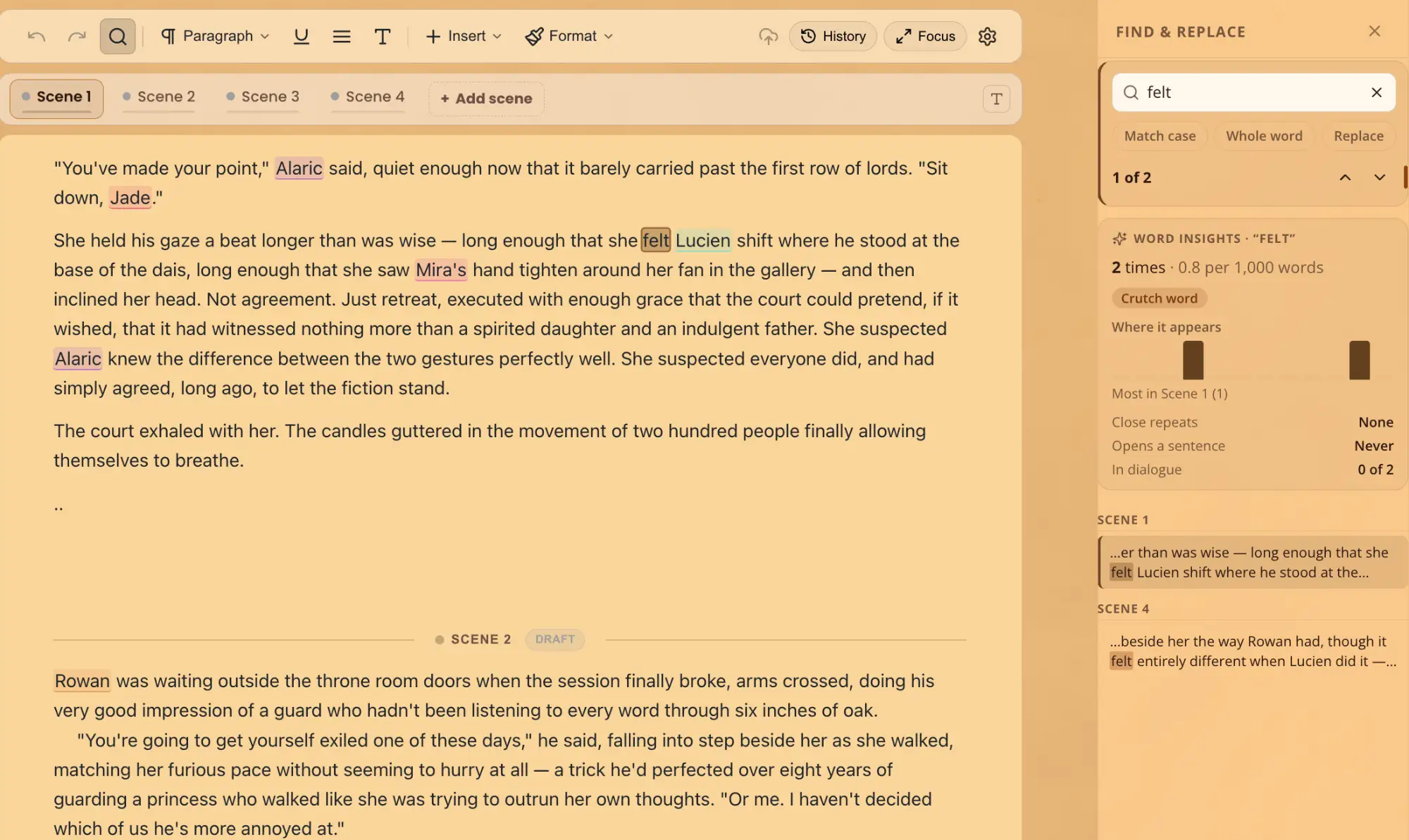
In WriteO, Find & Replace searches every scene in the chapter at once. Its Word Insights panel shows how often a word appears, flags common crutch words, and points to the scene that leans on it most.
Watch for "could." "She could see the lanterns" becomes "Lanterns burned along the dock."
Cut "seemed" and "appeared." "He seemed calm" hedges. Commit: "He didn't blink."
Use filters on purpose in deep POV breaks. When a character is dazed or drugged, a filter word can signal that distance.
4. Swap named emotions for physical proof
When you name an emotion (angry, nervous, jealous), you're giving a label. When you show what the body does, you're giving evidence.
Why it works: Readers believe what they can picture. A specific action also tells them how strong the emotion is, which a label can't.
Example:
Before: "Sera was suspicious of him."
After: "Sera kept her knife hand free every time he came near."
Before: "Tobias was afraid of being caught."
After: "Tobias sat with his back to the wall and his eyes on the door."
Try this: Highlight every emotion word in a scene. Replace each one with an action, a gesture, or a choice that proves it.
Skip the clichés. Racing hearts and clenched jaws are invisible from overuse. Find the gesture only this character would make.
Use objects as mirrors. Sera polishing a pistol that's already clean shows nerves better than any trembling hand.
Show the cover-up. A character hiding an emotion is often stronger than one showing it. Tobias laughing too easily tells us he's afraid.
5. Kill on-the-nose dialogue
On-the-nose dialogue is when characters say exactly what they think and feel. Real people dodge, deflect, and answer the question beneath the question.
Why it works: Tension lives in the gap between what's said and what's meant. Readers lean in to close that gap themselves.
Example:
Before: "Why did you lie to the officer for me?" "Because I'm starting to trust you."
After: "Why did you lie to the officer for me?" "Your gold hasn't cleared yet. Dead men don't pay."
She still hasn't admitted anything, but the reader knows.
Try this: Find one line where a character states their feelings outright. Rewrite it so they change the subject, make a joke, or answer with an action.
Cut greetings and goodbyes. "Hello," "How are you," and "See you later" rarely earn their space.
Remove names in two-person scenes. Characters rarely say each other's names mid-conversation. Use one only for emphasis.
Swap adverb tags for action beats. "He said angrily" becomes "He slammed the ledger shut."
6. Hunt crutch words, then read it aloud
Crutch words are the soft fillers every writer leans on: just, really, suddenly, began to, started to, very. Once they're gone, reading aloud catches the rhythm problems your eye skips.
Why it works: Crutch words delay or soften the action. Your ear notices monotony, such as five sentences of the same length in a row, faster than your eye does.
Example (crutch words):
Before: "Tobias suddenly started to reach for the hidden blade."
After: "Tobias reached for the hidden blade."
Example (rhythm):
Before: "The officer stepped closer. Sera smiled. Tobias looked away. The officer paused."
After: "The officer stepped closer. Sera smiled, wide and easy, while Tobias studied the floorboards. The officer paused."
Try this: Keep a personal list of your top five crutch words and search for them before every revision. Then use text-to-speech on the chapter and mark every spot where your attention drifts.
Cut "that" where it isn't needed. "She knew that he lied" reads cleaner as "She knew he lied."
Kill stacked adjectives. "The dark, cold, silent hold" becomes "The silent hold." Pick the strongest one.
End sentences on the punch word. "He drew a knife, quick as anything" lands softer than "Quick as anything, he drew a knife."
Putting it all together
Here's one paragraph before and after all six techniques. It's the same scene, but with a completely different pulse.
Before:
Sera woke early and went up on deck, where she suddenly saw the customs ship approaching. She felt nervous because she was starting to suspect Tobias was hiding something. "Are you in trouble?" she asked. "Yes, the crown is hunting me," he admitted sadly.
After:
The customs ship was already alongside. Sera found Tobias below, his back to the wall, a blade half-hidden in his sleeve. "Are you in trouble?" He sheathed it. "Do you want the rest of the gold or not?"
What changed: The scene enters late at the moment of threat. Filter words, crutch words, and named emotions are gone. The dialogue dodges, so the reader works out the truth before Sera says it.
Common mistakes
Line editing before structural editing. You'll spend hours on sentences inside scenes that don't survive the next pass.
Cutting every filter word. Keep one when the act of noticing matters. "She noticed his ring was missing" can be the whole point of a scene.
Over-correcting into vagueness. Removing every emotion label can leave readers guessing. If a gesture is ambiguous, one clear label is fine.
Making all dialogue cryptic. Subtext needs contrast. Let characters speak plainly sometimes, so the dodges stand out.
Editing right after drafting. Rest the chapter for a few days at least. You can't spot gaps while your memory is still filling them in.
Treating feedback as a to-do list. When a reader flags a problem, trust the symptom, but find your own fix.
Sanding off your voice. Not every fragment is a mistake. If a rule flattens the way your narrator sounds, break the rule on purpose.
Editing every chapter to the same length. Pacing needs variety. A short, sharp chapter after a long one can hit like a slammed door.
Never finishing. Endless revision is often fear in disguise. Set a deadline for each pass and move on when it arrives.
10 quick wins for any revision
These small habits make every pass faster and sharper.
Change the font before you edit. A new typeface tricks your brain into reading the page as fresh.
Edit on paper once. Printed pages reveal pacing problems that screens hide.
Track one thread per pass. Follow only the romance subplot through the whole draft, then only the magic system.
Make a scene list. One line per scene, with its want and shift. Gaps and repeats show up instantly.
Check chapter endings in a row. Read only the last lines of each chapter. Every one should pull forward.
Search for "was" + "-ing." "She was running" becomes "She ran" in most cases.
Trim the first 50 pages hardest. That's where most writers over-explain the world.
Give each character a verbal fingerprint. Tobias speaks in formal, full sentences. Sera clips hers short. Cover the names and test it.
Keep a cut file. Moving deleted lines into a separate document makes cutting painless, since nothing is truly lost.
Stop at "different," not "perfect." If an edit only changes the draft without improving it, you're done.
Your editing checklist
Run through this list for every chapter, in order:
The plot holds together from start to finish.
Every scene has a clear want and a clear shift.
Each scene starts at the tension and ends before it fades.
Filter words are cut, unless noticing is the point.
Named emotions are replaced with physical proof.
At least one line of dialogue dodges instead of declares.
Your personal crutch words are searched and cut.
The chapter has been read aloud, and the flat spots are fixed.
Edit in passes with WriteO
WriteO keeps every pass in the same place you wrote the draft, so there are no copies of your manuscript to juggle.
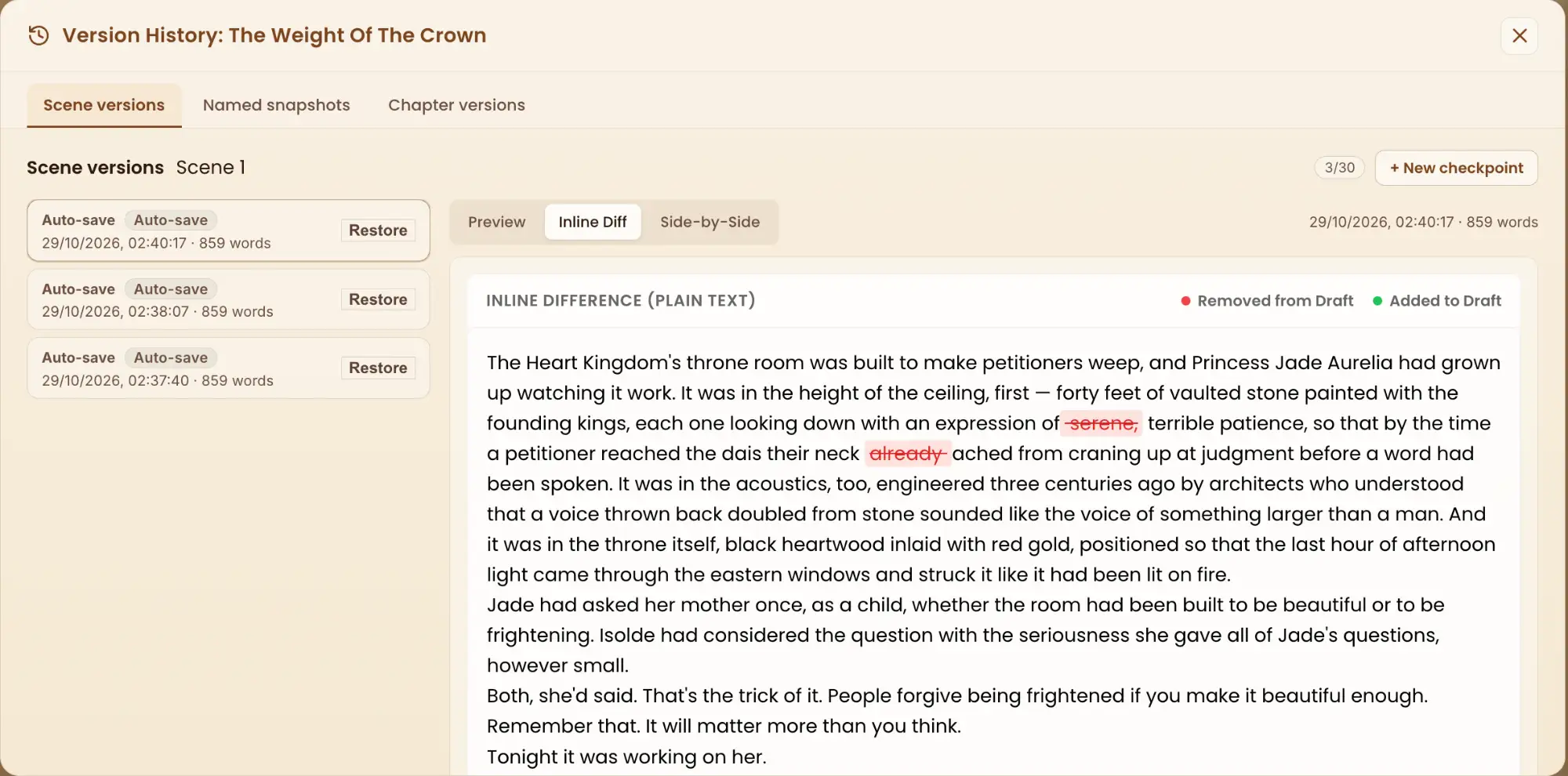
Save a checkpoint before each pass. Version History keeps autosaves, named snapshots and chapter versions, and lets you compare an older version with the current scene before you restore anything.
Track where each chapter stands. Chapter statuses run from Draft Complete to Under Review to Final, so you can see which chapters have had their line pass.
Search the whole chapter at once. Find & Replace covers every scene, and Word Insights shows how often your crutch words appear.
When the last pass is done, our guide on how to format a book for self-publishing covers what comes next.
Frequently Asked Questions
QHow many times should you edit a novel?
There is no fixed number, but most novels need at least three passes: structure, scenes and lines. Stop when an edit makes the draft different rather than better.
QShould I edit while I am still drafting?
QWhat is the difference between structural editing and line editing?
Structural editing checks whether the plot, scenes and character arcs hold together. Line editing works sentence by sentence on clarity, rhythm and word choice. Do structure first.