

Writing 50,000 words in November sounds ambitious. That's roughly the length of a short novel. And if you've ever attempted a writing challenge, you know the hardest part usually isn't coming up with ideas. It's showing up every day, keeping your story moving, and finding time to write when life gets in the way.
The nonprofit behind NaNoWriMo shut down in 2025 after more than 20 years, but the challenge itself is still going. Every November, writers set out to draft 50,000 words in 30 days, on their own, with a friend or in an online group. Some still call it NaNoWriMo; others call it Novel November.
You don't need NaNoWriMo to take on the challenge. You don't need an official event, a complicated writing system, or a perfectly planned novel. You need three things:
A realistic writing routine
A story you're excited to tell
A plan that makes your goal feel manageable
Whether you're starting a new manuscript, returning to an unfinished draft, or simply challenging yourself to write more consistently, this guide walks you through it in four parts: preparing before you start, writing through the month, handling the hard days, and staying motivated to the finish.
Starting late? If November has already begun, you haven't missed it. Jump to section 8, recalculate your daily target, and start from today.
Part 1: Before You Start
1. Understand the 50,000-word challenge
November has 30 days, so 50,000 words means averaging about 1,667 words a day. Breaking that into smaller milestones makes it far less intimidating.
Timeframe | Word count target |
Daily | 1,667 words |
Weekly | 11,667 words |
10 days | 16,667 words |
15 days | 25,000 words |
20 days | 33,333 words |
25 days | 41,667 words |
30 days | 50,000 words |
Remember that 1,667 is an average, not a daily rule. Some days you'll write 2,500 words; others might only give you 500. Instead of treating every day as pass-or-fail, focus on your overall progress.
2. Choose a story you can actually finish
One of the biggest mistakes writers make is choosing an idea too complicated to manage in a month. You don't have to abandon ambitious stories, but understand their scope before you commit. Start by answering five questions:
What is my story about?
Who is the main character?
What do they want?
What's stopping them from getting it?
What changes by the end?
You don't need full character biographies or an elaborate plot, just enough direction to avoid staring at a blank page. Then write a one-paragraph premise. It's the thing you return to whenever you lose your way.
Example premise: When a burned-out baker inherits her grandmother's failing bakery in a small coastal town, she has one summer to turn it around before the bank takes it. But saving the shop means confronting the family secret that drove her away, and deciding whether she's running toward a new life or away from an old one.
Notice what it covers in just two sentences: a character, a goal, an obstacle, a deadline, and a hint of how she'll change.
3. Create a simple outline
You don't need to outline every chapter, but a rough roadmap saves hours of indecision. Divide your story into three sections:
Section | Word range | What happens |
Beginning | 0–12,000 | Introduce your protagonist, the setting, and the central conflict; give readers a reason to keep turning pages |
Middle | 12,000–37,000 | Develop relationships, add complications, raise the stakes, and push your protagonist toward difficult decisions |
Ending | 37,000–50,000 | Bring the conflict to its peak, resolve major storylines, and land a satisfying conclusion |
If you're a discovery writer who figures out the story as you go, keep it flexible. A list of key scenes or plot points is enough. The goal isn't to plan away the fun; it's to make sure you always know where to go next. If you'd like more structure, our guide on how to outline a novel walks through it step by step.
Plan it in WriteO. A good place to build this roadmap is WriteO, which brings planning, writing, and book design into one workspace. Before you start drafting, you can map your plot points and chapters there, then draft and edit straight into the same chapter structure as the month goes on. Your outline and manuscript stay side by side, so you spend less time switching between apps and more time writing.
Part 2: Writing Through November
4. Break your goal into weekly milestones
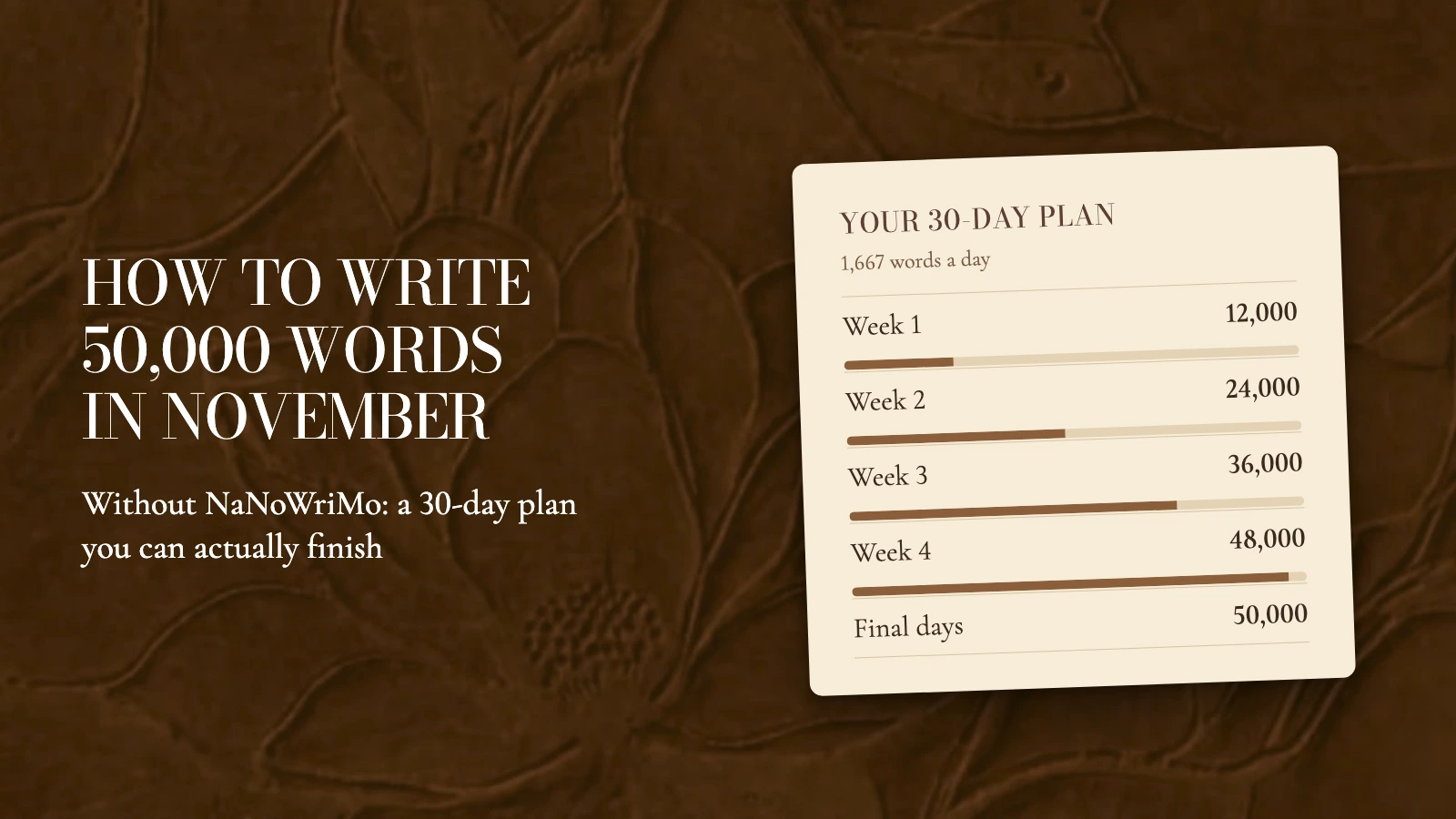
The goal shrinks when you stop thinking about the whole manuscript and focus on one week at a time. These are cumulative targets, not additional words each week:
Week | Cumulative target | Main focus |
Week 1 | 12,000 words | Introductions and setup |
Week 2 | 24,000 words | Developing the conflict |
Week 3 | 36,000 words | Raising the stakes |
Week 4 | 48,000 words | Climax and resolution |
Final days | 50,000 words | Reaching your goal |
The weekly numbers are rounded up a little from 1,667 a day, so you build a small buffer as you go and still have two days in hand at the end.
Adjust them to fit your schedule. If weekends are your most productive days, use them to build a buffer for busier weekdays.
Try a minimum and a bonus target. Aim for 1,200 words as your floor and 2,000 as your stretch goal. You keep making progress without feeling like you've failed whenever you miss the ideal number.
5. Build a routine that fits your life
Waiting for inspiration isn't a reliable strategy on a deadline. Make writing part of your day instead:
Morning writing: write before checking email or social media.
Evening writing: set aside time after work or classes.
Writing sprints: work for 20–30 minutes without editing or checking your phone.
Multiple sessions: split your daily target into smaller pieces, such as 500 words in the morning, 500 in the afternoon, and 667 in the evening.
What a sprint looks like: Set a timer for 25 minutes and put your phone in another room. Glance at your outline and pick one scene. Write without rereading or deleting, even if a sentence comes out clumsy. When the timer ends, note your word count and one line about where the scene goes next, so you can pick it up instantly. Take a five-minute break, then go again. Two or three sprints can cover a full day's target.
The best routine is the one you can realistically maintain. For more ways to protect your writing time, see our 7 habits for staying productive while writing a novel.
6. Stop editing while you're drafting
This is one of the most important rules of a fast-drafting challenge. You'll notice awkward sentences, plot inconsistencies, and dialogue that doesn't sound right. Resist the urge to fix everything now: drafting and editing need different kinds of focus, and switching between them kills momentum.
To keep moving:
Leave placeholders like [RESEARCH THIS] or [FIX DIALOGUE].
Highlight sections to revisit later.
Jot down notes about plot changes instead of rewriting whole chapters.
Keep going, even when a scene isn't perfect.
Your first draft is allowed to be messy. You can make it beautiful later.
Part 3: When Things Get Hard
7. Have a plan for writer's block
At some point you'll get stuck. Instead of abandoning the session, change your approach based on what's actually wrong:
If you're stuck because… | Try this |
You don't know what happens next | Write from another character's perspective · skip ahead to a scene you're excited about · ask what your protagonist would least want to happen · add a complication that breaks their plan |
The writing feels flat | Add a meaningful conflict · give characters something to disagree about · change the setting · reveal a new piece of information |
You're mentally exhausted | Take a short break · revisit your outline · jot bullet points for the next scene · set a smaller target and rebuild momentum |
You don't have to produce your best writing every day. Sometimes simply returning to the manuscript is the achievement.
8. Don't let falling behind end your challenge
You'll almost certainly have days when writing isn't possible. Classes, work, family, and exhaustion all get in the way. The worst thing you can do is miss one day and decide the whole challenge is ruined.
If you're behind, recalculate:
Words per day = words remaining / days left
For example, if you've written 15,000 words by November 12, you have 35,000 words left and 18 days to go. That's about 1,945 words a day. You can also use buffer days or longer weekend sessions to catch up gradually.
Starting late works the same way. Begin on November 10 and you have 21 days left, so 50,000 words means about 2,381 a day. If that's too much, set a smaller goal, like 30,000 words, and the daily target drops to about 1,430. Writing in WriteO? Join the November Writing Challenge and every word you type from the day you join counts toward your goal.
Just don't sacrifice your sleep or well-being to protect a number. Adjusting your goal is better than turning writing into something you dread.
Part 4: Staying Motivated to the Finish
9. Find your writing community
Writing is solitary, but finishing a novel doesn't have to be. Other writers make November feel less overwhelming: you can share progress, celebrate milestones, swap ideas, and find motivation when your word count stalls. A single conversation, prompt, or another writer's progress update might be exactly the push you need.
A few ways to make a community work for you:
Daily check-ins: post your word count each evening. Knowing someone will ask makes it easier to show up.
Group sprints: join other writers for a timed session and compare totals afterward.
Accountability partners: pair up with one writer and trade weekly goals.
Milestone celebrations: mark 10,000, 25,000, and 50,000 words together.
10. Remember that 50,000 words don't have to be perfect
A common misconception is that you should end November with a polished manuscript. You shouldn't. A 50,000-word first draft is a starting point. It may contain plot holes, inconsistent characters, unnecessary scenes, and paragraphs you'll eventually delete. That's part of the process.
Your November goal is to build the foundation of a story, not a publication-ready book. Revision, restructuring, and editing come after. Don't let perfectionism stop you from finishing what you started. When you get there, our guide on how to edit your novel breaks the work into passes.
11. Make November about showing up
You might reach 50,000 words. You might reach 35,000. You might finish a complete first draft. Whatever the final number, you'll have spent a month making time for a story that mattered enough to write.
The real achievement isn't just the word count. It's building the habit of showing up, learning how you work best, and proving you can make progress even when inspiration isn't around.
How WriteO Handles This
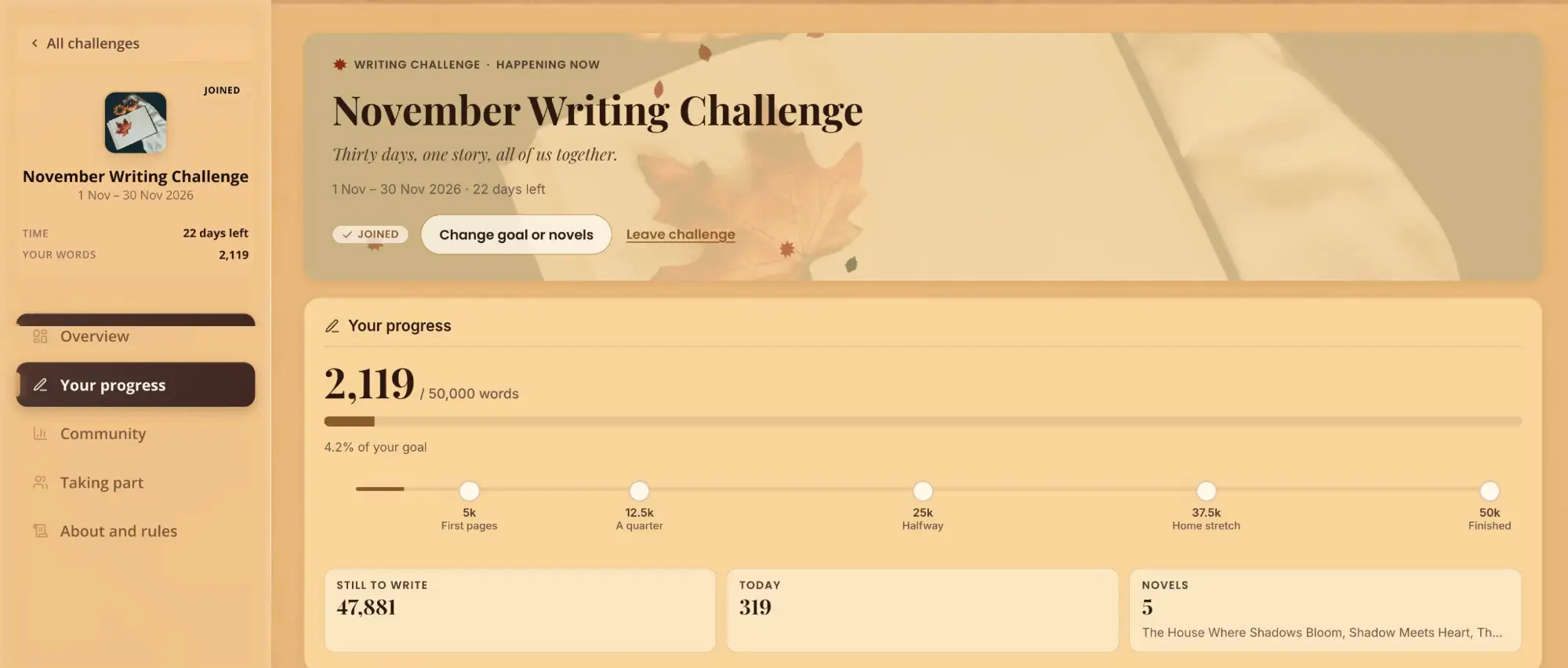
This November, WriteO is also running its own free November Writing Challenge, open on every plan. You pick a goal (10,000, 25,000, 50,000 words or your own), choose which novels count, and every word you type in WriteO counts toward it. Pasted text doesn't count. Join any time and your words count from the day you join.
The challenge page shows what you've written, what's left and today's count, with milestones along the way and a Words per day chart that marks your best day. You can also see the community total and which of your friends have joined.
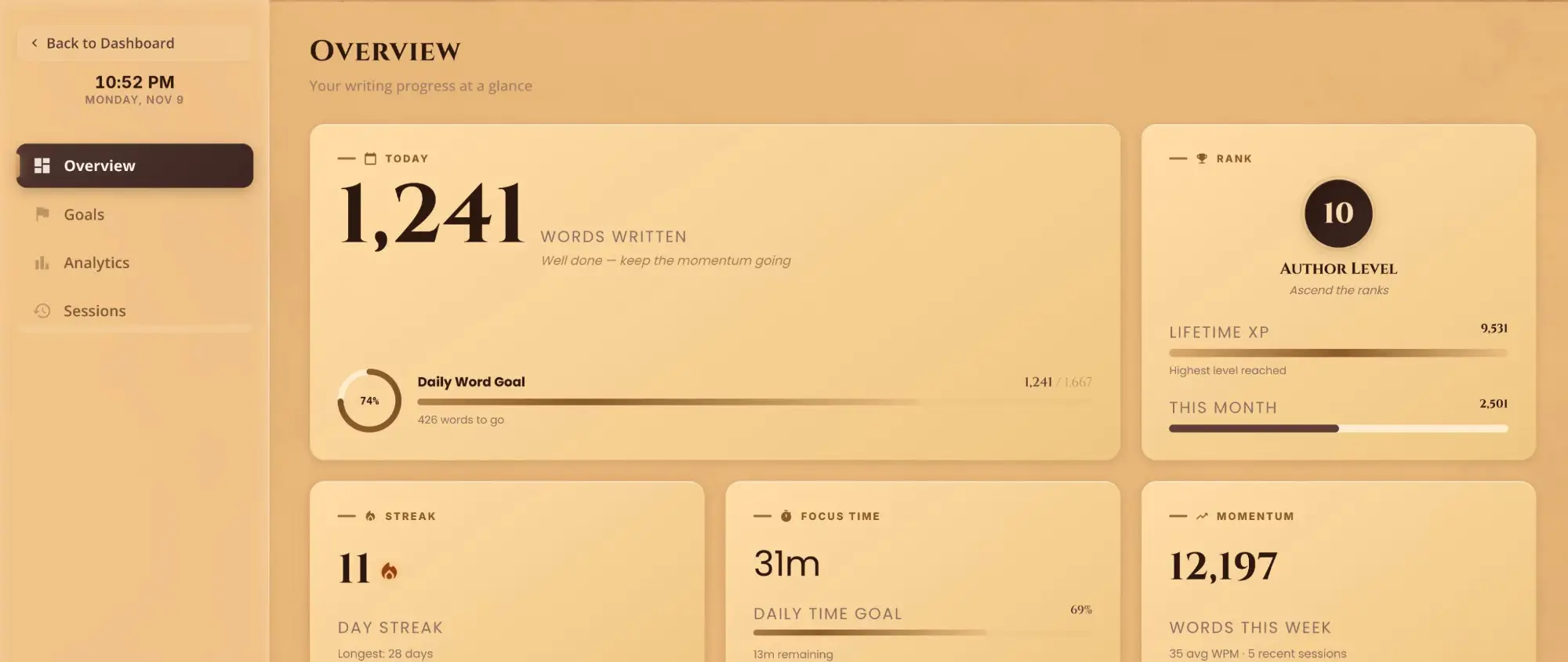
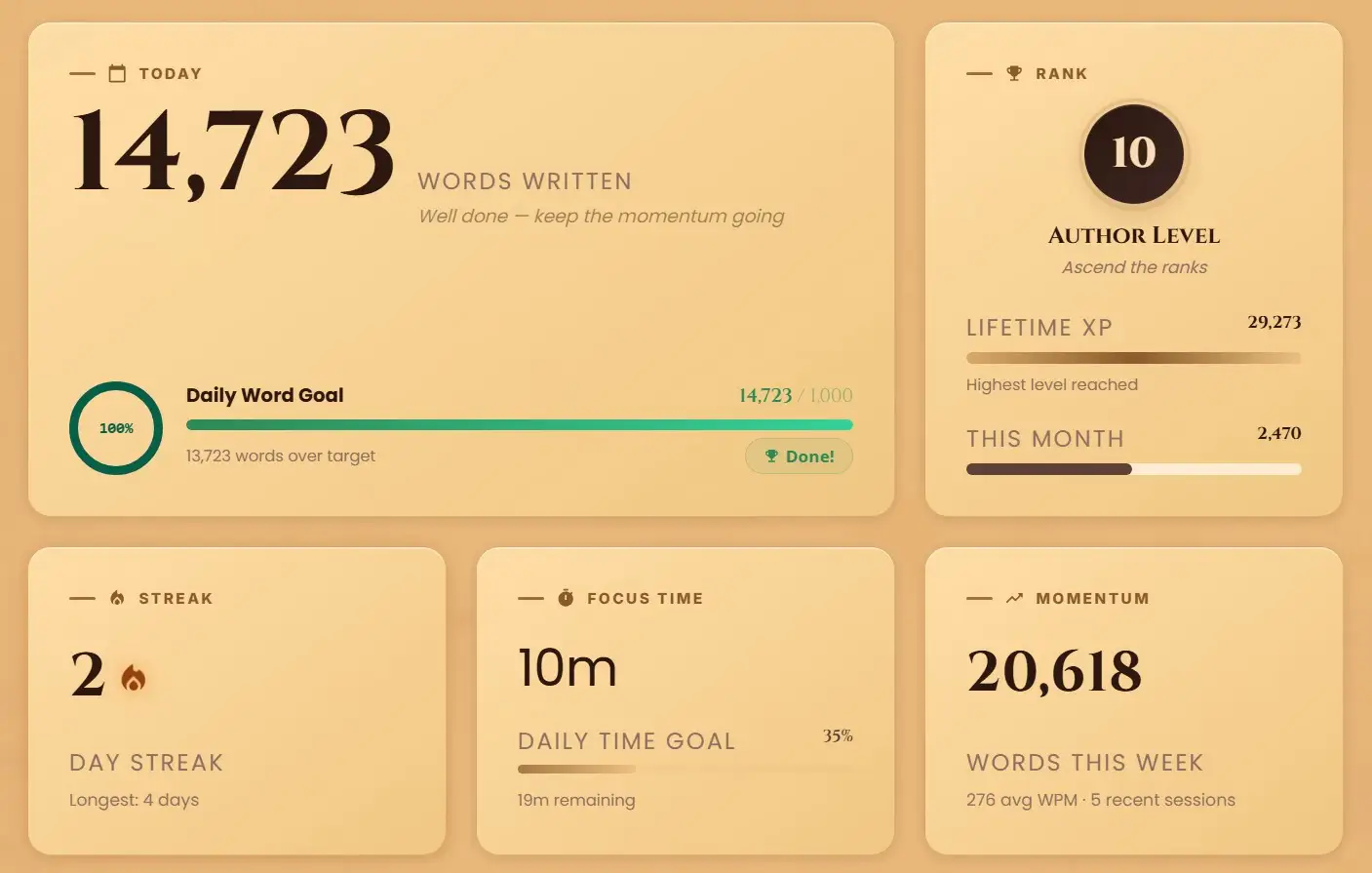
Hitting 50,000 words is easier when you can see your progress. WriteO's Progress dashboard tracks it for you as you write. Set a daily goal, like 1,667 words, or a 50,000-word goal for the whole novel, then just write. Overview shows today's words, your streak and your weekly total, Sessions lists every sprint with your speed, and Analytics shows when you write best.
The Free plan shows seven days of history; PRO and Lifetime keep it all, including a 365-day writing heatmap.
Ready to Start Writing?
You don't need NaNoWriMo to write a novel in November. You need a story, a plan, and the willingness to keep going. Set your goal, open your manuscript, and write the first word. Don't wait for the perfect moment or the perfect routine. The best way to finish a novel is to begin it.
Write, organize, and connect with WriteO. When you need one space to plan, write, organize chapters, design your cover and interior, and export to EPUB, PDF, or DOCX, give WriteO a try. And you don't have to write alone. Join the WriteO community to share your progress and keep each other accountable all month:
Discord (the Tavern): connect with fellow writers, join discussions, and find your writing people.
Threads: share your goals, talk about your work-in-progress, and stay accountable.
Instagram: follow along for writing tips, updates, and creative inspiration throughout November.
Frequently Asked Questions
QIs NaNoWriMo still running?
The NaNoWriMo nonprofit shut down in 2025, so there is no official site or event anymore. The challenge carries on: writers still aim for 50,000 words every November, on their own, with friends or in online communities like WriteO's Discord.
QIs there a free NaNoWriMo alternative?
QHow many words a day do you need to write 50,000 words in November?
About 1,667 words a day for 30 days. If you miss days or start late, divide the words you have left by the days left to get your new daily target.
QCan I start the challenge late?
Yes. Start on November 10 and you need about 2,381 words a day to reach 50,000. You can also pick a smaller goal, such as 30,000 words, which works out to about 1,430 a day.