


Jaime Lannister pushed a child out of a window in the first chapter of A Game of Thrones.
By book three, readers were writing fan letters about him.
That is not an accident. That is craft. Understanding exactly how George R.R. Martin pulled it off is the difference between a morally grey character who grips readers and one who just reads as unlikeable.
This is the guide to that craft.
TL;DR Morally grey characters work when readers understand before they judge. Your job is not to make dark behaviour excusable. It is to make it legible. Front-load the humanity, make the internal logic airtight, let the darkness cost something real, and never redeem your character faster than they deserve. The tension between understanding and disapproval is the engine. Protect it. |
What Morally Grey Actually Means (And What It Does Not)
A morally grey character is not a villain with a sad origin story.
It is not a hero who occasionally loses their temper. It is not a character who does one bad thing and spends the rest of the book atoning for it.
A morally grey character exists in the space where the reader understands and disapproves at the same time. That tension is not a problem to solve. It is the whole point.
Snape is petty and cruel to teenagers for six entire books. Walter White starts cooking meth to protect his family and ends doing it because power feels better than dying quietly. Joe from YOU is a stalker and a killer who narrates his obsession so intimately that readers caught themselves rooting for him. Gillian Flynn has said she wanted readers to feel complicit in Amy Dunne's plan before they fully understood what the plan was.
The discomfort is not a bug. It is the feature.
The Sympathy Budget
Before you make a reader watch your character do something dark, you need to make a deposit.
Every time your character does something recognisably human, every moment of genuine care, sharp wit, or ordinary vulnerability, you earn credit. Every dark action spends it. Go into the red too early and readers stop caring in the particular way that closes them off rather than draws them in.
Rowling spent six books with Snape. Six books of bitterness, favouritism, and cruelty toward a child who had done nothing to deserve it. By the time the "Always" reveal arrived in book seven, readers had accumulated enough history with him that the grief landed like something personal.
Martin gave Cersei a coherent worldview before he gave her atrocities. Her chapters in A Feast for Crows are studied precisely because readers arrive there already understanding why she does what she does. The deposit comes first. The withdrawal follows.
This is the sequence. Do not reverse it.
The 3 Types of Morally Grey Characters
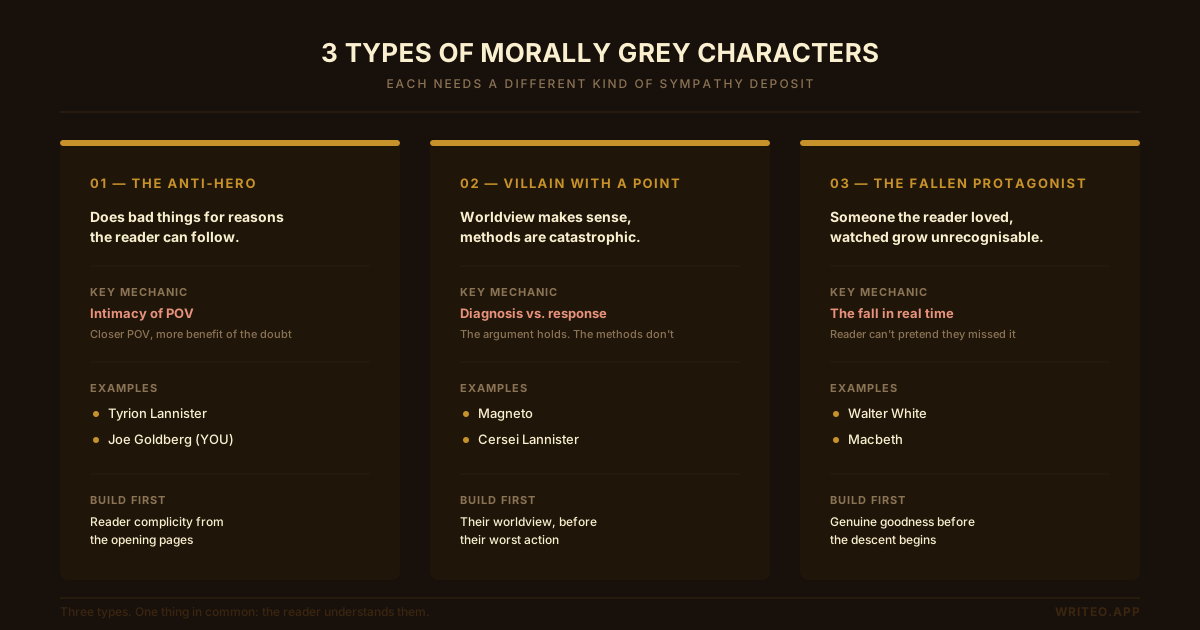
The anti-hero does bad things for reasons the reader can follow from the inside. Tyrion Lannister schemes and drinks and plays the game, but his targets tend to have it coming. Joe from YOU frames every violent act as love. The reader is inside the logic and finds it uncomfortably convincing. The key mechanic is intimacy. The closer the POV, the more the reader extends the benefit of the doubt.
The villain with a point has a worldview that makes structural sense even when the methods are catastrophic. Magneto watched the Holocaust and concluded that oppressed groups must seize power or be annihilated. That is not a delusional conclusion. The argument holds. The methods are monstrous. The gap between the diagnosis and the response is where the grayness lives. Cersei belongs here too. She is right about almost everything she observes about power. She is wrong about almost everything she does in response.
The fallen protagonist is someone the reader loves, watched making worse and worse choices until the person they were at the start is no longer recognisable. Walter White is the definitive example. Vince Gilligan described the goal as taking Mr Chips and turning him into Scarface. These characters are painful precisely because the fall is watched in real time. The reader cannot pretend they did not see it happen.
Knowing which type you are writing shapes what you need to build first. The anti-hero needs reader complicity from the opening pages. The villain with a point needs their worldview established before their worst action. The fallen protagonist needs genuine goodness visible on the page before the descent begins.
TIP: Match the Front-Loading to the Type Each type makes a different kind of withdrawal from the sympathy budget. Build the deposit that matches the withdrawal you are planning, not a generic sympathetic backstory. And when planning which story layers to lock before you draft, see our guide on how to outline a novel for a framework that applies to character arcs. |
How POV Changes Everything
The same character can read as compelling or repellent depending entirely on how close the narrator sits to them.
First person is the most powerful tool for moral grayness because it collapses the distance between the character's logic and the reader's experience. Joe Goldberg in YOU narrates his obsession and violence in the same register he would use to describe making breakfast. He never wavers. He never questions himself. And because readers are inside that voice from page one, they find themselves following his reasoning before they have had a chance to examine it. That is the trap Kepnes builds. It works because the POV builds it.
Close third person gives readers sympathy with some distance. Tyrion Lannister is written in close third. Readers understand his perspective completely but retain just enough separation to watch him make choices they might not endorse. That distance is part of why he is so beloved. Readers feel close to him without feeling implicated by him.
Omniscient narration creates the most reader autonomy. The narrator can show a morally grey character's logic and the damage it causes simultaneously, letting readers hold both without the text directing a verdict. This is why omniscient narration is common in literary fiction featuring morally ambiguous characters.
Martin's choice to give every major character their own POV chapters is itself a structural argument about morality. Cersei's chapters do not make her sympathetic in a simple way. They make her legible. That legibility is more powerful than sympathy, because it implicates the reader in the act of understanding rather than just the act of feeling.
TIP: Choose POV Intentionally Ask yourself how much you want readers to feel complicit versus how much you want them to retain judgment. First person maximises complicity. Omniscient maximises judgment. Close third sits in between. The answer should shape your POV choice before you draft a single scene, not after. |
5 Mechanics That Make Morally Grey Characters Work
1. Their internal logic must be airtight
Your character must believe they are justified in a way that holds up to pressure. If the reasoning collapses when examined, the grayness collapses with it.
Amy Dunne's theory about how men treat women is not wrong about most of it. That is what makes her so unsettling. Her diagnosis is accurate. Her response is murderous. The logic holds. The application is catastrophic. That gap is where the character lives.
2. They must love something genuinely
A character who cares about nothing is hollow, not grey. Give them an attachment that is real, something that costs them, something they would not sacrifice even when convenient. Cersei loves her children completely. Snape loves Lily Potter to a degree that warps his entire professional life. The love does not excuse the damage. It is the thread that keeps readers attached through it.
3. Their worst choices must cost them something permanent
If your character does something terrible and faces no lasting damage, no fractured trust, no guilt that lingers, the darkness reads as consequence-free. That is power fantasy, not moral grayness.
Breaking Bad is relentless about this. Every choice Walter makes costs him something he cannot recover. The ending is not a surprise. It is an accounting.
4. Let the reader judge on their own
Characters who announce their own complexity are performing it, not living it. The moment your character starts explaining what kind of person they are, you have replaced the reader's experience with a summary of it. Let the character act. Trust the reader to arrive at the discomfort without being walked there.
5. Understanding before judgment, always
Understanding first. Judgment second. This is the order and it is not negotiable. If you place a dark action before the reader has access to the logic behind it, you produce a character readers simply dislike. Dislike is a different response than the one you are building toward. Sympathy and approval are not the same thing. You need the first. You can afford to lose the second.
COMMON MISTAKE: The Sad Backstory Trap A tragic childhood explains a character. It does not excuse them. These are different things, and conflating them produces grayness that reads like a defence brief. The backstory should make the present behaviour legible, not forgivable. Readers will grant understanding. They will not grant a free pass. If your character's darkness resolves cleanly because of what happened to them, you have not written moral grayness. You have written an excuse with chapters around it. |
Case Study: How Breaking Bad Built the Greatest Fallen Protagonist in Television
Walter White begins the series as a man the audience pities.
He is brilliant, underestimated, dying of cancer, and working a second job at a car wash to keep his family financially stable. Gilligan front-loads everything. Before Walter does a single morally questionable thing, the audience has already deposited enormous sympathy. They want him to win.
The first withdrawal is almost nothing. Walter gets into the drug trade to leave money for his family after he dies. The justification is airtight and the audience accepts it completely. At this stage Walter is not grey. He is a good man making a desperate choice.
Then Gilligan begins the slow turn.
Walter's lie to himself is that it is all for the family. The show dismantles that lie incrementally. He turns down a legitimate offer of financial help from his former business partner because it would mean admitting he needs it. He chooses pride over practicality. He lets a man die rather than compromise a business arrangement. He poisons a child to manipulate a relationship.
Each step is small enough that the audience follows. Each step is permanent.
The moment the lie fully collapses comes in season four. Skyler asks Walter why he does not simply leave if the situation is so dangerous. His answer is four words: "I am the danger."
That line is the pivot of the entire series. It is the first moment Walter stops pretending even to himself. And because Gilligan has spent four seasons building the deposit, the audience watches Walter's self-revelation with something closer to recognition than shock. They knew. They just waited for him to know.
The final season is the accounting. Walter loses his family, his freedom, his health, his money, and finally his life. Nothing is recovered. Nothing is redeemed. The ending is devastating precisely because it is honest.
What Gilligan understood is that the tragedy only works if the fall is earned and the consequences are real. A Walter White who escapes, who redeems himself, who gets the family back would be a lie. The grayness requires the full cost.
Morally Grey Love Interests: What Romantasy Gets Right
Romantasy readers are arguably the most sophisticated consumers of morally grey characters in contemporary fiction.
Kaz Brekker in Six of Crows is a criminal who uses people as instruments and has caused genuine harm long before the first page begins. He is also one of the most beloved love interests in the genre. Rhysand in A Court of Thorns and Roses appears to be a villain for an entire book before his perspective is revealed. Cardan in The Cruel Prince is actively cruel to the protagonist for most of the story. The Darkling in Shadow and Bone is a manipulator willing to sacrifice thousands for a cause he has convinced himself is righteous.
These characters work for reasons that are specific to the genre.
Romance and romantasy operate with an implicit contract. Readers understand that the emotional stakes are centred on the relationship, and that the relationship will, eventually, provide some form of safety or resolution. This contract gives writers more room to take the love interest into darker territory because readers are not afraid of being permanently abandoned to the discomfort. They trust the arc even when they are not sure of the destination.
The grayness of romantasy love interests also tends to be directional. The violence and manipulation is most often aimed at antagonists or contextualised through the relationship's arc, rather than arbitrary cruelty toward innocents. Readers can follow the logic and retain a thread of hope without endorsing the methods.
What kills this archetype is when writers confuse grey with dangerous in a way that removes the reader's sense of agency. A love interest who is controlling or cruel in ways the text presents as romantic rather than complicated is not morally grey. That is a different problem entirely.
The test is whether the text knows the difference. The best romantasy writers know exactly what their love interest is doing and why, and they trust readers to see it clearly even while rooting for them.
TIP: The Romantasy Grayness Check Ask whether the narrative endorses your love interest's worst behaviour or simply portrays it. Portraying darkness honestly, letting it cost something in the relationship, letting the protagonist see it clearly, is morally grey. Framing manipulation as passion without acknowledgment is something else. The line matters, and readers notice when it is crossed. |
The Mistakes That Kill Moral Grayness
The soft landing.
You build a character who does genuinely dark things, then redeem them too fast and too completely. Partial redemption that costs the character something real is more interesting than full redemption that costs them nothing. If readers feel relieved, you have lost the tension. The goal is not relief. It is ambivalence.
Relentless darkness.
Readers need contrast. They need moments where the character is funny, tender, competent, or just ordinary. Tyrion is genuinely funny. Snape is capable of extraordinary loyalty. The contrast is what gives the dark moments weight instead of letting them blur into numbness.
Telling rather than showing the complexity.
Other characters saying "they are not all bad" is not characterisation. It is a stage direction. Let the reader arrive at the complexity through the character's own choices and logic. If you are explaining the grayness, you have not built it yet.
Overcorrecting out of fear.
Some writers get anxious that readers will hate their character and start softening every dark choice until the grayness has been quietly written out. Commit to the complexity. A reader who feels uncomfortable is not a reader you have lost. A reader who feels nothing is.
"The villain is the hero of the other story." George R.R. Martin This is the operating principle behind every morally grey character who works. They are not broken heroes or humanised villains. They are people whose story, told from their own perspective, makes complete sense. Your job is to make that perspective visible without endorsing it. The reader should understand the other story even as they watch it cause damage. |
The Closing Test
Before you finalise a morally grey character, run this.
Write a scene from their POV where they justify their worst action to themselves. Not to the reader. To themselves, in the full privacy of their own logic. If you cannot make it convincing, you do not have their internal world yet. Keep writing until the reasoning holds under pressure.
You do not have to use it in the book. But every scene that character appears in should be informed by that logic, whether the reader sees it or not.
The character who has a complete and coherent answer to why they did what they did, even if no one ever asks them, is the character readers cannot stop thinking about after the book closes. For more on planning which elements of your character to lock before you draft, see our plotter vs pantser guide.
What Readers Are Really Asking When They Love a Morally Grey Character
When a reader says they love Tyrion, or Snape, or Amy Dunne, they are not saying they approve.
They are saying: I understood them. I stayed with them. I felt something I could not fully name.
That is the response you are building toward. Not agreement. Not comfort. The specific, uncomfortable feeling of understanding someone you probably should not.
That feeling is the mark of a morally grey character done right.