

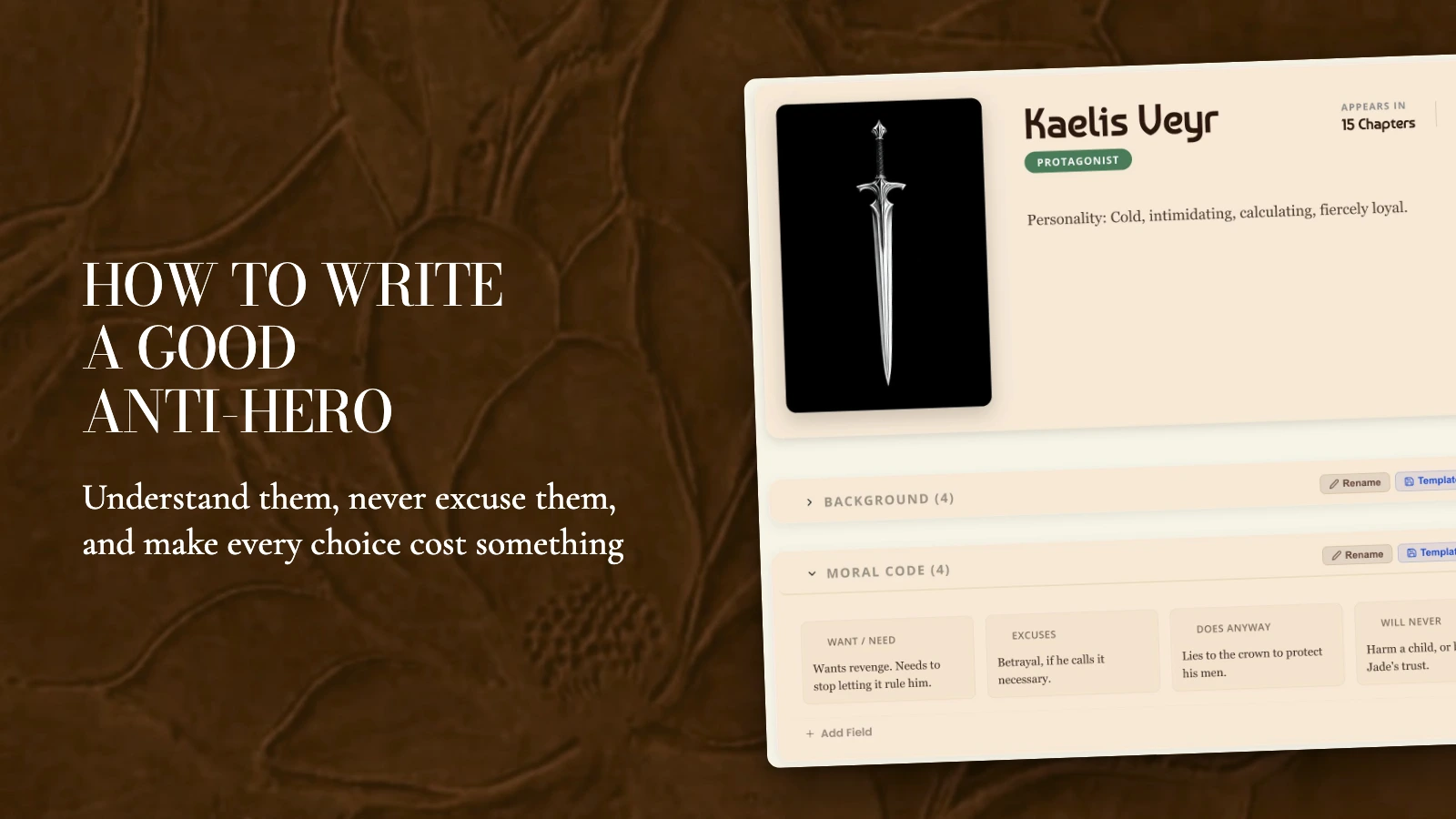
What makes an anti-hero different?
A traditional hero does the right thing for the right reasons. A villain pursues harmful goals and is usually willing to destroy anyone in the way. The anti-hero sits in the uncomfortable space between them: someone who may want something admirable, but whose methods, motives or flaws make it impossible to call them a hero.
Readers are drawn to these characters because they feel honest. Most of us know what it is to want something good and still handle it badly, to justify a choice we would criticize in someone else, or to protect the people we love at someone else's expense. An anti-hero puts those instincts under a magnifying glass.
However, a sarcastic, cruel or emotionally unavailable protagonist is not automatically an anti-hero. Rudeness is a personality trait, not a moral framework. A real anti-hero is defined by the tension between what they want, what they believe and what they are willing to do to get it.
That tension is the heart of this guide. The goal is not to make readers excuse your anti-hero. It is to make readers understand them, and then feel the weight of everything they have done.
1. Give your anti-hero a goal readers can understand
Every compelling anti-hero wants something, and that want needs to matter to them deeply. Their goal can be selfish, protective, ambitious, revenge-driven or even idealistic. What matters is that readers can see why it consumes them.
Avoid flat motivations like "they want power" or "they want revenge." Ask what the power would give them, or what the revenge would finally fix. The answer is usually more human, and more interesting, than the goal itself.
This is where the difference between want and need becomes powerful. A character might want revenge on the people who destroyed their family, but what they actually need is to stop letting those people control their life. The gap between the two creates an arc before you have written a single scene.
Consider pushing it further: what if your anti-hero is fighting for something genuinely good, but has become so obsessed with achieving it that they have started hurting the very people they set out to protect? That is where the justification loop begins. Each questionable decision becomes "necessary" because of the one before it, until the character can no longer see how far they have drifted.
2. Build their morality around contradictions
A list of good and bad traits doesn't create moral complexity. Contradictions do.
Give them a personal moral code. Decide what your anti-hero will never do, and whether they follow that rule even when breaking it would benefit them. A thief might happily rob wealthy merchants yet refuse to steal from an ordinary family. Lines like this tell readers who the character is far more efficiently than any description.
Let their beliefs clash with their actions. A character might believe violence is wrong but reach for it the moment they feel threatened. They might despise manipulation while manipulating everyone around them, or value honesty while lying constantly to protect their reputation. These gaps feel real because people are rarely as consistent as they believe.
Explore their double standards. An anti-hero often forgives themselves for things they would never forgive in others. Their own betrayal was "necessary"; someone else's is unforgivable. This hypocrisy is a gift for conflict, especially when another character finally holds up a mirror.
This feeds the self-image problem. Many anti-heroes genuinely consider themselves good people despite repeatedly doing terrible things. The distance between who they think they are and who they actually are is one of the richest areas you can explore.
3. Give them flaws that actually affect the story
An impressive list of flaws means nothing if those flaws never cause problems. Choose flaws that shape decisions and damage relationships:
Pride: they would rather lose everything than admit they were wrong.
Paranoia: they struggle to trust even the people who genuinely care about them.
Selfishness: they put their own survival first, even when others suffer for it.
Control issues: they cannot let anyone else make a decision.
Vindictiveness: they remember every slight and rarely let anything go.
Emotional detachment: they struggle to recognize or respond to other people's feelings.
The key is resisting the urge to make every flaw secretly useful. It is tempting to let a character's ruthlessness win the final battle or their paranoia expose the traitor. Sometimes it should. But their arrogance should also cost them opportunities, and their distrust should push away someone who sincerely wanted to help. Flaws that only ever pay off are just strengths in disguise.
4. Make readers understand them without excusing them
This is the most important skill in writing an anti-hero, and the one most writers get wrong.
Use backstory as an origin, not an excuse. Give their behavior a believable source and show how their experiences shaped their worldview. But avoid tracing every questionable act back to a single tragic childhood event. A painful past explains behavior; it doesn't erase responsibility. Your anti-hero should still own their decisions.
Show vulnerability in unexpected moments. Vulnerability doesn't require a sudden turn into softness. It might be remembering a small detail about someone they claim not to care about, or keeping an object that belonged to someone they lost. It might be helping someone and insisting it was purely for personal gain, or failing to apologize but quietly trying to make things right.
This is also where selective kindness shines. An anti-hero can be genuinely compassionate toward one person while remaining completely indifferent to everyone else. That single exception reveals more than a dozen speeches would.
Let actions speak louder than words. A character who constantly says they care but never shows it quickly becomes hard to believe. Show their concern through the choices they make when nobody is watching.
Just as importantly, don't let one kind act cancel out several harmful ones. Readers notice when a story tries to balance the books too neatly.
It also helps to separate guilt from remorse. A character can feel terrible about getting caught without regretting what they did at all. Letting readers see that difference is far more honest than a convenient moment of self-reflection.
5. Create relationships that challenge their beliefs
Relationships are one of the best tools for exposing an anti-hero's contradictions without lengthy internal monologues. Consider introducing:
A moral opposite: someone who does the right thing regardless of the consequences.
Someone they cannot manipulate: a person who sees through them and refuses to tolerate it.
A former friend: someone who remembers who they used to be.
A dependent character: someone whose safety forces them to think about another person's needs.
A rival: someone who uses similar methods for very different reasons.
One especially powerful figure is the person who remembers their worst moment. This character refuses to see the anti-hero as who they have become and keeps reminding them of what they did. No reinvention can fully escape that gaze.
Also pay attention to how your anti-hero behaves around different people. Someone who intimidates strangers might become oddly obedient around an older sibling, or unexpectedly patient with a child.
Then test the limits of their loyalty. They might be willing to betray an entire kingdom but refuse to abandon one particular person. Ask what makes that exception so important, because the answer often reveals who they really are.
6. Make their decisions have real consequences
An anti-hero who never pays for their choices quickly stops being morally complex and starts being a power fantasy. Their actions should affect other characters, not just their own reputation. Manipulation should damage relationships. Selfishness should cost them opportunities. Sometimes innocent people should suffer because of what they chose, and the narrative shouldn't conveniently forgive them for it.
Think carefully about the difference between feeling guilty and taking responsibility. One anti-hero might regret betraying someone yet still refuse to admit what they did. Another might apologize sincerely but struggle to accept that forgiveness isn't guaranteed.
Then consider the cost of being right. What if their harsh methods actually work? The city is saved, the enemy defeated, the family protected. Achieving the right outcome through harmful means can still leave lasting damage: broken trust, people who can no longer look at them the same way, and a character who has proven to themselves that crossing the line pays off.
7. Decide what kind of arc your anti-hero will have
Not every anti-hero needs to become a better person. Choose the arc that serves your story:
The redemption arc: they gradually recognize the damage they have caused and actively work to change.
The downfall arc: their flaws and choices eventually destroy the very things they once valued.
The resistance arc: they are offered chances to change and repeatedly choose their old ways.
The partial growth arc: they improve in some areas but stay morally complicated, perhaps learning to trust one person while manipulating everyone else.
The unchanged anti-hero: they achieve their goal without fundamentally changing, but readers clearly see what it cost them.
Whichever you choose, the arc should grow from the character's established wants, needs and flaws rather than from what the plot happens to require.
8. Common mistakes to avoid
Confusing cruelty with complexity: being needlessly rude doesn't make a character interesting.
Making them invincible: intelligence and skill shouldn't shield them from every consequence.
Using trauma as a free pass: a painful past explains behavior but doesn't justify it.
Making everyone admire them: other characters should be free to dislike, challenge and distrust them.
Forcing a redemption arc: not every morally questionable protagonist has to become good.
Romanticizing harmful behavior: charisma, good looks or a troubled past shouldn't make readers excuse everything.
Inconsistent morals: contradictions are compelling, but they must come from recognisable motivations, not plot convenience.
Writing exercise: build your own anti-hero
Work through these questions before you draft, or use them to deepen a character you already have.
Exercise 1: Establish their moral code
What is one thing they would never do?
What do they regularly do despite knowing it is wrong?
What behavior do they condemn in others but excuse in themselves?
Exercise 2: Challenge their beliefs
What situation would force them to question their moral code?
Who can see straight through their justifications?
What would they sacrifice to achieve their goal?
Exercise 3: Give their flaws consequences
Which flaw causes them the most trouble?
Who has suffered because of their decisions?
What opportunity have they lost because they refused to change?
Would they make the same decision again?
How WriteO Helps You Keep an Anti-Hero Honest
Anti-heroes are easy to soften by accident. Twenty chapters in, the line he swore he'd never cross is forgotten, and the betrayal that should still hurt has quietly stopped mattering. WriteO keeps both the code and the cost in view.
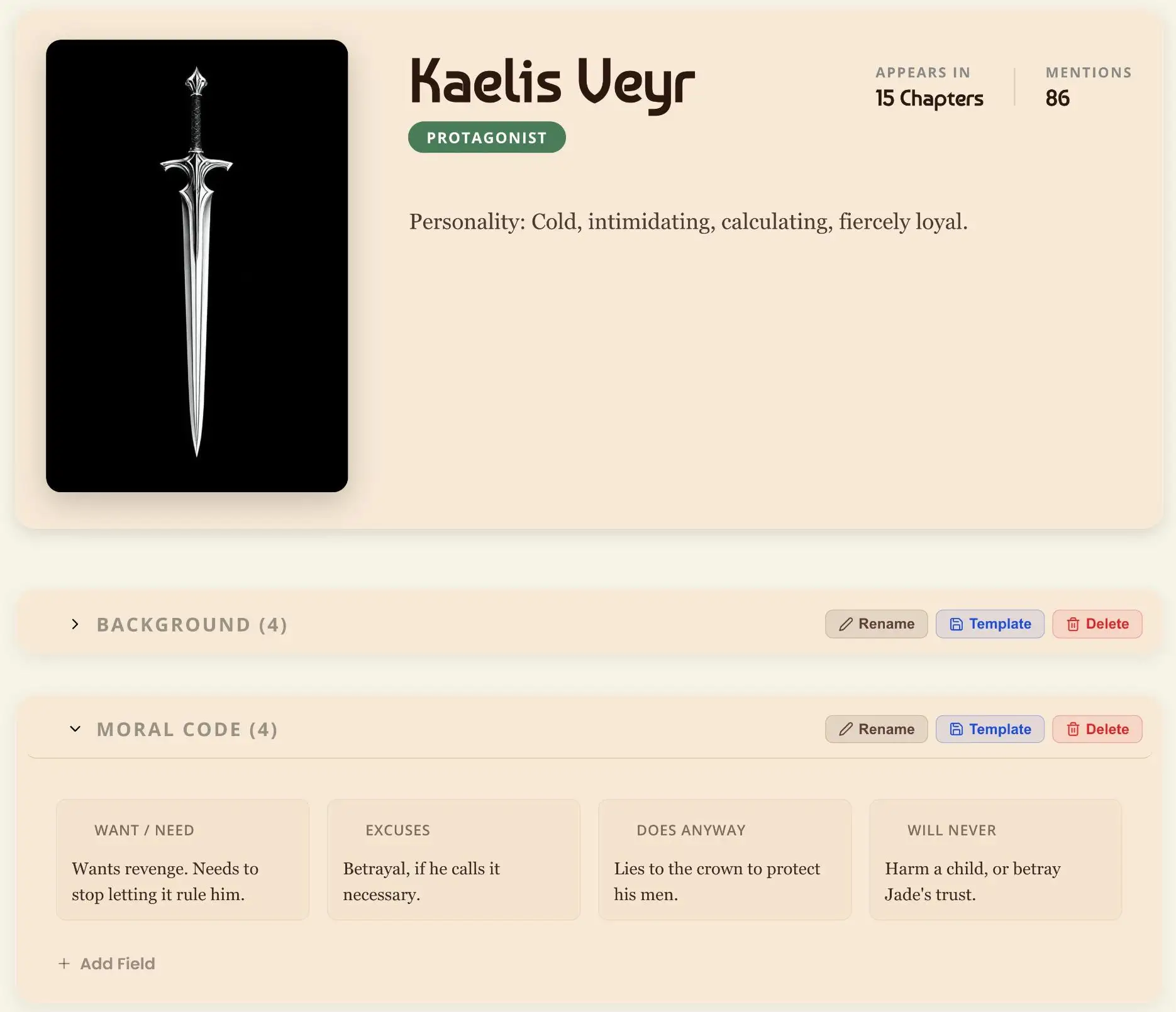
Write down their moral code. Every character in WriteO has a profile with sections you can add and rename. Add a Moral Code section with what they will never do, what they do anyway and what they excuse in themselves but condemn in others, plus their want and their need. Keep it open beside the chapter, and you'll notice the moment a scene asks them to break a rule without paying for it.
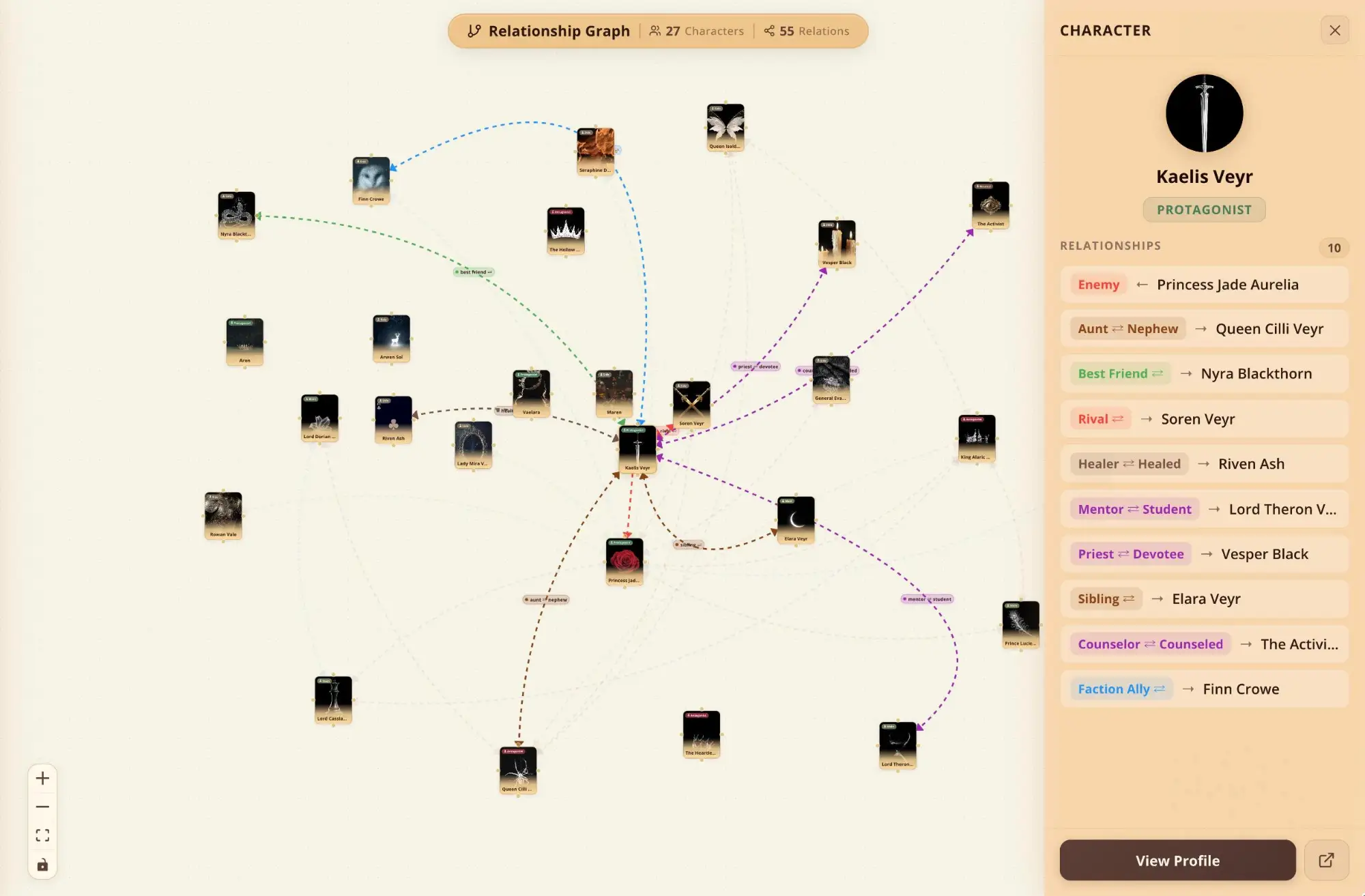
Track the damage, chapter by chapter. The Relationship Visualizer maps who your anti-hero is tied to. When a choice breaks trust, click Evolve on that relationship to record what it became, in which chapter and why. By the final act you can see exactly who they've lost and what it cost, so the consequences in section 6 never disappear.
Conclusion: let your anti-hero be difficult to define
The best anti-heroes aren't simply heroes with a darker personality or a sharper tongue. They are people with understandable motivations, conflicting beliefs, genuine flaws and consequences that follow them through the story.
Your job isn't to convince readers that your anti-hero is right. It is to help readers understand why they made each choice, while still leaving room to question, criticize and even fear them. When readers find themselves sympathising with a character they would never trust in real life, you have done something powerful.
A compelling anti-hero doesn't have to be likeable. But they should always be interesting, and they should never be easy to sum up in a single word.
Ready to write yours? Give WriteO a try and keep your anti-hero's code, contradictions and consequences in view from the first chapter to the last.
Frequently Asked Questions
QWhat is an anti-hero?
An anti-hero is a main character who may want something good but whose methods, motives or flaws stop them from being a traditional hero. Readers follow them because they understand them, not because they approve.
QWhat's the difference between an anti-hero and a villain?
A villain pursues harmful goals and will destroy anyone in the way. An anti-hero usually wants something readers can understand, even admire, but reaches for it in ways that hurt people.
QIs an anti-hero the same as a morally grey character?
Not quite. Any character can be morally grey. An anti-hero is usually the protagonist, the person whose choices drive the story, and readers are asked to stay with them anyway.
QDoes an anti-hero need a redemption arc?
No. They can redeem themselves, fall, refuse to change, grow only partly or end unchanged. What matters is that the arc grows from their wants, needs and flaws, and that readers see what it cost.