

Intimacy lives in the little things
Readers don't need two characters to announce their feelings to know that something meaningful exists between them. Often, they believe it more when nobody says a word.
Compare two moments. In the first, one character says, "I love you." In the second, she notices he hasn't eaten all day and, without comment, leaves half her sandwich beside his elbow. The first tells readers what to feel. The second lets them discover it, and discovery is what makes a relationship feel real on the page.
This kind of closeness isn't reserved for romance. It lives between friends, siblings, old rivals, long-married couples, and characters who would rather die than admit they care. The techniques below work for all of them.
The principle underneath every one of them is simple: make the relationship visible through behavior, not explanation.
Use small acts of unconscious care
The most convincing gestures are the ones characters perform without thinking. Remembering that someone hates raisins. Brushing a leaf off their shoulder mid-conversation. Saving them the last dumpling. Walking on the side nearer the traffic. Handing over a pen before they've finished patting their pockets for one. Noticing they've gone stiff at a crowded party and inventing a reason to leave together.
What makes these moments land is that the character doing them doesn't treat them as special. A grand, carefully planned gesture reads as performance. A reflex reads as love. If your character pauses to admire their own thoughtfulness, the moment loses its power.
Give gestures a history, too. A character bringing tea is pleasant. A character who has brought the same chipped mug of tea, two sugars, every morning for eleven years is telling us an entire relationship in one action.
And let care cost something. Someone staying up until 3 a.m. to help finish a grant application, yawning and irritable the whole time, reveals more than any perfectly timed bouquet. Inconvenience is proof. Taking the long route home, waiting in the cold outside a clinic, sitting through a terrible amateur play because the other person didn't want to go alone: shared inconvenience is one of the quietest and most persuasive forms of devotion.
Telling: He knew her better than anyone.
Showing: Halfway through his sentence, he reached over and turned the radio down. She hadn't said anything, but she'd been rubbing her temple, and she always got headaches when she was tired.
The second version never names the closeness. It proves it with a detail only someone paying attention for years would know.
Develop a language only these characters understand
Close relationships grow their own vocabulary. Private jokes that mean nothing to outsiders. Nicknames born from an embarrassing night or a shared disaster. A raised eyebrow that carries a full paragraph. A reference to a memory that neither person bothers to explain.
Resist the urge to translate these for the reader. When a character explains an inside joke, it stops being inside. Readers enjoy the slight feeling of eavesdropping, of witnessing something that wasn't staged for them.
Callbacks are where this language earns its keep. A throwaway joke in chapter two can break a reader's heart in chapter twenty if it's repeated at a hospital bedside. Plant early, return late.
This language can also evolve. A nickname might start as a jab between rivals and, over the course of a book, soften into something tender without either character noticing the shift. The word stays the same; the tone changes, and readers feel the relationship move.
Private language also shows up as anticipation: one character reaching for the salt just as the other was about to ask, or finishing a thought because they've heard its first half a hundred times.
Telling: They had been through a lot together, and the memory of that night still made them laugh.
Showing: "The blue umbrella," she said. He groaned and covered his face, and she laughed so hard she had to put her drink down.
Readers don't need the full story of that night. They only need to see that both of them remember it.
Show physical familiarity without making every touch romantic
Physical closeness doesn't have to be sexual or even romantic. Much of it is simply about how comfortably two people share space. It comes in layers:
Casual touch: a nudge of the shoulder, a tap on the knee to get attention.
Comfortable proximity: sharing a blanket, leaning against each other on a sofa, sitting closer than the bench requires.
Practical familiarity: straightening a tie, picking lint off a sleeve, cleaning a scraped palm.
Protective instinct: a hand cupped behind someone's head as they duck into a car, a grab at the elbow when they stumble.
Unconscious habit: a head drifting onto a shoulder on a long bus ride, a hand found in a crowd.
The most revealing question is who initiates and who allows. A character who flinches from every handshake but lets one person fix their collar has just told readers everything. That is the intimacy of permission: being allowed into space that is closed to everyone else.
Contrast sharpens this. If a character keeps everyone at arm's length but casually steals one friend's chips and props their feet in that friend's lap, the exception becomes the story.
Not every touch should linger. Writers often slow touch down to signal importance, but the absence of hesitation can be more intimate than a long, charged moment. Two people who don't think twice about touching are further along than two people who think about nothing else.
Physical familiarity should always grow out of the characters' established personalities and boundaries. It is a way of revealing who they are to each other, not a shortcut to manufacture romance.
Let silence become comfortable
A relationship deepens when characters stop needing to entertain, impress, or explain themselves. They can sit in the same room doing completely different things. They can be seen in old pajamas, in a foul mood, with unwashed hair. They can let a pause hang without rushing to fill it, fall asleep mid-film, or let a conversation simply end.
The challenge is making silence read as comfort rather than distance. Body language does the work here. Silence between estranged characters looks like crossed arms, turned backs, and careful avoidance. Silence between close characters looks like loose shoulders, shared space, and small acknowledgments that each knows exactly where the other is.
Keep both characters busy and still aware of each other. Ordinary settings help enormously: a kitchen at midnight, a long train journey, a rainy afternoon of reading. The less dramatic the backdrop, the more the closeness shows.
Telling: They were comfortable enough with each other that they didn't need to talk.
Showing: They hadn't spoken in twenty minutes. He was repairing his watch; she was reading beside him. When she shifted to tuck her legs up, he moved his feet without looking up to make room.
Nothing happens in that scene, and that is exactly the point. The intimacy lies in how little needs to happen.
Reveal how well they read each other
Intimacy often shows up as noticing what everyone else misses. The difference between a real laugh and a polite one. Whether a friend wants advice or just needs to vent. The particular brightness in someone's voice when they say "I'm fine" and mean the opposite. The way they clean obsessively when they're anxious. The moment to step in, and the moment to leave them alone.
This perceptiveness should be earned. Characters who magically understand each other from page one feel like a plot convenience. Root their insight in accumulated experience: he knows she goes quiet before she cries because he's seen it happen three times.
Let them get it wrong sometimes. Misreading someone you love is deeply human, and the repair afterward can be more intimate than the original understanding.
And show how knowing someone changes the response. Understanding is only half of it; what makes it intimate is what the character does with that knowledge. Gentle correction is a good example: quietly whispering the right name to someone who's about to get it wrong, or adjusting their grip on a knife without making them feel foolish.
Telling: He could always tell what she was really feeling.
Showing: Everyone at the table assumed she was angry. He saw the flush creeping up her neck, recognized embarrassment, and asked loudly whether anyone had tried the dessert.
The reader learns two things at once: what she feels, and that he is the only one who knows.
Use shared memories and mundane rituals
A relationship feels lived-in when the characters have piled up ordinary experiences together. The same Sunday pancakes. A designated seat on the left side of the booth. A playlist passed back and forth for years. A bookshop they always end up in. Small traditions that neither of them ever decided to start.
Establish these rituals early, while they seem unimportant. Their emotional weight grows quietly in the background, so that later you can do something powerful with them: break them. When a routine the reader has come to rely on suddenly doesn't happen, they feel the wrongness before any character names it.
This is also where you can show the intimacy of absence. A kitchen that's too quiet. A second toothbrush still in the cup. A habit that keeps running after the person it was built around has gone.
Objects are especially useful carriers of memory: a faded receipt kept in a wallet, a borrowed sweater never returned, a chipped mug no one else is allowed to use, a paperback full of someone else's penciled notes in the margins.
Telling: He missed her terribly after she moved away.
Showing: He still ordered two coffees every morning. He didn't realize he was doing it until the barista stopped asking whether the second one was for here or to go.
The grief is never mentioned, and it's everywhere.
Let vulnerability exist between them
Perhaps the deepest form of intimacy is letting someone see the parts of you that you usually hide. That might mean admitting a fear, being seen failing, sharing a memory never spoken aloud, or disagreeing openly without worrying the relationship will collapse. It might simply mean accepting comfort without rushing to repay it.
Vulnerability doesn't require tears or a trauma disclosure. A proud, competent character quietly admitting, "I don't actually know how to swim," can be more revealing than a long, sobbing confession. Small admissions feel truer because they cost the character something real without turning the scene into a set piece.
Let defenses come down in increments. Trust built through a single emotional conversation feels fragile; trust built through consistency, scene after scene, feels earned.
Most importantly, show the aftermath. What does the other character do with what they've been given? Do they treat it carefully? Do they remember it weeks later, quietly booking the hotel with the shallow pool, or steering the group away from the lake without explanation? The response to vulnerability is often where the intimacy truly lives.
Telling: She finally opened up to him about her insecurities.
Showing: "I've never been good at this," she said, staring at the half-assembled shelf. He didn't laugh. He just sat down on the floor beside her and handed her the next screw.
Use contrast to make intimacy noticeable
Sometimes the clearest way to show how special a relationship is, is to show how differently a character behaves everywhere else. The relentlessly sarcastic one who goes suddenly gentle. The fiercely independent one who turns, without thinking, to one particular person for help. The socially fearless one who fumbles their words around someone they care about. The person who never lends anything casually tossing over their favorite jacket. The one who hates being touched reaching for a single hand in the dark.
The key is that the contrast must grow out of who the character already is. A cold character doesn't become warm; they become slightly less cold, in one direction, for one person. If someone suddenly behaves like an entirely different human being just to signal affection, readers stop believing either version.
Telling: She was only ever soft with him.
Showing: She tore the intern's report apart in front of the whole team. An hour later, when he admitted he'd missed a deadline, she only sighed and said, "Send me what you've got."
Common mistakes that make subtle intimacy feel forced
Even well-chosen techniques can backfire. Watch for these:
Overusing touch. If every scene features brushed hands and lingering glances, the gestures stop meaning anything.
Making every interaction romantic. Not every kindness needs tension or an ulterior motive. Sometimes passing the salt is just passing the salt.
Explaining the emotion straight away. A meaningful action followed by a sentence spelling out what it means undoes the work. Trust the reader.
Perfect compatibility. Real closeness includes arguments, misunderstandings, and clashing ways of showing care.
Leaning on clichés. Borrowed jackets, forehead kisses, and the one-bed inn can still work, but only when grounded in these specific characters.
One-sided care. Both characters should contribute, even if one shows it through cooking and the other through stubborn, silent loyalty.
How WriteO Helps You Keep the Small Moments Consistent
Subtle intimacy only works if the details stay true. If she takes two sugars in chapter 3, she can't take it black in chapter 30. A callback only lands if you remember exactly what you planted. WriteO keeps those details where you can find them.
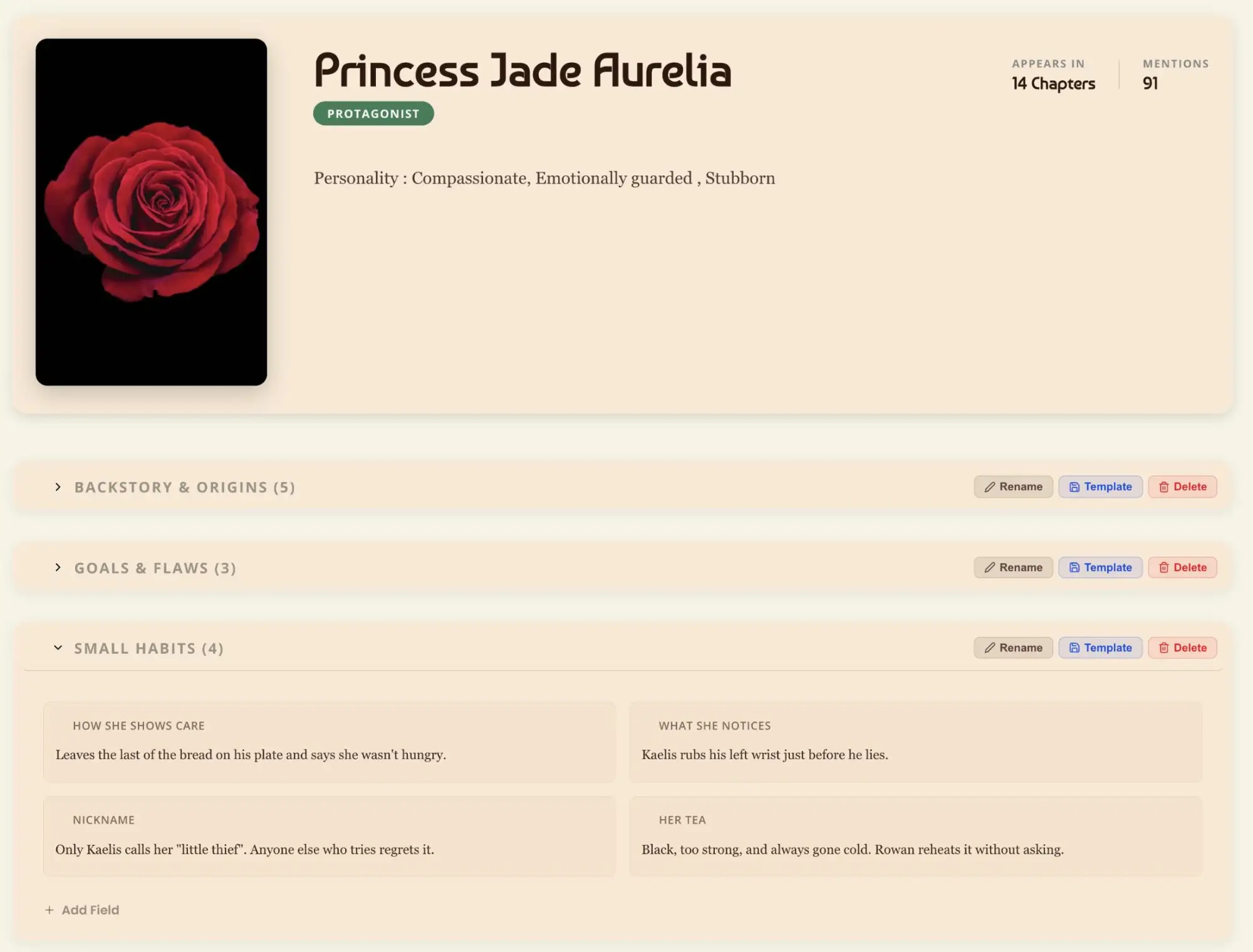
Give each character a Small Habits section. Every character has a profile in WriteO with sections you can add and rename. Write down how they take their tea, the nickname only one person uses, what they notice about the people they love and how they show care without saying it.
Keep a note for each relationship. Start a note inside your novel for a pair's private jokes, rituals and shared memories, and pin it so it stays at the top. When you plant a joke in chapter two, add it to the note, so you remember to bring it back in chapter twenty.
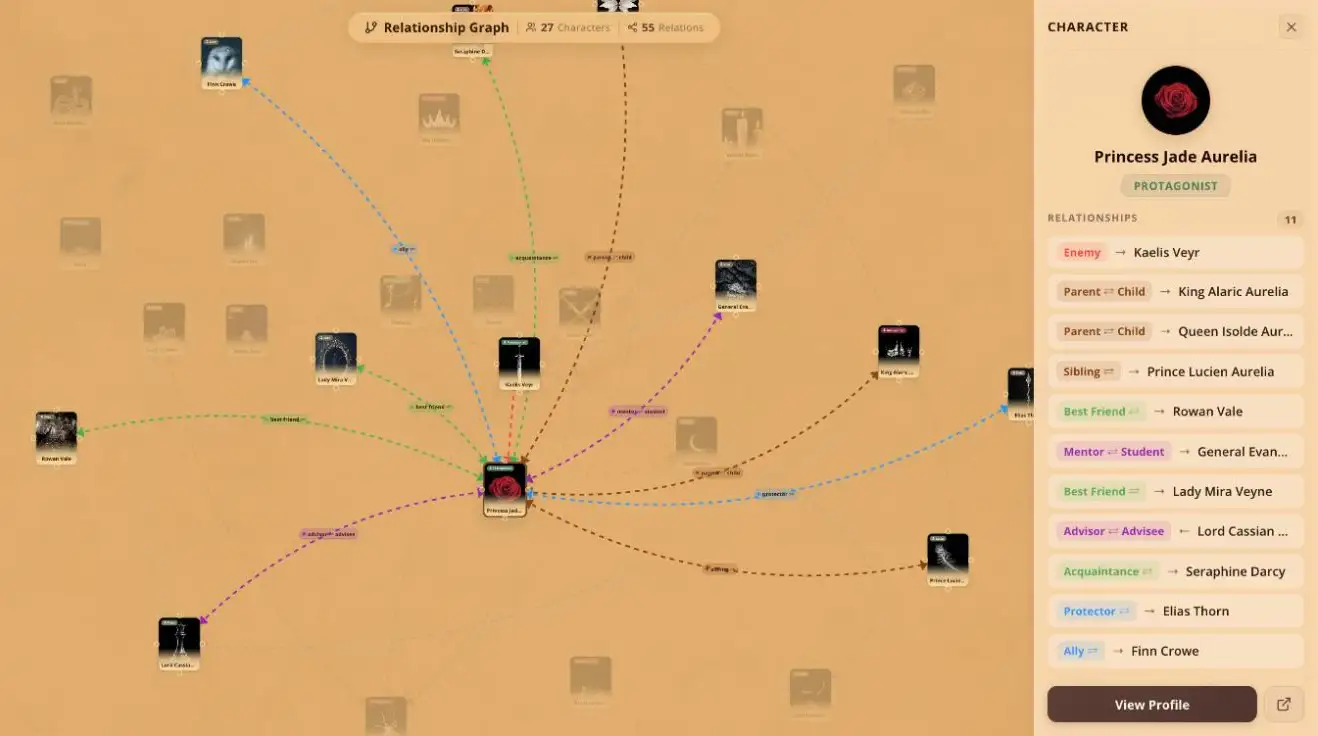
Watch the bond change. The Relationship Visualizer maps how your characters are connected. As rivals soften or friends become something more, record the change, the chapter it happens in and the reason, so the closeness grows at a pace readers can feel.
Let readers notice before the characters admit it
Intimacy on the page is rarely built in one big scene. It accumulates through history, habits, and the small ways two people quietly bend their lives around each other. A remembered preference here, a private joke there, a silence that never needs filling.
When you write these moments, focus on what the characters do, not what they declare. Let readers piece the relationship together themselves, often before the characters are ready to say it out loud.
The strongest intimacy often happens when neither character is trying to be intimate at all. They are simply so familiar with each other that caring has become second nature.
Ready to write closeness readers can feel? Give WriteO a try and keep every habit, joke and ritual in view from the first chapter to the last.
Frequently Asked Questions
QHow do you show intimacy between characters without romance?
QHow do you show two characters are close without dialogue?
Use small, unconscious actions. One turns the radio down because the other has a headache. One moves their feet to make room without looking up. Readers believe closeness more when nobody explains it.
QWhat's the difference between telling and showing intimacy?
QHow do you write physical touch that feels natural?
Let it grow out of the characters' personalities and boundaries, and don't make every touch linger. Casual, unhesitating touch often feels more intimate than a long, charged moment.