

Magic works best on the page when it feels like a craft, with its own logic, history and price. Readers have seen countless glowing wands, Latin-sounding incantations and bubbling cauldrons filled with eye of newt. Those images still have charm, but they rarely surprise anyone.
The spells and potions that stay with readers feel as though they could only exist in one particular world. They reflect the people who invented them, the land that supplies their ingredients and the rules that keep them in check. This guide walks through how to build that kind of magic, from the first question about where power comes from to the small sensory details that make a single scene come alive.
1. Start by understanding how magic works in your world
Before you write a single incantation or invent a potion, decide what magic actually is in your world. Every spell you create later will grow out of this answer.
Start with a few foundational questions:
Is magic an inherited ability, a learned skill, or something anyone can access?
Does it come from nature, ancient beings, celestial objects, religion or somewhere else entirely?
Can anyone practice it, or is it restricted to certain families, orders or classes?
Is magic considered ordinary, sacred, dangerous or illegal?
The source of magic shapes how people use it. A society that believes power flows from nature will likely work with plants, minerals and seasonal rituals. Its healers might gather herbs at specific times of year and hold ceremonies at the solstice. A civilization that draws power from the stars might organize its entire practice around planetary movements, with astronomers as respected as sorcerers.
Think about time, too. Magic rarely arrives fully formed. Spells evolve across generations, and the version a modern apprentice learns may be a shortened or altered form of an ancient incantation. That history gives you texture: forgotten verses, lost techniques and scholars who argue over the original meaning of a word.
2. How to write spells that feel original
A. Develop your own magical language
Random Latin phrases and familiar fantasy incantations make magic feel borrowed. Instead, build a small vocabulary that belongs to your world. Create recurring words, phrases and symbols tied to different types of magic, and decide whether spells are spoken, whispered, sung or written.
Let the language reflect the culture that made it. A fictional tongue might have one word that means both to remember someone and to keep them alive. That single word could anchor an entire school of memory-preserving spells, and it tells readers something about how that culture views death.
Language can also drift. Perhaps an ancient spell has been mispronounced for centuries, and its modern version produces a slightly different effect from the original. A scholar who restores the correct pronunciation might unleash something nobody expected.
B. Make spellcasting more than saying words
Magic doesn't have to mean waving a wand and reciting a phrase. Think about the body. A caster might draw symbols in the air, hold their breath until the incantation ends, maintain eye contact with the target, adopt specific hand positions or sing at a precise pitch.
Then ask what happens when the technique slips. A trembling hand might distort a protection symbol and turn a barrier into a trap that stops people escaping. Physical technique also lets you show a character's experience instead of announcing that they are powerful.
C. Establish limitations and consequences
A spell becomes interesting when casting it requires a decision. Does it cost energy, concentration or a rare material? Can it be interrupted or reversed? Does it need several casters? Does it leave traces others can detect?
Avoid making every cost a generic loss of energy. A memory spell might slowly erase the caster's memories of the very person they are protecting. A fire spell might steal the caster's ability to feel warmth for a day. When the price connects to the purpose, every casting carries weight.
D. Give characters their own casting styles
No two spellcasters should work the same way. An experienced healer might perform complex spells with barely a gesture, while a beginner needs written instructions and several attempts. A battlefield mage favors fast, practical incantations; an academic relies on exact symbols and measurements.
Small habits help, too. One character taps their fingers before casting, another refuses to speak spells aloud, and a third compulsively corrects imperfect symbols. These details make magic feel personal rather than mechanical.
3. How to create interesting potions
A. Design potions around specific situations
Rather than inventing yet another healing or invisibility draught, start with the specific moments when your characters need help. Specific needs produce memorable potions:
A potion that lets someone recognize a familiar voice in a crowded room.
A potion that temporarily prevents the drinker from telling a deliberate lie.
A potion that lets someone hear conversations from a room they once occupied.
A potion that preserves the last emotion felt by a dying person.
A potion that makes someone forget a face but remember everything else about them.
Root each one in your characters' emotional and practical problems. A draught that helps someone remember a lost loved one sounds like a gift, until it also restores the memories they deliberately buried.
B. Give ingredients their own history and properties
Ingredients should never be mere decoration. Ask where each one grows, why it holds power, whether it is poisonous, rare or hard to harvest, and who controls its supply.
Let preparation change the result. A flower picked before sunrise might preserve memories, while the same bloom gathered at midnight reveals forgotten ones, and one cut during an eclipse erases memory entirely. Unusual harvesting conditions add story potential too: a plant that only grows where sunlight has never touched, or a creature that must willingly shed a feather before it can be used.
C. Establish rules for brewing and preparation
Potion-making should feel like skilled work. Consider precise measurements, temperatures and durations, as well as grinding, drying, fermenting and distilling. The order of ingredients matters, as do maturing conditions and storage.
Perhaps one ingredient loses its power if heated too early, while another must ferment for days. These rules also separate amateurs from masters. A novice follows the recipe word for word; a seasoned alchemist knows when a mixture needs more time or has reached exactly the right consistency.
D. Give potions unexpected side effects
A potion that always works perfectly removes chances for conflict. Side effects create tension, especially when they grow out of the potion's purpose:
Potion | Unexpected side effect |
Invisibility | The user's reflection remains visible |
Memory restoration | The user relives memories as if they are happening again |
Healing | The injury transfers to someone emotionally close to the patient |
Truth serum | The user cannot tell truth from their own assumptions |
Sleep potion | The user dreams another person's memories |
The best side effects feel inevitable in hindsight. A potion that lets you hear distant conversations might leave ordinary sounds unbearably loud for days afterwards.
4. Make magic part of your world’s culture and everyday life
Magic shouldn't appear only when the protagonist needs to defeat an enemy. If it exists, it shapes how ordinary people live, work and believe. Consider how it touches each part of society:
Culture: Are spells handed down through families, religious institutions or secret societies?
Economy: Are magical ingredients expensive, and do certain merchants control the supply?
Education: Do children learn basic spells at school, or must they seek out a mentor?
Law: Are memory-altering spells illegal? Do potion sellers need licenses?
Religion: Are some spells sacred, forbidden or sacrilegious?
Social class: Can wealthy families afford professionally brewed potions while poorer communities rely on homemade remedies?
Follow these ideas to their natural consequences. If healing potions are costly, counterfeits will flood the market. Apothecaries might develop enchanted instruments to test authenticity, while underground traders sell ingredients stolen from magical academies. Each of these details can become a subplot.
Cultural taboos add another layer. Perhaps casting any spell inside someone's home is deeply disrespectful, even if the spell is harmless. A character who breaks that rule out of ignorance instantly reveals that they are an outsider.
5. Use sensory details to make magic feel real
One of the quickest ways to make magical scenes feel repetitive is to describe everything as glowing, sparkling or shimmering. Sight is only one sense, and often the least interesting. Explore how magic engages all five:
Sense | Spellcasting | Potion-making |
Sight | Symbols bending in the air | Ingredients changing color |
Sound | Low vibrations traveling through walls | Bubbles clicking like tiny stones |
Smell | Burning rosemary and wet earth | Metallic, sweet or fermented scents |
Touch | Static crawling across the skin | Glass becoming unexpectedly warm |
Taste | Copper on the tongue | A bitter aftertaste that lingers |
You can also give each magical discipline its own sensory signature. Healing magic might smell of crushed herbs and warm linen, while forbidden magic leaves the taste of ash in the caster's mouth. Once readers learn these cues, they can recognize what kind of magic is at work without a word of explanation, and a single smell can signal danger before any character notices it.
6. Common mistakes to avoid when writing spells and potions
Even a carefully built magic system can stumble. Watch out for these pitfalls:
Making magic too convenient. If characters can solve every problem with a quick spell, conflict loses its purpose and readers stop worrying.
Using random ingredients. Every ingredient should earn its place with a reason for being in the recipe.
Ignoring consistency. Inventing a new ability whenever the plot needs rescuing breaks readers' trust in your rules.
Overcomplicating the system. Magic doesn't need dozens of rules to feel believable; a few well-chosen ones applied consistently go further.
Making every spellcaster identical. Training, background and personality should all shape how someone casts.
Adding meaningless side effects. Consequences should connect to the magic, not exist simply to make it look dangerous.
Forgetting everyday applications. Magic should influence jobs, relationships and social structures, not just battles.
7. Put your creativity to work: design a spell and a potion
The best way to absorb these ideas is to use them. Work through the exercises below for your own world, answering each question in a sentence or two.
Exercise 1: Create an original spell
What does the spell accomplish?
What words, gestures or symbols activate it?
What does casting it physically feel like?
What happens if it is performed incorrectly?
What does the caster sacrifice?
Exercise 2: Create a potion recipe
What specific problem does it solve?
Which three ingredients does it require?
Where do those ingredients come from?
What is the brewing process?
Does it have an unexpected side effect?
Exercise 3: Connect magic to your world
Who is allowed to practice magic?
Is it regulated, celebrated or feared?
Who profits from magical ingredients?
What happens when someone uses magic illegally?
Which magical practices are considered taboo?
Your answers to the third exercise will often reshape your answers to the first two, which is exactly the point: magic and world should grow together.
How WriteO Keeps Your Magic Consistent
Magic systems rarely break in one big moment. They break quietly. The cost you set in chapter 3 is forgotten by chapter 20, and a potion that took three days to brew is suddenly ready in an afternoon. WriteO keeps your rules next to the chapters that use them.
Keep your rules in one pinned note. Write where your magic comes from, what it costs and what it can't do in a note inside your novel, then pin it so it stays at the top of your notes. Before you write a casting scene, check the price you promised readers.
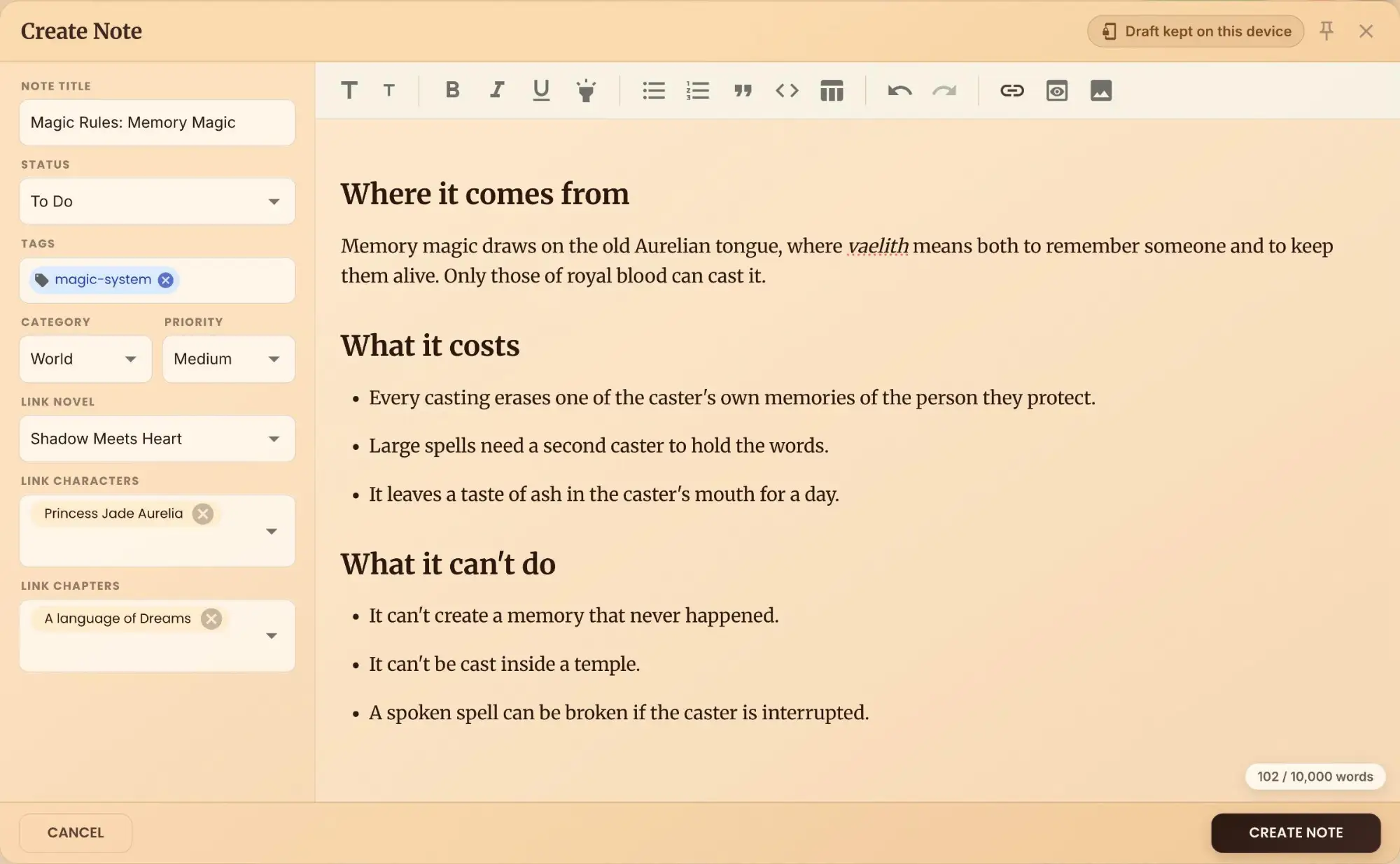
Give every spell and potion its own note. Add the words, gestures, ingredients, brewing steps and side effects, tag it Spell or Potion and link it to the chapters where it appears. When the potion returns in chapter 25, its recipe is one click away. If your world spans a series, the global notes dashboard shows every note across all your books.
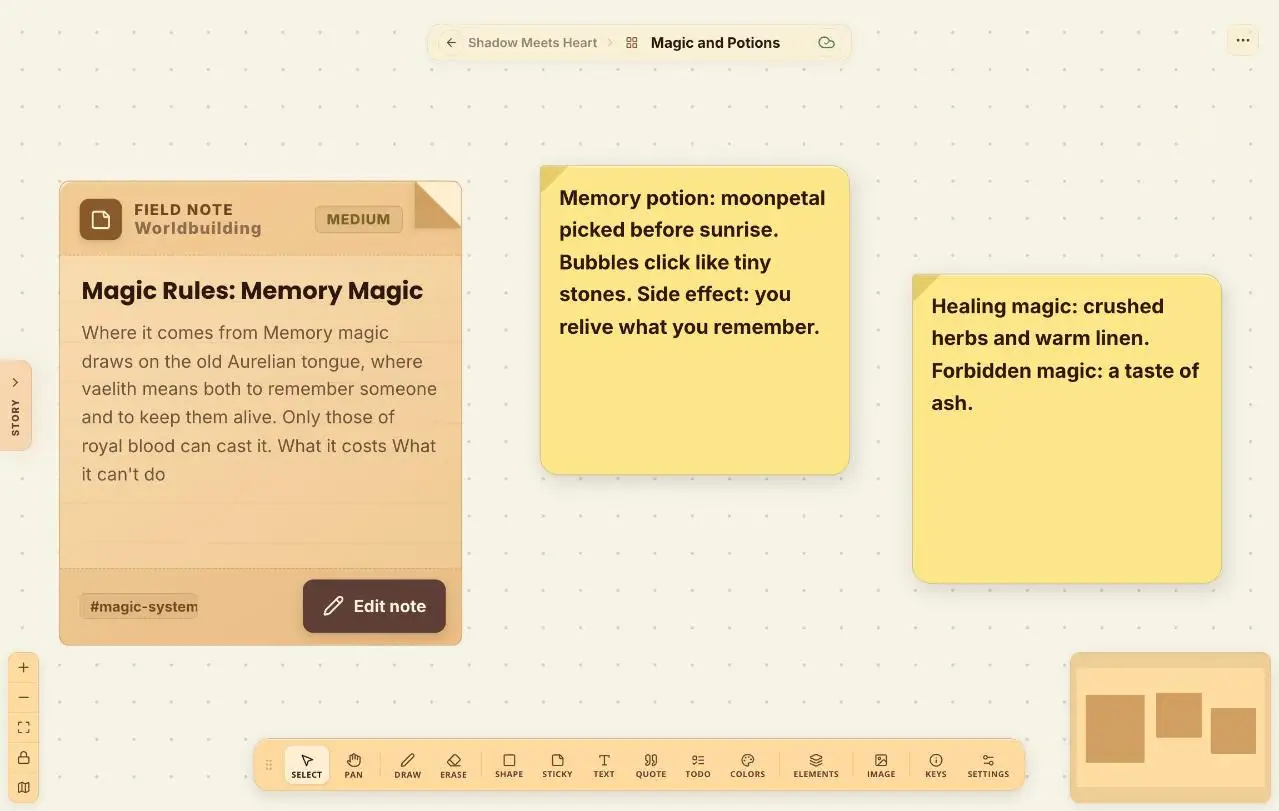
See your ingredients and sensory cues. Every novel has its own moodboard, a freeform canvas where you can drop reference images for your ingredients, sketch the symbols your casters draw and add sticky notes for how each kind of magic smells and tastes. The ash taste of forbidden magic stays the same from the first chapter to the last.
8. Conclusion: make magic feel like it belongs to your world
Great magic isn't defined by how powerful it is, but by how thoughtfully it is woven into the story. A modest spell with a real cost and a clear place in its culture will stay with readers far longer than a dazzling one that solves everything.
Give your spells their own language, your potions their own processes, your ingredients their own histories and your magic its own consequences. Look past familiar fantasy conventions and build traditions that reflect your world's culture, environment and past.
Most of all, remember that small details carry great weight. The smell of a particular spell, the habit of a nervous apprentice or the law against brewing after dark can make an imagined world feel startlingly real. Start with one spell and one potion, and let your world grow around them.
Ready to build your magic? Give WriteO a try and keep every spell, potion and rule next to the chapters that use them.
Frequently Asked Questions
QHow do you write a spell in a fantasy book?
Decide where magic comes from in your world first. Then give the spell a clear effect, the words, gestures or symbols that trigger it, a cost and a way it can go wrong. The cost is what makes readers care about each casting.
QHow do you come up with potion ideas?
QHow many rules does a magic system need?
Fewer than you think. A few clear rules about its source, cost and limits, applied every time, feel more believable than dozens of rules readers can't remember.
QHow do you make magic feel original?
Tie it to your world's culture, language and land, give casters their own styles, and describe it with more than sight. Sound, smell, touch and taste make a spell feel real.