

A smuggler reaches the river checkpoint an hour before dawn. The guard doesn't ask for her name. He asks for her salt seal, the stamp proving she's paid the crown's tax on the one resource that keeps the river spirits from rising.
She doesn't have one. She has six barrels of untaxed salt under a tarp.
In four sentences, you know this world has scarcity, a ruling power, a supernatural rule, and a character about to break all three. That's what strong fantasy worldbuilding does: it shows up as pressure, not paperwork.
Most worldbuilding advice hands you a giant checklist of gods, governments, flora, and languages. Those lists aren't wrong, but they don't tell you which parts your story actually needs. This guide does. Below are seven fantasy worldbuilding essentials, why each one generates conflict, and how to reveal them on the page so your setting does real work in every scene.
What “Essential” Means in Fantasy Worldbuilding
Worldbuilding is the process of designing a story's setting: its rules, societies, history, geography, and the forces that shape daily life. In fantasy, that often includes magic, invented species, or entire cosmologies.
Here's the filter this article uses: a worldbuilding element is essential if it changes what a character can do, must do, or is forbidden to do. If you deleted it and no character's choices changed, it was decoration.
Decoration isn't bad. Texture makes a world feel lived in. But essentials come first, because they're load-bearing. You can add a festival or a regional dish later in revision. You can't easily retrofit the rule your entire climax depends on.
This also explains why many writers stall after months of planning. They've built breadth, lots of things that exist, without depth, things that matter to someone in the story. The seven essentials below are where depth comes from.
The 7 Fantasy Worldbuilding Essentials
Each essential below includes why it creates story, a short example, and one question to test against your own world.
1. A Central Scarcity
Every compelling fantasy world is short on something. Water, fertile land, magic, heirs, safe roads, trust between species. Scarcity is the engine of conflict because it forces people to compete, bargain, steal, or sacrifice.
The key is to pair the shortage with control. A drought is a backdrop. A drought where one temple owns the only deep wells is a political system, a black market, and a dozen motives waiting to happen.
Example: In a world where healing magic draws on years donated from a living person's lifespan, the rich buy years from the poor. A healer protagonist now faces a moral question in every scene: whose life is she spending?
Ask yourself: Who profits from this shortage, and who pays for it?
2. Magic Rules With Real Costs
Novelist Brandon Sanderson's widely cited essays on magic systems offer two principles worth knowing. His First Law argues that the more clearly readers understand a magic system, the more an author can use it to resolve conflict without the ending feeling unearned. His Second Law states that limitations are more interesting than powers.
This doesn't mean every system needs rigid rules. "Soft" magic that stays mysterious can create wonder and dread. The practical takeaway is narrower: if magic solves your climax, readers need to understand its rules and costs well before that moment.
Weak: Aren whispers the binding word, and the bridge holds.
Stronger: Aren whispers the binding word. The bridge holds, and with it goes his sense of taste, the third sense he's traded this month. He doesn't know which one the next spell will take.
The second version makes every future spell a decision. That's the real function of cost: it turns magic from a tool into a dilemma.
Ask yourself: What does using power take from the user, and what can it never do?
3. Institutions That Enforce the Rules
Rules only matter if someone enforces them. Guilds, courts, churches, crime syndicates, and border authorities turn abstract laws into obstacles with faces.
Institutions are especially useful because they're never perfectly unified. A corrupt magistrate, a reform faction inside the priesthood, or a guard who can be bribed gives your characters room to maneuver.
Example: If a mage guild licenses all spellcasting, a farm girl with untrained talent isn't just gifted. She's committing a crime every time her power slips out. Her magic becomes a secret before it becomes a strength.
Ask yourself: Where does enforcement break down, and who exploits the gap?
4. Daily Logistics and Economy
This is the most overlooked essential. What do ordinary people eat? How do goods travel? What currency do merchants trust, and which do they refuse?
Logistics rarely deserve long explanations, but knowing them prevents contradictions and supplies grounded obstacles. Sieges, famines, and rebellions all depend on supply.
Example: A city besieged for six months needs a credible food source. If you decide its grain arrives by an underground river, you've just created the target for your heist plot.
Ask yourself: If one trade route closed tomorrow, who would starve, and who would get rich?
5. Culture Shaped by Environment and History
Culture works best as a response to conditions rather than a costume. Customs, taboos, and values should make sense given the land, the scarcity, and the past.
A desert people might treat refusing offered water as a grave insult, because water is life. Now imagine your outsider protagonist declines a cup out of politeness during a tense negotiation. The cultural detail isn't trivia anymore. It's a scene turning point.
Ask yourself: Which of your cultures' customs could a well-meaning outsider break by accident?
6. Living History
Plenty of fantasy worlds have elaborate timelines that never affect the plot. Call that dead lore. Living history is the part of the past that still has consequences: unpaid war debts, disputed borders, a massacre one side commemorates and the other denies.
The most efficient technique is to let characters remember the same event differently. When a northern soldier calls a battle "the Liberation" and a southern innkeeper calls it "the Burning," readers learn history, politics, and character in one exchange.
Ask yourself: What past event do your characters still argue about?
7. Geography That Limits Movement
Distance, terrain, and climate decide how fast armies move, how long news takes to arrive, and which places stay isolated. These limits create deadlines and cut characters off from help.
Consistency matters here more than anywhere. Readers notice when a journey takes three weeks in chapter four and two days in chapter twenty. Do you need a map? If your plot involves extensive travel, a rough sketch with travel times is worth making. For a story set in one city, a list of neighborhoods may be enough.
Ask yourself: What can't your characters reach in time, and why?
Fantasy Worldbuilding Essentials at a Glance
Essential | Key Question | How It Creates Plot |
Central scarcity | Who controls the shortage? | Competition, theft, sacrifice |
Magic with costs | What does power take? | Every use becomes a dilemma |
Institutions | Where does enforcement fail? | Obstacles, corruption, allies inside |
Logistics and economy | What breaks if supply stops? | Sieges, heists, famine stakes |
Culture | What taboo could an outsider break? | Misunderstandings, tense scenes |
Living history | What do people still argue about? | Grudges, factions, unreliable accounts |
Geography | What's too far to reach in time? | Deadlines, isolation, journeys |
Notice the pattern in the final column: every essential produces a decision or an obstacle. If an element in your notes doesn't connect to either, it's probably texture. Keep it, but don't let it consume planning time that your essentials need.
How to Reveal Your World Without Info-Dumping
Building the essentials is half the job. The other half is getting them onto the page without stopping the story to deliver a lecture.
Reveal Details at the Moment of Need
Introduce a piece of world information at the moment a character has to act on it. Readers retain a rule far better when they watch it constrain someone than when they're told about it in advance, because the detail arrives attached to stakes.
A useful drafting check: for any paragraph of explanation, ask whether a character is about to make a decision that depends on it. If not, move it closer to that decision or cut it.
Let Characters Disagree About the World
Narration explains. Disagreement dramatizes. When characters from different backgrounds interpret the same law, god, or historical event differently, readers learn the world through conflict, and they learn the characters at the same time.
This also spares you from deciding who is "right." Contested beliefs make a world feel larger than any single point of view.
Example: Before and After
Before (info-dump):
The Kingdom of Varrow taxed salt heavily because salt was used to seal the river against the water spirits. Anyone transporting salt was required to carry a crown seal proving the tax had been paid. Smuggling untaxed salt was punishable by drowning, since the crown believed it fitting that smugglers be given to the spirits they had endangered.
After (revealed through scene):
"Seal," the guard said.
Mira patted her coat as if searching. Behind her, the tarp over the barrels shifted in the wind, and a few white grains spilled onto the dock.
The guard looked at the salt. Then at the river. "You know what we do with smugglers here."
She did. Everyone in Varrow had watched at least one drowning.
The second version delivers almost the same information: salt is taxed, seals prove payment, the river matters, and smuggling carries a brutal penalty. But it arrives through a threat, a physical detail, and a character's fear. The reader isn't studying the law. They're worried about Mira.
One limitation: this technique needs a scene with genuine tension. In quieter chapters, a short line of direct explanation is sometimes cleaner than forcing a dramatic setup. Brief, well-placed exposition isn't a failure.
Keeping Your Fantasy World Consistent Across a Novel
Most worldbuilding errors aren't failures of imagination. They're failures of memory. A spell's cost quietly changes, a character's hometown moves north, or the currency gets a new name halfway through.
The common fix is a story bible: a living reference that records your world's rules, costs, names, distances, and key dates. Two habits make it far more useful:
Update it during drafting, not just before. Your best worldbuilding often appears mid-scene. Log new rules the moment you invent them, or you'll contradict them later.
Record consequences, not just facts. Instead of noting "salt is taxed," note "salt is taxed; smugglers are drowned; Mira has untaxed salt." That connects the world to the plot it drives.
It also helps to keep this reference close to the manuscript itself. A writing workspace like WriteO lets you plan, write, and organize your novel in one place, so your world notes sit alongside your chapters instead of scattered across separate files.
How WriteO Helps You Keep Your World Straight
Seven essentials means seven sets of rules to remember across a whole novel. A spell’s cost, a trade route, the name one side gives a battle: lose track of one and readers notice. WriteO keeps your world next to the chapters that depend on it.
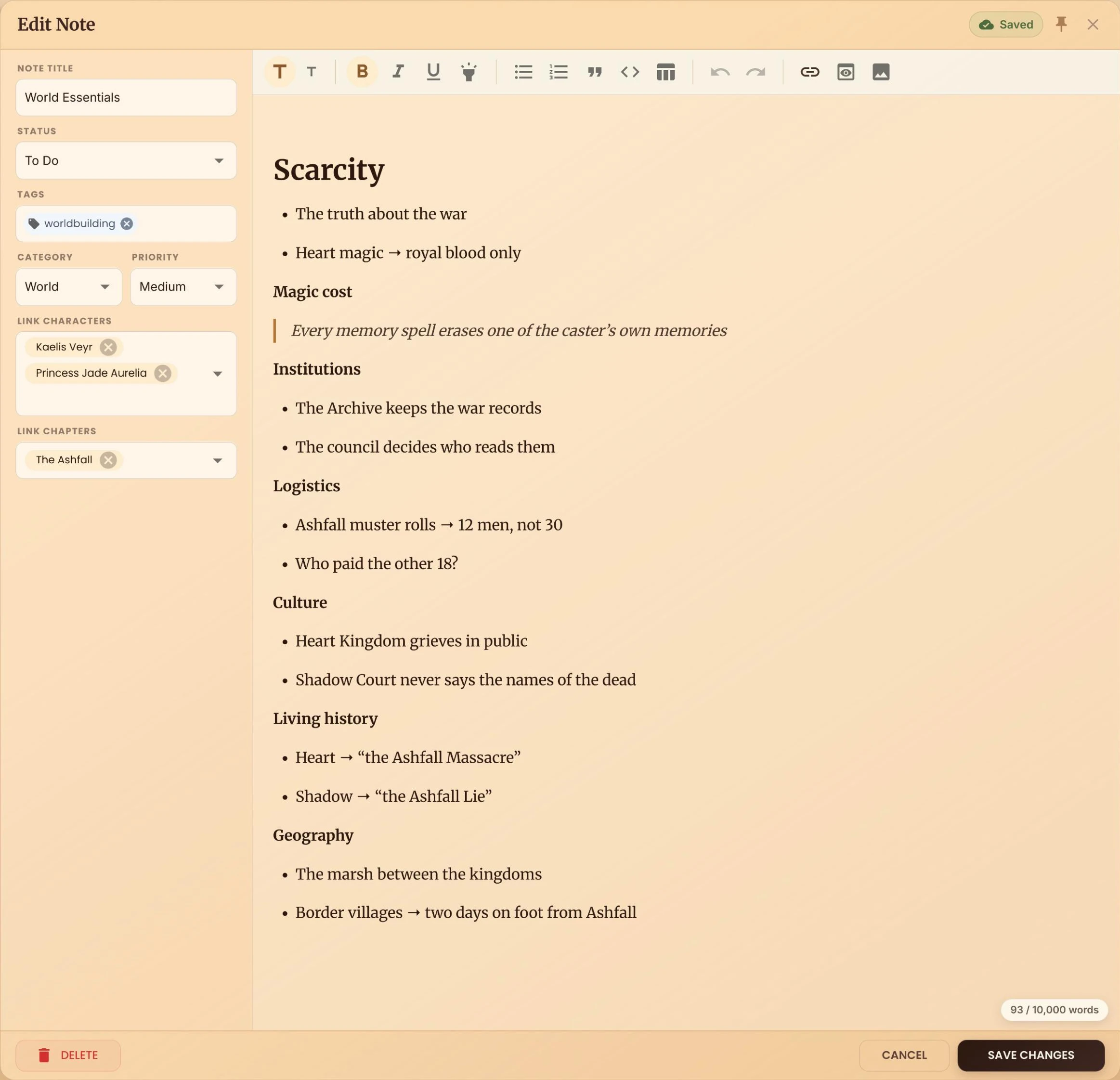
Answer the seven essentials in one note. Start a note inside your novel with a heading for each essential and a line or two under each. Tag it, pin it, and link it to the characters and chapters each rule touches, so the rule your climax depends on is never more than a click away.
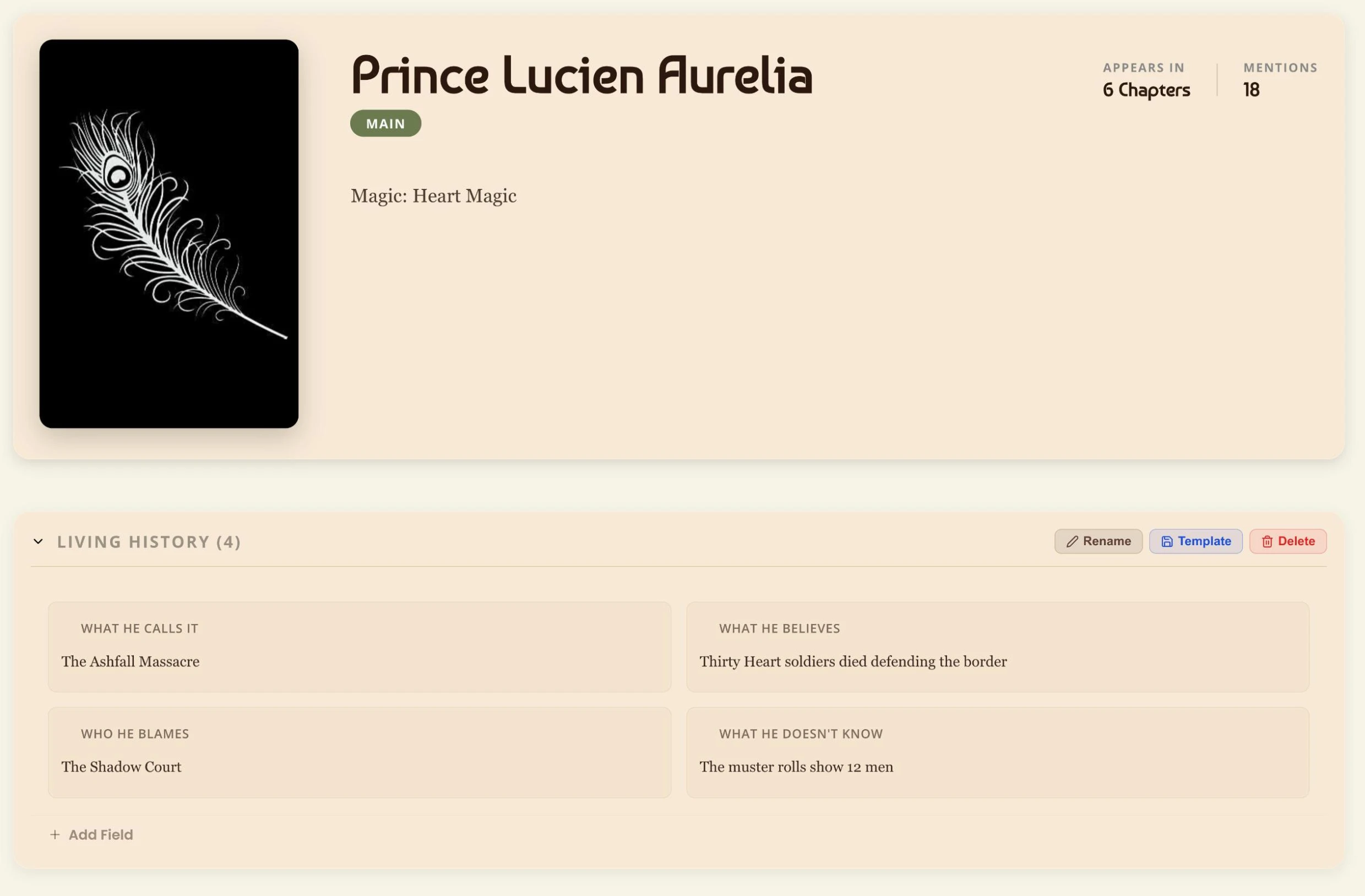
Give each side its own version of history. Every character has a profile with sections you can add and rename. Add a section for the history they still argue about, in their own words, so the soldier who calls it “the Liberation” never slips and calls it “the Burning.”
Keep travel times with the chapters. Give each chapter a short description in chapter management, such as “Day 3: Ashfall to the river checkpoint, two days on foot”, so a three-week journey never shrinks to two days.
Frequently Asked Questions
Frequently Asked Questions
QHow much worldbuilding should I do before I start drafting?
Enough to answer the seven essentials at a basic level, especially the rules your climax depends on. Many writers discover the rest during drafting. If planning has stretched on for months with no scenes written, that's usually a sign to start drafting and build as you go.
QDo I need to invent a language for my fantasy world?
No. A consistent naming style (similar sounds, syllable patterns, and spellings within each culture) gives most readers the sense of a distinct language. A fully constructed language is a deep, rewarding hobby, but it isn't required for a strong novel.
QCan I base my fantasy world on a real culture or historical period?
Yes, and many writers do. Research the source carefully, avoid reducing it to surface aesthetics, and consider sensitivity readers when drawing on cultures outside your own experience.
QWhat are the most important elements of fantasy worldbuilding?
The ones that change what characters can do: a central scarcity, magic with real costs, institutions that enforce the rules, daily logistics, culture shaped by environment, living history and geography that limits movement. Everything else is texture you can add in revision.
QHow do you make a fantasy world feel real?
Make it press on the characters. Give it shortages, rules that cost something and a past people still argue about, then reveal each detail at the moment a character has to act on it instead of explaining it up front.
Build the World Your Story Needs
A fantasy world doesn't become believable through volume. It becomes believable when its rules, shortages, and histories press on the people living inside it.
Key Takeaways
Scarcity drives conflict. Decide what your world lacks and who controls it.
Limitations beat powers. Magic that costs something turns every use into a choice.
Living history beats lore. Keep the past that characters still fight about.
Reveal at the moment of need. Introduce world details when a character must act on them.
Consistency is a habit. Maintain a story bible during drafting, not only before it.
10-Minute Worldbuilding Exercise
Pick one scarce resource in your world. Then:
Name three groups who want it.
Write one sentence for each describing what they'd sacrifice to get it.
Draft a three-line scene premise where your protagonist is caught between two of those groups.
By the end, you'll have a ready-to-draft conflict that grows directly out of your setting. If you're using WriteO, add the result to your novel's planning notes so it's waiting for you when you reach that chapter.
A Question to Leave You With
Which rule in your world has cost a character the most, and what would happen to your story if you made it cost more?
Ready to build the world your story needs? Give WriteO a try and keep every rule, cost and border in view while you write.