

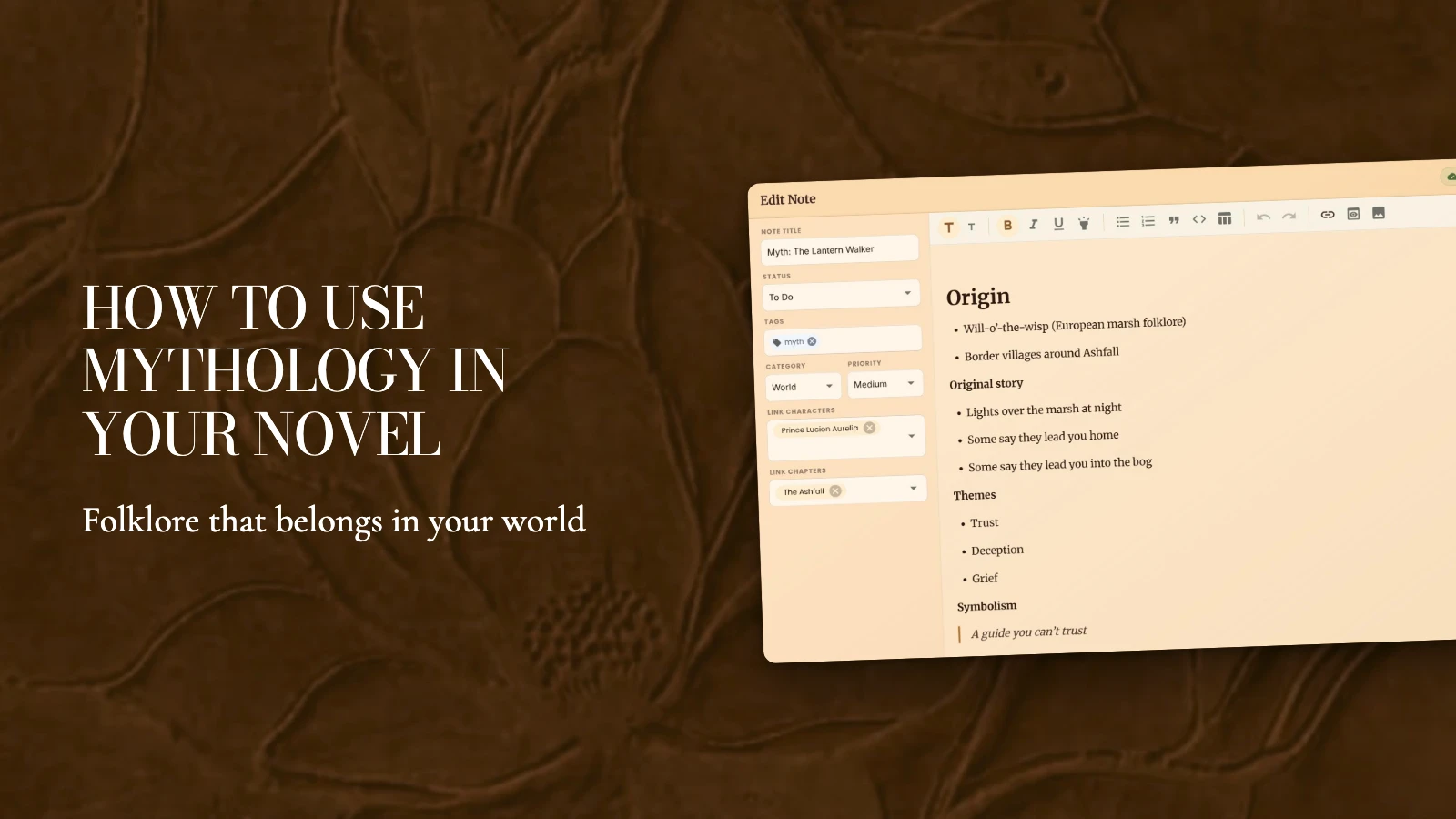
The right mythology for your novel is the one that serves its themes, characters, setting, and conflicts, not the one that simply looks impressive on the page.
It is tempting to reach for a thunder god, a Norse wolf, or a famous legend because it fits the aesthetic you have in mind. But mythology dropped into a story for decoration tends to feel like set dressing. Readers can sense when a creature or ritual exists only because the author thought it was cool.
The folklore that works best feels as if it grew out of your world's soil. This guide walks you through how to find it: how to start from your own story, where to look, how much to borrow, and how to check that every myth you keep is earning its place.
1. Start with your story, not the mythology
Before you open a single book of legends, get clear on what your novel is actually about. Its central themes might be betrayal, sacrifice, rebirth, forbidden love, power, or mortality. Those themes are your compass.
Next, decide what job mythology will do in your book. It might be pure worldbuilding texture, a layer of symbolism, the basis of a magic system, a source of conflict between characters, or the foundation of the entire plot. A myth that underpins your magic system needs far more depth than one that appears in a tavern song.
Resist the pull of trends. Greek retellings and Norse-inspired sagas fill bookstore shelves, but popularity is not the same as fit. A mythology that suits someone else's story may add nothing to yours.
Try this: Write down three recurring themes in your novel before you start researching. Use them as filters. Every myth, creature, or tradition you consider should connect to at least one of them.
2. Understand the different types of mythology and folklore
"Mythology" covers a huge range of material, and each kind brings different tools to a novel. Knowing the categories helps you search with purpose.
Creation myths explain how the world, its gods, and its magic came to be. They are ideal for establishing your fictional world's origins and the rules that govern it.
Death and afterlife folklore can inspire underworlds, reincarnation, restless spirits, and a culture's whole attitude toward mortality.
Nature folklore gives you forest spirits, water deities, sacred animals, and seasonal rites. It ties belief to landscape and weather.
Heroic legends supply quests, prophecies, tragic heroes, and legendary weapons. They shape how a culture defines greatness and failure.
Local superstitions are the small beliefs of daily life: curses, omens, rituals, and protective charms. They make a world feel lived in.
Fairy tales and oral traditions excel at moral complexity, risky bargains, and cautionary warnings. They also offer unusual storytelling structures, such as rules of three or nested tales.
Most novels draw on more than one category. A story might use a creation myth for its cosmology and village superstitions for its texture.
3. Match mythological traditions to your novel’s themes
Once you know your themes, let them point you toward the right material. Here is how common themes map onto mythological territory worth exploring.
If your story explores… | Investigate… |
Fate | Prophecies, oracles, and myths about destiny and its inescapability |
Transformation | Shapeshifters, metamorphosis tales, and rebirth myths |
Forbidden knowledge | Trickster figures and stories of divine punishment for curiosity |
Grief | Mourning traditions, ghosts, and afterlife beliefs |
Power | Divine hierarchies, succession myths, and wars between gods |
This approach changes the question you ask. Instead of "Which mythology is coolest?" you ask "Which stories have people already told about the thing my novel is wrestling with?" Human cultures have been exploring these themes for thousands of years, so there is almost always a rich vein to mine.
Look for contradictions. The most compelling mythological figures rarely have a single trait. A deity linked to both creation and destruction, or a spirit that both heals and punishes, carries built-in tension. That tension can become a far more interesting character than a god who simply stands for one thing.
4. Research beyond the most popular mythologies
Greek, Roman, and Norse mythology dominate fantasy fiction because they are well documented and widely taught. That familiarity is also a drawback: readers have seen Zeus, Loki, and Medusa many times before.
Widening your research opens up far more possibilities. Look into regional folklore, lesser-known legends, and the everyday supernatural beliefs of particular villages or valleys. If your setting is inspired by a real place, study the folklore of that geography, including its mountains, rivers, coastlines, and weather.
Pay attention to how myths change. The same legend often shifts from region to region and generation to generation, and those variations reveal what each community cared about. A water spirit that drowns careless swimmers in one region might be a protector of fishermen in another.
Search by archetype, not by celebrity. Rather than looking up famous figures, look up roles: tricksters, guides of the dead, water spirits, household protectors. Comparing how different cultures interpret the same archetype will give you a deeper understanding of it, and often a fresher angle than any single famous myth.
5. Choose between borrowing, adapting, and creating
Once you have found promising material, decide how closely you will follow it. There are three broad approaches.
Direct incorporation. You bring an existing deity, creature, or legend into your novel more or less as tradition describes it. This works well for contemporary or historical fantasy set in the real world, where readers expect recognizable figures.
Adaptation. You reinterpret an existing myth by changing its setting, its characters' motivations, or its outcome. Retellings live here, and so do stories that use a familiar legend as a skeleton for something new.
Original mythology. You invent your own gods, rituals, creatures, and legends, informed by what your research taught you about how real myths work.
The challenge with the second and third approaches is keeping the inspiration recognizable without making your world feel like a patchwork of copied myths. Aim for coherence: borrowed elements should obey the same internal logic as everything you invented.
Change the purpose, not just the look. Giving a creature a new color or extra horns is a cosmetic change. Changing what it does is a creative one. A spirit traditionally known for protecting travelers becomes far more unsettling if it deliberately leads them astray, and that single shift can generate an entire plot.
6. Make sure the folklore fits your worldbuilding
Real myths grow out of real conditions. Desert peoples tell different stories from island peoples, and farming communities worship differently from nomadic ones. Your fictional mythology should feel equally rooted. Ask yourself:
Does it align with your world's geography, climate, history, and social structure?
How do ordinary people interact with these beliefs, day to day?
Are certain creatures feared, worshipped, hunted, or protected, and by whom?
Do myths shape laws, festivals, architecture, clothing, or burial practices?
Is the mythology alive in everyday life, or has it faded into old stories that only grandparents tell?
Follow the ripple effects. Mythology becomes convincing when it changes ordinary behavior. If people genuinely believe a forest is cursed, merchants will route their caravans around it. Villages will be built at a careful distance. Parents will invent warnings to keep children from wandering in, and someone will make a living selling charms to those who must pass through. Each of these details reinforces the belief without a single line of exposition.
7. Avoid cultural appropriation and surface-level representation
Myths are not just raw material. Many belong to living cultures and, in some cases, to active religious practice. Treating them carefully is both an ethical responsibility and a craft advantage, because deeper understanding produces richer fiction.
Research the context. Learn the cultural and historical background of any tradition you draw from, not just its most dramatic stories.
Understand what symbols mean. Sacred objects, rituals, and figures often carry significance that is not obvious from the outside. Misusing them can cause real offense.
Don't treat living faiths as aesthetics. A religion people practice today deserves more than borrowed imagery for a cool magic system.
Take extra care with marginalized and Indigenous traditions. These communities have often had their stories taken and distorted by outsiders.
Know what is shared and what is restricted. Some folklore is freely told; some knowledge is sacred or meant only for initiated members of a community.
Credit and consult. Cite your sources where appropriate, and seek out knowledgeable voices, such as cultural consultants or sensitivity readers, when you are working outside your own background.
8. Avoid overloading your novel with mythology
Research is addictive, and it is easy to fall in love with everything you find. But a novel crowded with dozens of gods, creatures, and legends can overwhelm readers before they care about anyone in it.
Skip the lengthy lore dumps. Instead, introduce folklore through what characters do and say: a sailor who refuses to whistle on deck, a grandmother who leaves bread on the windowsill, a festival nobody will explain to the outsider. Environmental details work too, such as a shrine at a crossroads or iron nails hammered above every door.
Let readers discover the mythology gradually, the way a newcomer to a real culture would. Mystery is part of the appeal. Keep only the elements that contribute to the plot, the atmosphere, or a character's development, and save the rest for your notes or a sequel.
The removal test: If you could delete a mythical element and nothing about your story would change, it probably does not need to be there.
9. Build a mythology research sheet
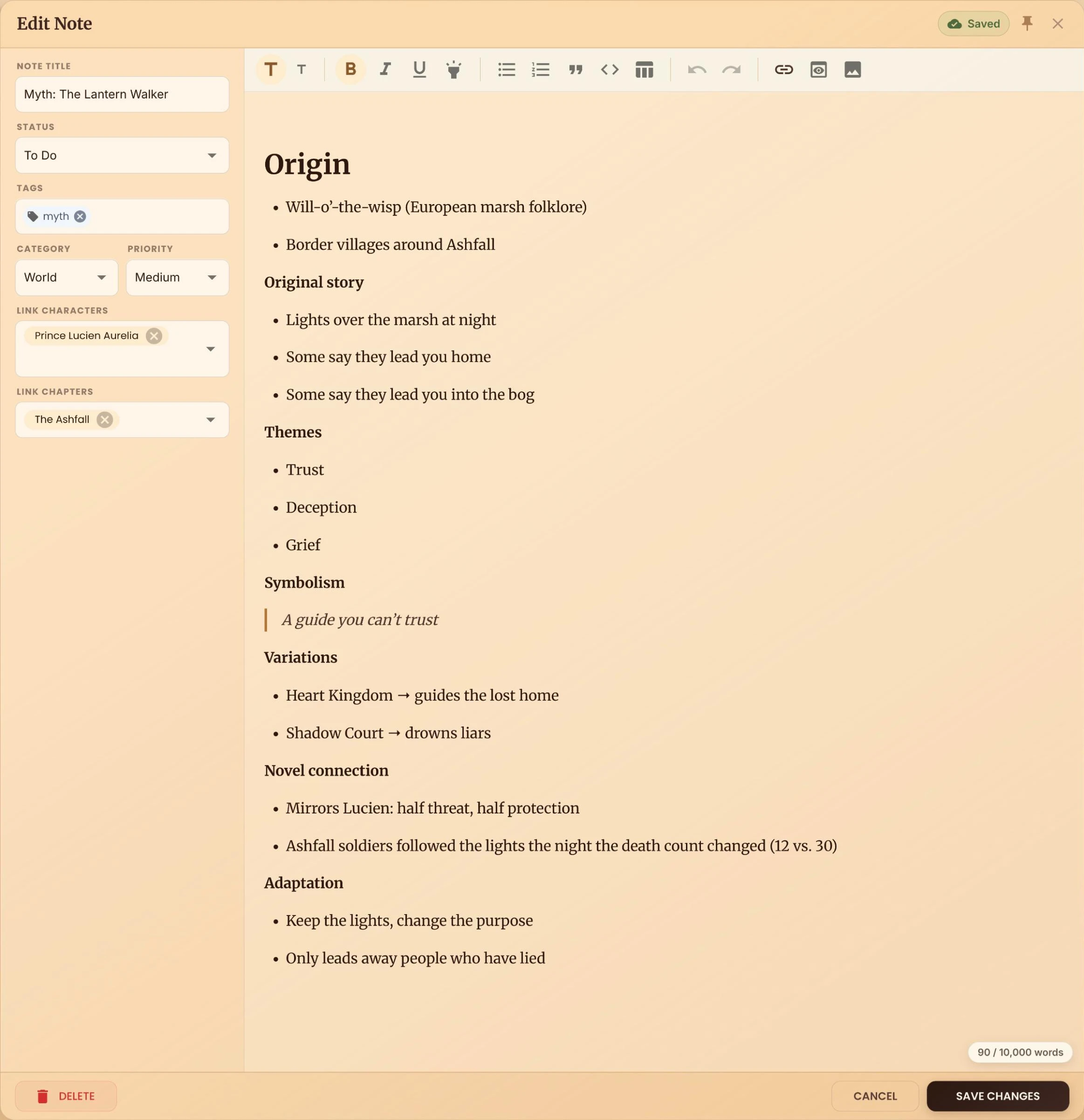
Before anything goes into your manuscript, record it in a research sheet. Filling one in for every myth, creature, or tradition you are considering keeps your notes organized and forces you to articulate why each element belongs.
Research category | What to record |
Origin | Culture, region, and historical context |
Original story | The actual myth or legend as traditionally told |
Themes | Death, rebirth, betrayal, and so on |
Symbolism | What the creature or figure represents |
Variations | Different interpretations across regions or eras |
Novel connection | How it serves your story |
Adaptation | What you intend to change, and why |
The last two rows matter most. If you struggle to fill in "Novel connection," that is a strong sign the element is decoration rather than substance.
10. Final checklist: does this mythology belong in your novel?
Run every mythological element through these questions before you commit to it.
Does it complement your novel's central themes?
Does it make sense within your fictional world's history and geography?
Does it add something to the plot or the characters?
Have you researched its original cultural context?
Are you adapting it thoughtfully rather than copying it wholesale?
Does it feel integrated rather than randomly inserted?
Would the story lose something meaningful without it?
If you can answer yes to all seven, you have found mythology that belongs.
How WriteO Helps You Keep Your Mythology Straight
A mythology only feels real if it stays consistent. If the forest is cursed in chapter 2, the caravans can't cut through it in chapter 20 without someone noticing. WriteO keeps your research and your world's beliefs in one place, next to the manuscript.
Give every myth its own research sheet. Create a note inside your novel for each myth, creature or tradition, and fill in the rows from the research sheet above. Tag it so all your folklore is easy to find, pin the myths your plot depends on, and link each note to the characters and chapters it touches.
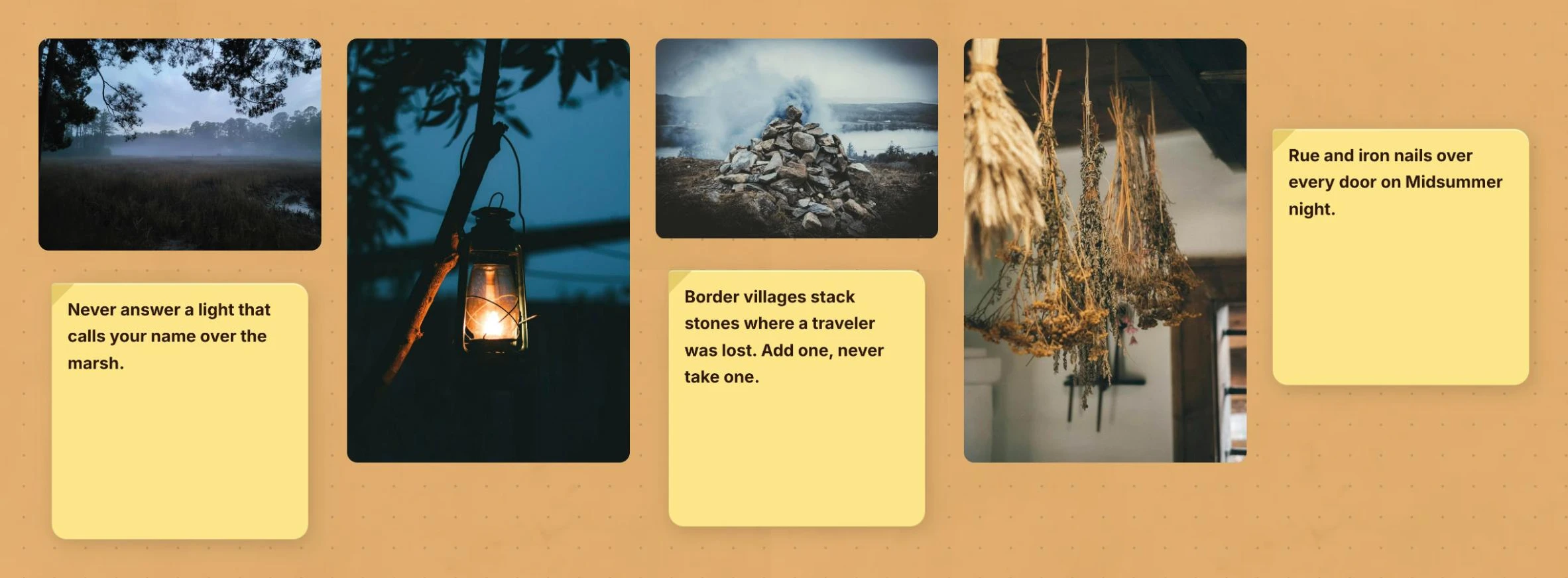
Collect the look and feel. Build a moodboard for each tradition with images of shrines, charms and landscapes, plus sticky notes for the rituals and warnings that grow around them. It helps you describe the same shrine the same way every time.
Track who believes what. Every character has a profile with sections you can add and rename. Add a Beliefs section for what each character fears, worships or refuses to believe, so the sailor who won't whistle on deck never forgets his superstition halfway through the book.
Conclusion: give your story another layer of meaning
The best mythology for your novel is not necessarily the oldest, the most powerful, or the most recognizable. It is the one that adds another layer of meaning to your story.
You might draw from ancient creation myths, regional superstitions, half-forgotten legends, or a belief system entirely of your own making. Whatever you choose, make sure there is a reason it exists in your world, and that your characters feel its weight.
So don't just ask which mythology would look interesting in your novel. Ask what stories the people of your fictional world would tell each other, what they would fear, and what they would believe. Answer those questions honestly, and your mythology will stop feeling borrowed. It will feel like it has always been there.
Ready to build a mythology that feels like it has always been there? Give WriteO a try and keep every myth, ritual and belief in view while you write.
Frequently Asked Questions
Frequently Asked Questions
QHow do you use mythology in a novel without it feeling forced?
Start from your story's themes, not the myth. Choose folklore that speaks to what your novel is about, show it through what characters do rather than lore dumps, and cut any element that could be removed without changing the story.
QCan I use real mythology in my novel?
Yes. Most ancient myths are free to use and retell. Take extra care with living religions and Indigenous or sacred traditions: research the context, avoid treating sacred figures as decoration, and consult people from that culture when you can.
QHow do you create your own mythology for a fantasy world?
Study how real myths work, then build from your world's conditions: its geography, climate, history and fears. Decide what each myth explains, who believes it, and how it changes everyday life, from festivals to where villages are built.
QHow much mythology should a fantasy novel have?
Only as much as the story needs. A few well-rooted myths that shape the plot, setting or characters do more than dozens of gods and creatures. Keep the extras in your notes, or save them for a sequel.