

How to Write Dual POV Without Confusing Your Readers
Dual POV is one of those techniques that looks simple from the outside and turns into a minefield the moment you actually try it. Two characters, two perspectives, weaving through the same story. Easy enough as a pitch. Then you're three chapters in and you can't remember whether you already showed the reader that Character A knows about the affair, or if that was only something Character B figured out, and suddenly the whole structure feels like it's held together with tape.
The good news is that reader confusion in dual POV books almost never comes from the concept itself. It comes from a small set of specific, fixable habits. Once you know what those are, dual POV stops being a risk and starts being one of the most useful tools available to a novelist.
Why Writers Reach for Dual POV in the First Place
Dual POV earns its place in a story when a single perspective genuinely can't carry the whole thing. Maybe there's dramatic irony you want the reader to feel, where they know something one character doesn't. Maybe there's a romance and half the tension comes from each person misreading the other's feelings, which only works if the reader gets to see both misreadings happen in real time. Maybe there's a mystery or thriller where one character is chasing a truth the other character is actively hiding, and the reader needs both angles to feel the pressure build.
The thing all of these have in common is that the second POV isn't decoration. It's doing work that a single perspective literally cannot do. That's the first checkpoint worth running before you commit to dual POV at all: if you removed the second character's chapters entirely, would the story lose something structural, or would it just lose some extra detail? If it's the second one, you probably don't need dual POV, you need one strong POV and some well-placed scenes from the other character's world filtered back in through dialogue or action.
The Core Problem: Voices That Sound the Same
This is the single biggest source of reader confusion in dual POV books, full stop. A reader gets lost not because the plot switched perspectives, but because they can't tell from the prose itself whose head they're in. If both characters narrate with the same sentence rhythm, the same vocabulary, the same emotional temperature, the reader has to rely entirely on the chapter heading to know who's talking, and chapter headings get forgotten fast, especially in longer reading sessions.
Distinct voice doesn't mean one character talks in slang and the other in Shakespearean flourishes. It's usually much subtler than that, and subtler is actually more effective. It might be that one character notices details and the other notices people. One thinks in short, clipped internal sentences when stressed, the other spirals into long run-on thoughts. One uses humor to deflect, the other goes quiet and analytical. If you read a paragraph of internal narration with the name blacked out, you should be able to guess who it belongs to just from the texture of the thinking, not just the content of the scene.
A useful exercise: write the exact same small moment, like ordering coffee or reacting to bad news, from both characters' internal perspectives, and see if they come out sounding meaningfully different. If they read almost identically, that's the seam that needs work before the readers ever open the book.
Give Each POV a Reason to Exist in That Chapter
Confusion also creeps in when POV switches happen just because it's "someone else's turn," rather than because that character is the right lens for that particular scene. If Character A's chapter is really about something happening to Character B, and you're only in A's head because the schedule called for it, the scene tends to feel indirect, like you're watching the important thing through a slightly foggy window.
A helpful rule is to ask, for every scene: whose stakes are highest here, and who has the most to gain or lose from what's about to happen? That's usually your answer for whose head the reader should be in. It also naturally prevents the common trap of two characters basically narrating the same scene from two angles for no real payoff, which slows pacing and adds confusion without adding value.
Watch Your Transitions Closely
Even with distinct voices and well-chosen scenes, readers can get disoriented if a switch happens without warning. The opening lines of a new POV chapter are doing more work than writers usually give them credit for. They need to ground the reader immediately: who are we with, where are we, roughly when relative to what just happened.
This doesn't require clunky signposting like literally stating the character's name in the first sentence, though plenty of successful books do exactly that and it works fine. It just means the first paragraph shouldn't be so abstract or interior that a reader has to get three paragraphs deep before they're sure whose scene this is. A concrete physical action or a distinct sensory detail in that first paragraph tends to anchor the switch fast, letting the reader settle in instead of scrambling to reorient.
If your two POV characters are ever in the same scene together, be extra careful here. Head-hopping within a single scene, jumping from one character's internal thoughts to the other's without a clear break, is one of the fastest ways to lose a reader's trust in the narration itself, because it starts to feel like the story doesn't know whose experience it's telling.
Choosing Person, Tense and Chapter Labels
Before you draft, make three decisions and keep them consistent for the whole book.
Label your chapters. The most common approach, especially in romance, is putting the POV character's name at the top of each chapter. Some books add a time or place, which helps if your two timelines don't run in step. You can go without labels, but only if the two voices are distinct enough to carry the switch on their own.
Pick first or third person. First person for both characters is standard in contemporary romance, because it puts the reader inside both sides of the misunderstanding. Close third works well for thrillers and fantasy, where you might want a little more distance. Mixing the two is possible but should be deliberate. In Gone Girl, Nick narrates in the present tense while Amy's early sections are diary entries, and that difference in form is part of the story.
Decide on tense. Using the same tense for both POVs is the safe choice. Using different tenses can separate two timelines, but it's one more thing the reader has to track.
Managing What Each Character Knows
Dual POV lives or dies on information control. Every scene you write is quietly teaching the reader what each character knows, suspects, and is hiding, and readers are much sharper at tracking this than writers sometimes assume. If Character A learns something devastating in chapter six, and then in chapter nine Character B reacts to Character A in a way that only makes sense if B already knows the secret too, readers will catch that gap, even if they can't immediately articulate why something feels off.
It helps to actually keep a simple running list, scene by scene, of what each POV character knows at that point in the story. It sounds tedious, but it saves you from the two most common dual POV knowledge errors: characters reacting to information they haven't been given yet, or the reverse, characters acting mysteriously ignorant of something they were clearly present for two chapters ago.
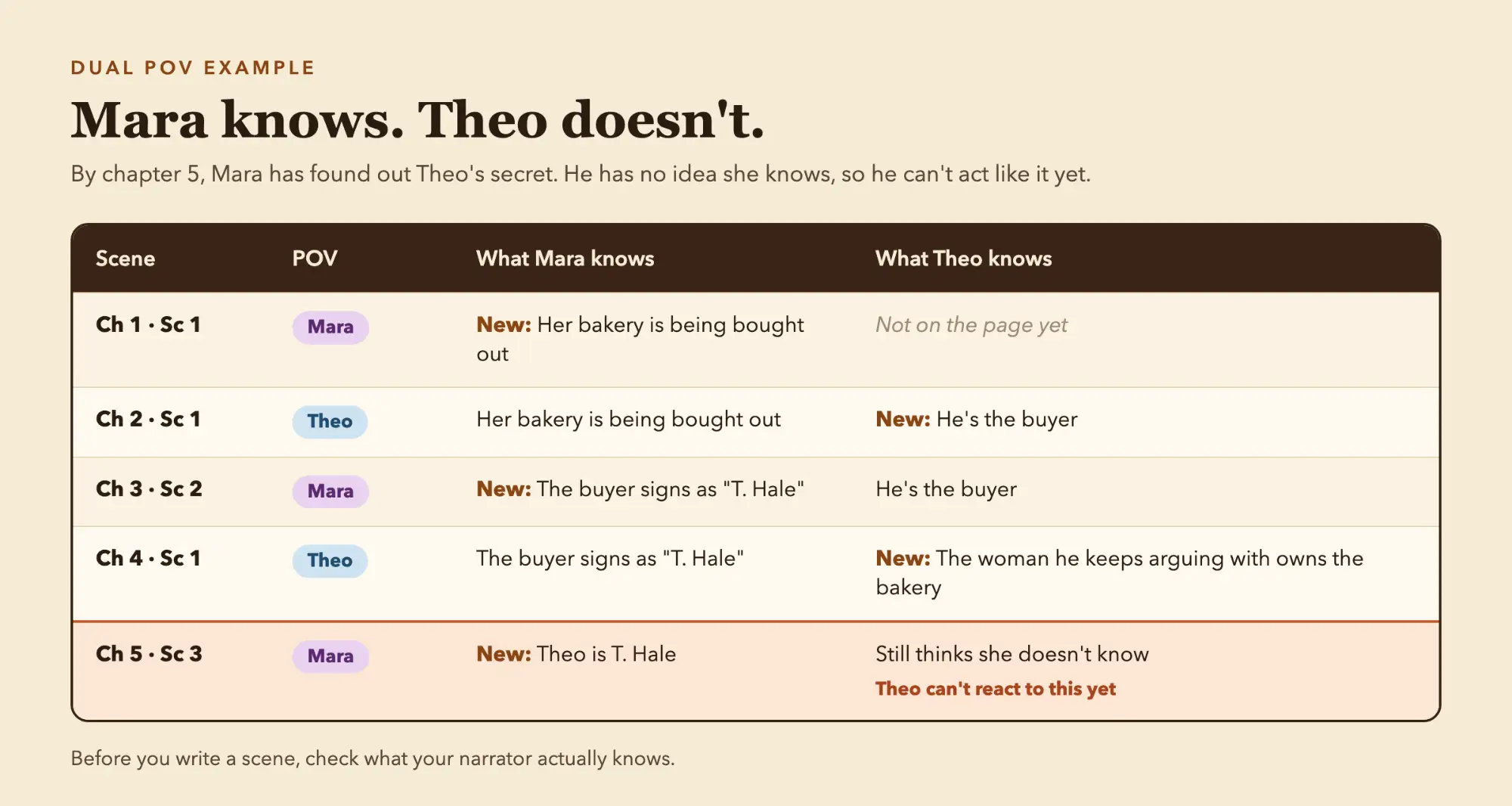
A dual POV example table showing a knowledge gap between the two narrators
Balance Doesn't Mean Equal Word Count
A lot of writers assume dual POV means splitting the book exactly down the middle, alternating chapters like clockwork. That's a formatting choice, not a rule, and forcing strict alternation can actually hurt the story if one character's arc genuinely needs more page time at a given point. What actually matters isn't equal word count, it's that both characters feel like they're moving, changing, wanting something, throughout the book. A character who disappears for a hundred pages and then reappears having apparently done nothing in the meantime will feel like a placeholder rather than a real co-lead, regardless of how many total chapters they were given.
Bringing This Into Your Actual Draft
If you're working through a dual POV manuscript, one of the most useful things you can do before you're deep into drafting is map out, scene by scene, whose POV each moment belongs to and why, alongside a simple tracker of what each character currently knows. Seeing that laid out across your whole outline tends to surface problems, like an unmotivated POV switch or an information gap, long before they'd show up organically while you're just writing forward chapter by chapter. Once the structure holds up on that level, distinct voice and clean transitions become a lot easier to execute, because you're not also fighting a shaky foundation underneath them.
You can build this map directly inside your manuscript in WriteO. Split a chapter into scenes and give each one a POV, along with its purpose, conflict and outcome, so the POV plan for the whole book lives next to the writing instead of in a separate spreadsheet. The scene cast shows which characters actually appear in each scene. Notes attached to a chapter work well as your running list of who knows what. For romance, the relationship map lets you record each shift between your two leads, so you can see how the relationship changes across the book.
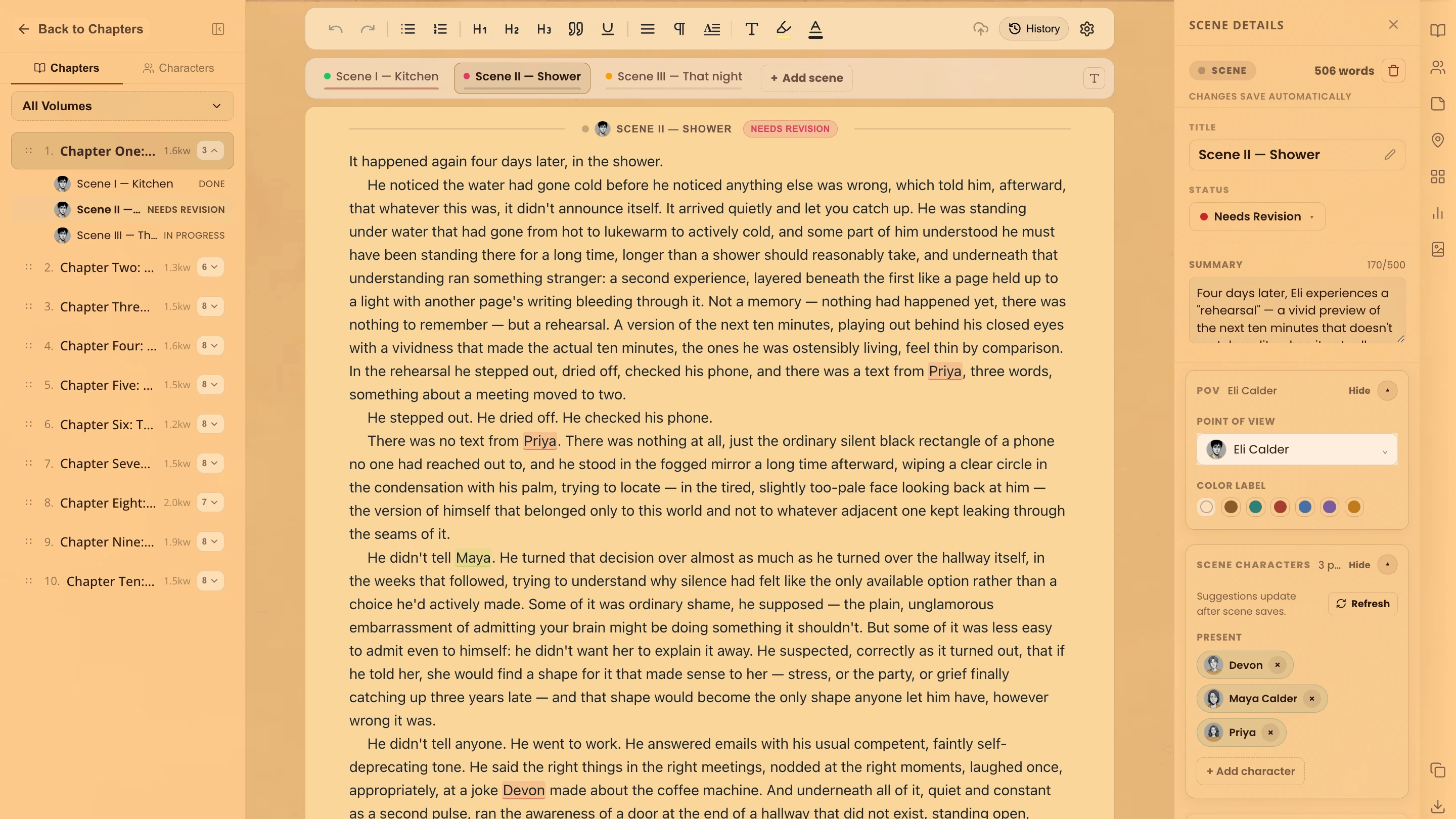
Set a POV for each scene and see which characters appear in it
A Quick Dual POV Checklist
Would the story lose something structural without the second POV?
Could a reader identify the narrator with the name hidden?
Does each scene belong to the character with the most at stake?
Does the first paragraph of every switch show who, where and when?
Is there no head-hopping inside a single scene?
Does each character only react to what they actually know?
Do both characters keep moving, even when they're off the page?
Dual POV isn't inherently harder to write than single POV, it's just less forgiving of vague choices. Every switch has to earn its place, every voice has to actually sound like a different person thinking, and every scene has to respect what each character already knows walking into it. Get those three things right and the format stops being a risk and starts doing exactly what it's supposed to: letting the reader see a story that's genuinely bigger than what any one character alone could show them.