

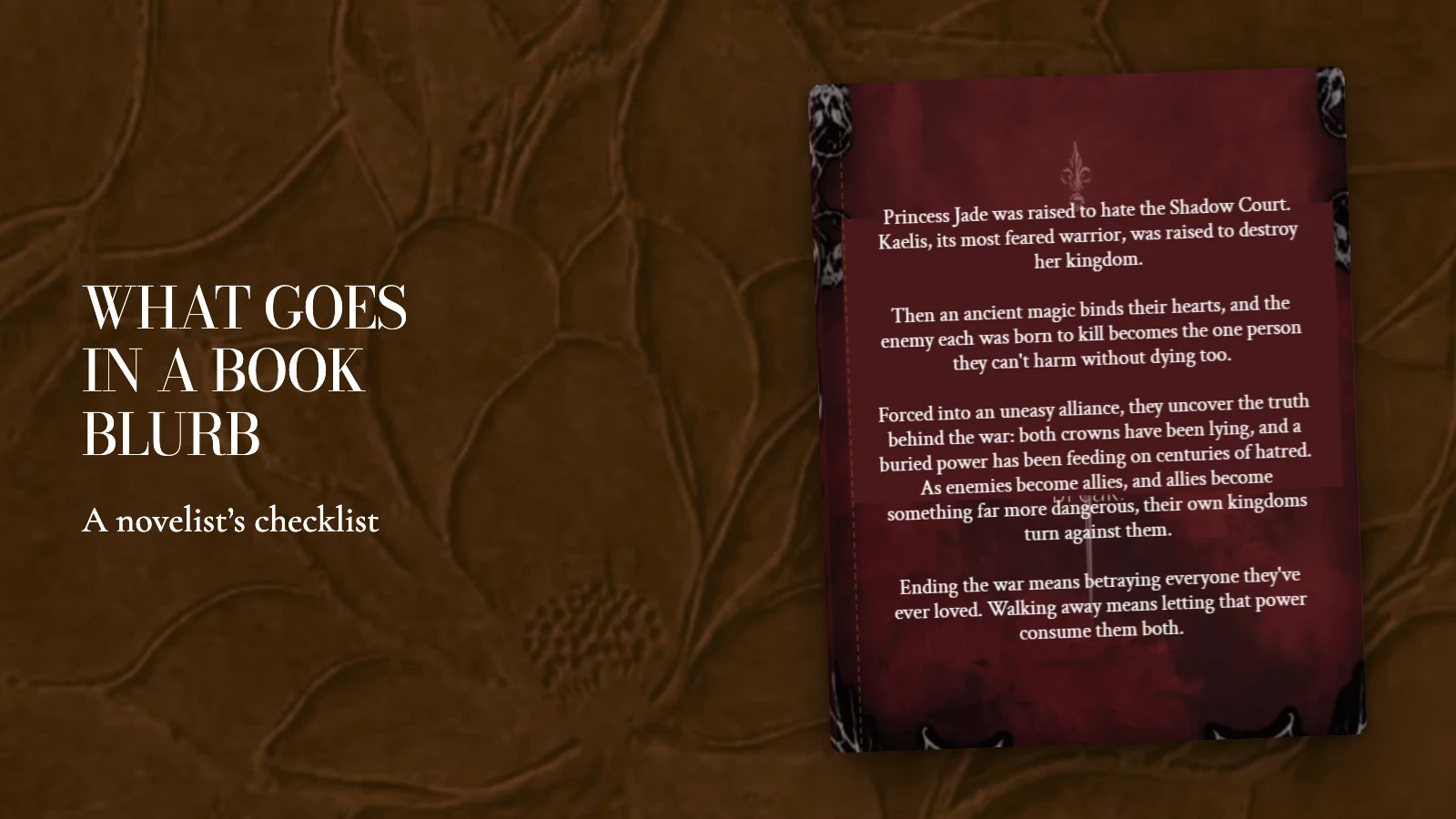
You wrote 90,000 words. You built a world, tangled three subplots together, and somehow untangled them by the final chapter. Now someone asks you to describe the book in 150 words, and you can’t get past the first sentence.
This is one of the strangest walls a novelist hits. The blurb is the shortest thing you’ll write about your book, and it often feels like the hardest, because you know too much. Every subplot seems essential. Every character feels like they deserve a mention.
The problem usually isn’t your writing ability. It’s that a blurb follows different rules than a novel. Once you know what to include in a book blurb, and just as importantly what to leave out, those 150 words become far less intimidating. This guide breaks the blurb into its working parts, shows what changes by genre, and ends with a checklist you can run your own draft against.
What a Book Blurb Is (and What It Isn’t)
A book blurb is the short description on your back cover or retailer page that tells a potential reader what the story is about and why they should keep reading. For most novels, it runs somewhere between 100 and 200 words.
One point of confusion trips up many new authors. In traditional publishing, “blurb” can also mean an endorsement: the line of praise from another author printed on the cover. When an editor asks whether you can “get a blurb,” they usually mean that quote, not your description. This article covers the description.
The bigger confusion is between a blurb and the other short summaries writers are asked to produce:
Document | Purpose | Who reads it | Typical length | Reveals the ending? |
Blurb (book description) | Persuade a reader to start the book | Readers, browsers | 100–200 words | No |
Synopsis | Show an agent or editor the full plot works | Agents, editors | 1–2 pages | Yes |
Query letter pitch | Make an agent want to request pages | Agents | 1–3 paragraphs | No |
Endorsement | Lend another author’s credibility | Readers | One or two sentences | No |
The key difference is direction. A synopsis answers what happens. A blurb raises the question of what will happen, then stops. Many weak blurbs are really compressed synopses: accurate, complete, and missing the one thing that makes a reader click “buy.”
The Core Elements to Include in a Book Blurb
Most effective fiction blurbs contain the same handful of ingredients. The order can shift, but if one is missing, readers tend to feel it even when they can’t name it.
A hook line that creates friction
Your first line does the heaviest lifting, especially online, where it may be the only line visible before a “Read more” link. The strongest hooks put two things in tension: a situation and something that shouldn’t be true about it.
Weak: Lena Marsh has always loved the sea.
Stronger: Lena Marsh can hold her breath for eleven minutes, and the coast guard wants to know why.
The first line describes a feeling. The second introduces an ability, an authority figure, and a threat, all in one sentence, and the reader immediately wants the explanation.
A protagonist defined by situation, not adjectives
“Fierce, independent, and loyal” tells readers almost nothing, because almost every protagonist is described that way. A character becomes distinct through their circumstances, especially a secret, a burden, or a contradiction. “Mara has spent three years lying to her village about the drought” reveals more about Mara’s personality than any list of traits.
Weak: Mara is fierce, independent, and loyal.
Stronger: Mara has spent three years lying to her village about the drought.
The inciting incident
This is the moment the protagonist’s normal life breaks. Place it early, usually within the first two or three sentences. Readers need the “before” only long enough to understand what’s being disrupted.
Weak: Everything changes when Mara discovers a dangerous secret.
Stronger: Then the last well runs dry, and the elders start asking where the reserve water went.
A clear goal and a specific opposition
State what the character wants and what stands in the way. Concrete opposition is more persuasive than abstract danger. “A rival forger who wants Kael’s territory” is easier to picture, and fear, than “dark forces gathering.”
Weak: Kael must stop the dark forces gathering against him.
Stronger: Kael has to find whoever is copying his tokens before a rival forger takes his territory.
Personal stakes alongside the big ones
If your story involves a kingdom, a city, or the world, say so, but pair it with what the protagonist personally loses. Readers have seen countless worlds in danger. They respond more strongly to a specific person losing a specific thing: a sister, a home, a reputation, a future they’ve worked for.
Weak: If she fails, the kingdom will fall.
Stronger: If she fails, the kingdom falls, and her brother hangs with the rest of the rebels.
An unresolved choice to close
End at the point of maximum tension, ideally on a dilemma rather than a generic question.
Weak: Will she survive? And what will it cost her?
Stronger: To save her brother, she’ll have to give the coast guard the one secret that could sink her entire village.
The weak version could close almost any book. The stronger one could only close this one, and it shows the reader that both outcomes will hurt.
Genre and tone signals
Readers decide within a few lines whether a book matches their mood. Word choice, sentence rhythm, and detail do that work. Short, clipped sentences and a deadline suggest a thriller. Wry asides and a small-town setting suggest a cozy mystery. If your blurb’s tone doesn’t match your book’s, you may attract readers who leave disappointed reviews.
Weak: Detective Ana Ruiz investigates a series of strange murders.
Stronger: Three bodies, three cities, the same word carved into each door, and Ana Ruiz has 48 hours before the fourth.
The Blurb Checklist
Run your draft against these points before you publish it:
The first line contains tension, not just description
The protagonist is introduced through a situation, secret, or contradiction
The inciting incident appears within the first two or three sentences
The goal and the opposition are both concrete
At least one stake is personal to the protagonist
No more than two or three characters are named
The blurb ends on a choice or tension, not a resolution
The tone matches the book’s genre and mood
What to Leave Out of Your Blurb
Most blurb problems come from including too much, not too little. Because you know the whole story, details that matter deeply to you can feel essential when a new reader would simply find them confusing.
Common mistake | Why it hurts | Practical fix |
Naming four or more characters | Readers can’t attach to names they haven’t met yet | Name the protagonist and, at most, one or two others; describe the rest by role (“her estranged father”) |
Summarizing the middle of the plot | It turns the blurb into a synopsis and spends tension you need later | Stop at the central conflict, usually around the end of your first act |
Vague stakes (“nothing will ever be the same”) | The phrase could describe any book | Name the specific thing the character stands to lose |
Invented worldbuilding terms | Unfamiliar words force readers to decode instead of feel | Translate into plain language, or keep one striking term at most |
Stacked rhetorical questions | They feel like filler and delay the point | Replace them with one concrete dilemma |
Revealing a twist or the ending | It removes the reason to read | End at the moment of decision, before the outcome |
A useful test: read each sentence and ask whether a stranger would miss it if it disappeared. If the answer is no, cut it, even if it describes your favorite subplot. The blurb only has to get readers to page one. The book itself will introduce everything else.
How Blurbs Change by Genre
The core elements stay the same across genres, but readers in each genre scan for different signals first. Leading with the signal your readers care about most helps the right audience recognize your book quickly.
Genre | What readers look for first | What to emphasize | Common pitfall |
Romance | Who the two leads are and why they shouldn’t be together | Both leads’ perspectives, the central obstacle, a recognizable trope or dynamic | Focusing on external plot and burying the relationship |
Thriller / mystery | The threat and the clock | A specific danger, a deadline, the question that must be answered | Hinting at the twist so heavily it gives it away |
Fantasy / science fiction | One world detail that feels new | A single striking element of the setting tied to the character’s problem | Explaining the magic system, history, or politics |
Literary fiction | Voice and emotional question | The character’s inner conflict and the tone of the prose | Staying so subtle that nothing seems to be at stake |
The main insight from the table is that the “first signal” changes, not the structure. A fantasy blurb still needs stakes and a closing choice; it simply opens with a world detail rather than a romantic obstacle.
Romance deserves a special note. Many romance blurbs give each lead a short paragraph of their own, because readers want to know both people before committing to their story. If your novel alternates points of view, this structure often mirrors the reading experience well. If it stays with one narrator, a single-perspective blurb is more honest about what readers will get.
Before-and-After Blurb Example
Here’s an original fantasy blurb written the way many first drafts turn out, followed by a revision.
Before:
In the kingdom of Varethia, where the Ashborn and the Tidekin have warred for centuries, young Kael discovers a secret that will change everything. With the help of his friends Mira, Doran, and the mysterious Sevrin, he must journey across the Shattered Wastes to stop the Dark Lord Malgrath before it’s too late. But can he trust his allies? And what is the true cost of power?
After:
Kael has spent six years forging ration tokens for a city that would hang him for it.
Then a token he never made turns up on a dead soldier, and the queen’s investigators start counting every forger in the lower quarter. To clear his name, Kael has to find whoever copied his work. The trail leads to the one person who taught him the craft: his missing sister.
Turn her in, and he walks free. Protect her, and the whole city learns what he’s been doing all along.
What changed and why:
Proper nouns dropped from nine to one. The revision names only Kael. The sister and the investigators are described by role, which readers understand instantly.
The secret became specific. “A secret that will change everything” became forged ration tokens, a crime with a clear punishment.
The world arrived through the problem. Instead of explaining two warring peoples, the revision shows a city strict enough to ration food and hang forgers.
Rhetorical questions became a choice. The last line forces Kael between two losses, and readers want to know which one he picks.
Build Your Blurb From Your Story Planning
Staring at a blank page is the hardest way to write a blurb. A faster approach is to pull its raw materials from planning work you’ve already done. Before drafting a single sentence, answer four questions in a line each:
What is your protagonist hiding, carrying, or doing at the start of the book?
What event breaks that situation open?
What does the protagonist want next, and who or what is blocking it?
What is the hardest choice they face around the end of the first act or the midpoint?
Those answers usually map onto a simple blurb template:
[Protagonist] has [situation or secret]. When [inciting incident], [they] must [goal] before [opposition or deadline]. But [complication], and now [they] must choose between [loss one] and [loss two].
Treat the template as scaffolding, not a final draft. Once the pieces are in place, rewrite the sentences in your book’s voice so the blurb doesn’t read like a form.
This method works best when your character goals and turning points are easy to find. If they’re scattered across notebooks and old documents, gathering them can take longer than writing the blurb itself. Keeping your planning and drafting connected in a single workspace like WriteO means these answers are already in front of you when it’s time to pitch your book.
One limitation: if you’re a discovery writer who hasn’t formally planned, answer the four questions from your finished draft instead. The method works either way.
How WriteO Helps You Write Your Blurb
The raw material for a blurb is already in your planning: who your protagonist is, what breaks their life open, what they want and what they stand to lose. WriteO keeps that planning in one place, so you aren’t digging through old files when it’s time to pitch.
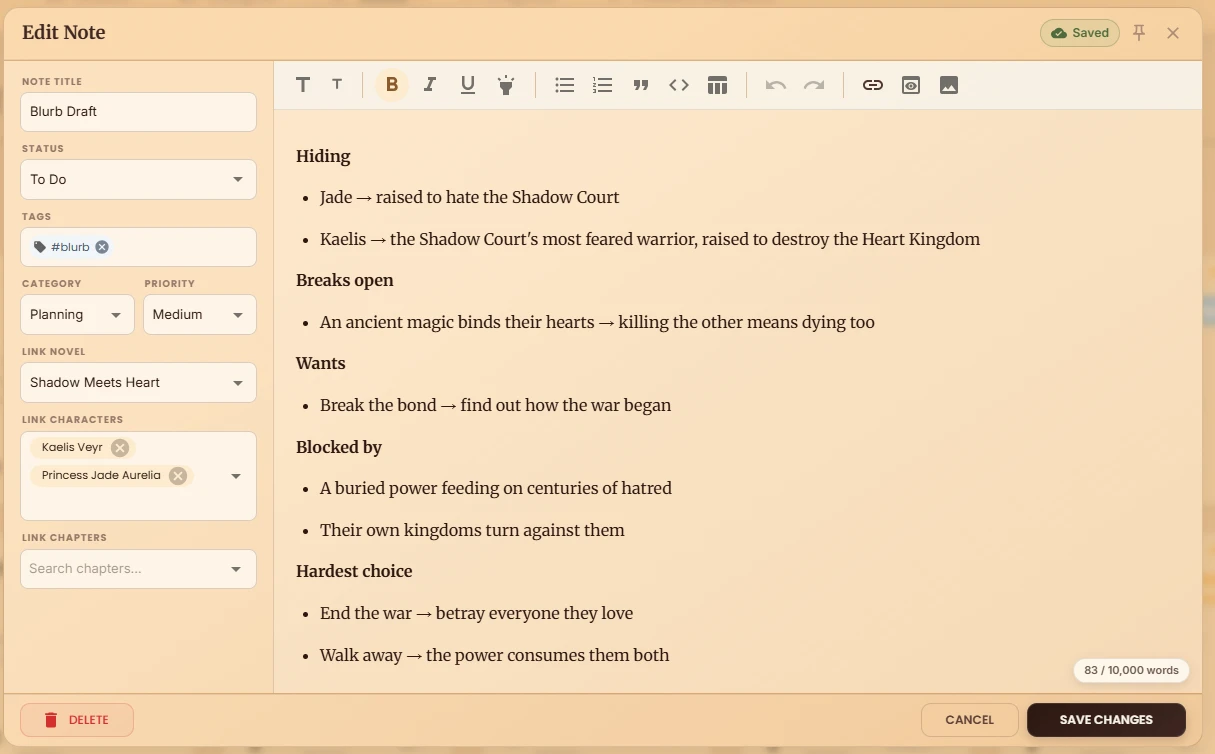
Answer the five questions in a note. Start a note inside your novel with the blurb questions as headings and a short line under each. Pin it, and link the characters the blurb is about so their profiles are one click away.
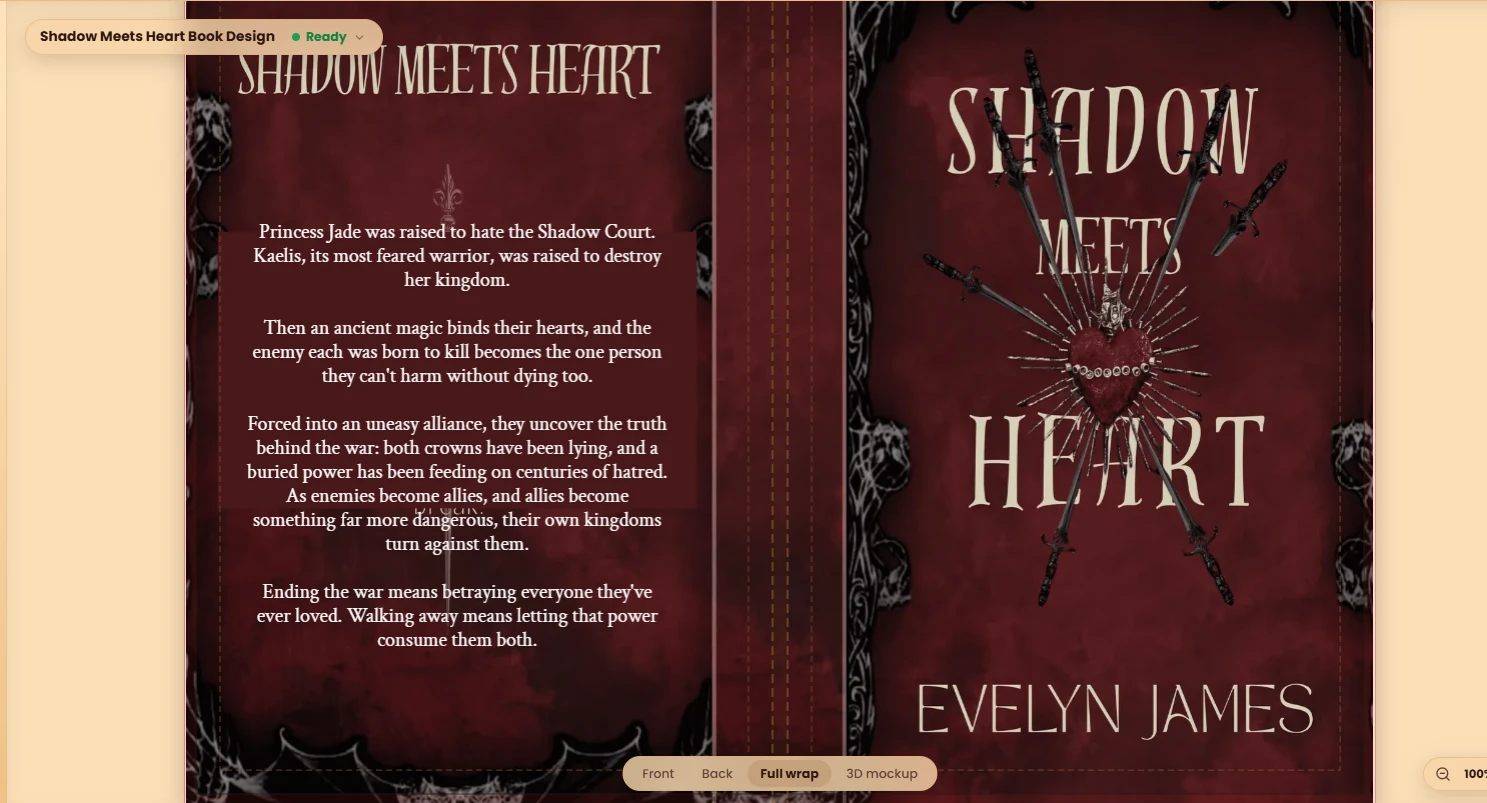
Put your blurb on the back cover. When your blurb is ready, add it to the back of your cover in Book Designer and check the full wrap, so you see the back, spine and front together before you export.
Find where your blurb should stop. Give each chapter a short description in chapter management, and the end of your first act, where most blurbs stop, is easy to spot at a glance.
Blurb Length and Formatting for Online Stores
A common guideline for fiction is roughly 100 to 200 words. Online retailers typically allow far more, but space isn’t the goal. Many readers browse on phones, where a long block of text looks like work. Check your retailer’s current description limit in its author help pages rather than writing to fill it.
A few formatting habits make blurbs easier to read on any screen:
Put the hook line on its own, so it stands out even if the rest is collapsed behind a “Read more” link.
Keep paragraphs to one to three sentences.
Use bold or italics sparingly, and only where the platform supports them.
Place any extra lines, such as series information or “perfect for fans of…” comparisons, after the main blurb so they don’t interrupt the story pitch.
Frequently Asked Questions
Frequently Asked Questions
QShould a blurb be written in first or third person?
Most fiction blurbs use third person, even for first-person novels, because it’s easier to summarize a situation from outside. Some voice-driven books, particularly in YA and romance, use first person to showcase the narrator. Choose first person only if the voice itself is a major selling point.
QShould I include comparison titles?
They can help readers place your book, but keep them in a separate line after the blurb rather than inside the story pitch.
QCan I change my blurb after publishing?
If you self-publish, you can usually update your book description on retailer platforms. Revising a blurb is one of the simplest changes you can test if a book isn’t finding its readers.
QHow long should a book blurb be?
For most novels, 100 to 200 words. Retailers allow more, but many readers browse on phones, so a tight blurb that ends on a choice usually works better than one that fills the space.
QWhat is the difference between a blurb and a synopsis?
A blurb persuades a reader to start the book and stops before the ending. A synopsis shows an agent or editor the whole plot, ending included, so they can see the story works.
Conclusion: Your Blurb Sells a Question
Key takeaways
A blurb isn’t a short synopsis. It raises the question of what will happen and stops before answering it.
Open with friction, introduce your protagonist through a situation, and get to the inciting incident fast.
Concrete opposition and personal stakes persuade more than abstract danger.
End on a choice between two losses instead of a rhetorical question.
When in doubt, cut. Fewer names and fewer subplots almost always make a stronger blurb.
A 10-minute blurb exercise
Set a timer for 10 minutes. Write your blurb in exactly three sentences: one for the protagonist’s situation, one for the inciting incident and goal, and one for the impossible choice. Don’t name anyone except your protagonist.
Then read it back and check two things: does the first sentence create tension on its own, and does the last sentence make both outcomes hurt? If yes, you have the spine of your full blurb. Expand it toward 150 words without adding new names.
If you plan and draft in WriteO, keep this three-sentence version alongside your story notes, so it can guide your revisions as well as your marketing.
Ready to write a blurb that sells the question? Give WriteO a try and keep your planning, your draft and your pitch in one place.